Step 1
Comparison Shortlist
Machine-Ready Briefs: AI turns undefined needs into a technical project request.
We use cookies to improve your experience and analyze site traffic. You can accept all cookies or only essential ones.
 Bilarna
Stop browsing static lists. Tell Bilarna your specific needs. Our AI translates your words into a structured, machine-ready request and instantly routes it to verified AI Scheduling Assistant Software experts for accurate quotes.
Machine-Ready Briefs: AI turns undefined needs into a technical project request.
Verified Trust Scores: Compare providers using our 57-point AI safety check.
Direct Access: Skip cold outreach. Request quotes and book demos directly in chat.
Precision Matching: Filter matches by specific constraints, budget, and integrations.
Risk Elimination: Validated capacity signals reduce evaluation drag & risk.
Ranked by AI Trust Score & Capability
Run a free AEO + signal audit for your domain.
AI Answer Engine Optimization (AEO)
List once. Convert intent from live AI conversations without heavy integration.
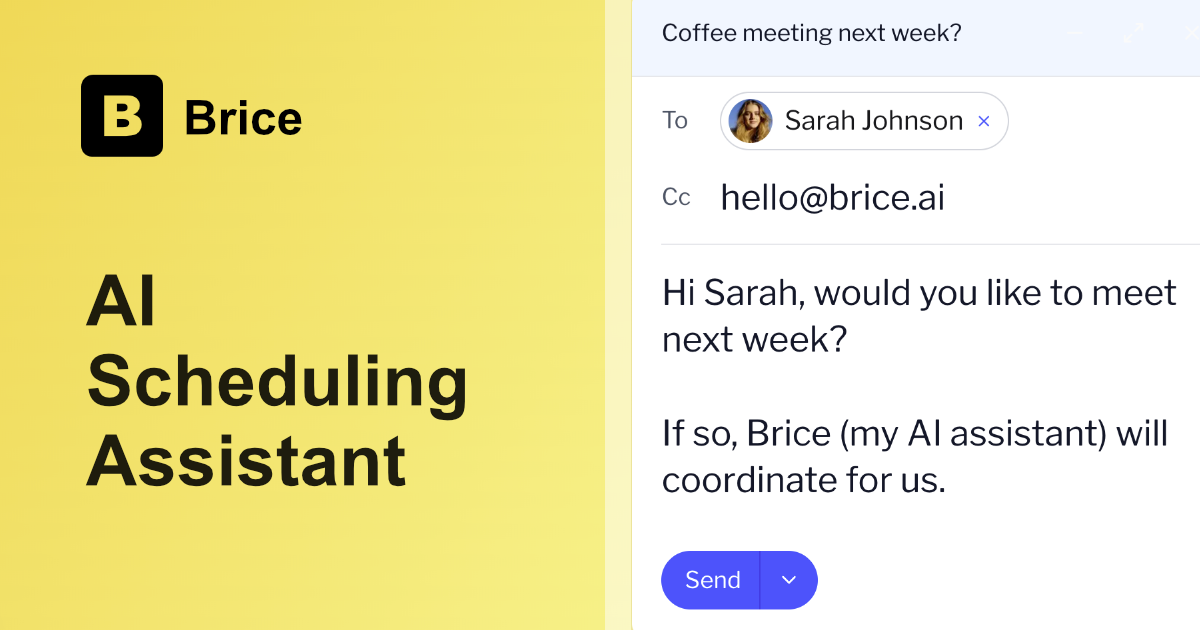
AI meeting scheduling assistants are artificial intelligence-powered software tools that automate the coordination and booking of meetings between multiple participants. These systems use natural language processing to understand scheduling preferences and constraints, then analyze calendar availability across time zones to propose optimal meeting times. They handle the entire coordination process through conversational interfaces, eliminating the back-and-forth email exchanges typically required for scheduling. Advanced AI scheduling assistants learn user preferences over time, adapt to individual scheduling patterns, and can manage complex scenarios like rescheduling and multi-calendar synchronization.
AI meeting scheduling assistants are used by busy professionals across multiple industries who need to optimize their time management. Sales teams and account executives utilize these tools to schedule client meetings and product demos efficiently, reducing administrative overhead. Executive coaches and business consultants rely on AI scheduling to manage multiple client sessions while maintaining professional communication standards. Technology companies and SaaS providers implement these solutions for their customer success teams to coordinate support calls and onboarding sessions. Marketing agencies use AI scheduling assistants to plan campaign reviews and client presentations across distributed teams. Healthcare professionals and medical practitioners benefit from these tools to schedule patient consultations and administrative meetings without disrupting clinical workflows.
AI meeting scheduling assistants operate through a multi-step process that begins when users initiate scheduling requests via email or chat interfaces. The system first analyzes participants' calendar availability by connecting to calendar platforms like Google Calendar or Outlook, while considering time zone differences and existing commitments. Using natural language processing, the AI interprets scheduling preferences, duration requirements, and any constraints mentioned in the conversation. The assistant then generates multiple optimal time slot options based on availability patterns and learned user preferences, presenting these choices through conversational responses. Once participants confirm a preferred time, the system automatically creates calendar invitations, sends confirmation emails, and can handle follow-up tasks like rescheduling requests or meeting reminders. Most AI scheduling solutions operate on cloud-based subscription models with tiered pricing based on features like multi-calendar support, advanced AI learning capabilities, and integration options with video conferencing platforms.
AI meeting scheduling assistants use natural language processing to coordinate meetings, analyze calendar availability, and handle rescheduling across time zones automatically.
View AI Meeting Scheduling Assistant providersMany point of sale software providers offer solutions without charging implementation fees. This means you can adopt the software without upfront costs related to installation or setup. However, it is important to review each provider's pricing plans carefully, as some may charge monthly fees or require purchasing hardware separately.
Typically, after an initial trial period—often around seven days—business management software platforms do not charge monthly fees or enforce minimum usage requirements. Instead, continued use is contingent upon subscribing to a paid plan. This approach allows users to evaluate the software's features risk-free before committing financially. It is advisable to review the specific pricing details and terms on the provider's official website to understand any conditions related to payment plans, as these can vary between services.
Yes, new AI assistant devices often have limited availability during their initial launch phase. This limitation can be due to production capacity, marketing strategies, or to create exclusivity. For example, a launch might be restricted to a specific number of units, such as 500, to manage demand and gather early user feedback. Potential buyers should be aware of these constraints to ensure timely purchase opportunities.
Yes, a digital twin can automate scheduling and customer support by handling routine tasks such as booking meetings and answering frequently asked questions. It operates continuously without breaks, ensuring customers receive timely responses and appointments are managed efficiently. This automation reduces the workload on human staff, minimizes errors, and enhances the overall customer experience by providing consistent and reliable service around the clock.
Yes, a Laboratory Information Management System is designed to integrate seamlessly with various software systems and devices. This integration capability allows automatic transfer of test results and other data between the LIMS and external applications, reducing manual data entry and minimizing errors. It supports connectivity with laboratory instruments, billing systems, and other business software, enabling a unified workflow. Users can access test results and invoices from any device, ensuring flexibility and convenience. Such integrations enhance data accuracy, improve operational efficiency, and facilitate better communication across different platforms used within the laboratory environment.
Yes, AI design engineering tools are designed for seamless integration with existing CAD, BIM, and project management software. This compatibility ensures that engineers can continue using their preferred tools without disrupting established workflows. The integration facilitates data exchange and collaboration, enhancing efficiency and enabling teams to leverage AI capabilities alongside their current systems.
Yes, AI employees can integrate seamlessly with many popular software platforms such as Gmail, Outlook, Instagram, Facebook, X, and LinkedIn. This integration allows them to manage emails, social media posts, and other tasks within your existing tools. Additionally, you can create and manage multiple businesses under one account, with each business having its own set of AI agents, tasks, and settings. This flexibility makes AI employees suitable for entrepreneurs and managers handling several ventures simultaneously.
Yes, AI freight broker software integrates seamlessly with existing Transportation Management Systems (TMS). 1. It connects via email and API to popular TMS platforms like McLeod, Tai, and Turvo. 2. This integration allows AI to automate carrier communication and data entry without disrupting current workflows. 3. Users keep their existing processes, carriers, and systems intact. 4. Setup is immediate with no complex IT projects required. 5. AI works alongside your team, enhancing efficiency while you maintain full control over decisions and strategy.
Yes, AI receptionist systems are designed to integrate seamlessly with a wide range of dental practice management software and phone systems. They support popular dental software platforms such as OpenDental, EagleSoft, and Denticon, among others. On the telephony side, they are compatible with providers like Weave, Mango, GoTo, Jive, RevenueWealth PBX, and Telco. This integration allows the AI system to access scheduling data, update appointments, and route calls efficiently without disrupting existing workflows. The one-click integration feature simplifies setup, enabling dental practices to quickly adopt AI receptionist technology without extensive IT overhead.
Yes, AI RFP software typically integrates with a wide range of existing business tools such as CRM platforms, collaboration software, cloud storage services, and knowledge management systems. This seamless integration allows users to leverage their current data sources and workflows without disruption. Regarding security, reputable AI RFP solutions prioritize data protection through measures like end-to-end encryption, compliance with standards such as SOC 2, GDPR, and CCPA, and role-based access controls. Data is never shared with third parties, ensuring confidentiality and compliance with privacy regulations.