Step 1
Machine-Ready Briefs
AI translates unstructured needs into a technical, machine-ready project request.
We use cookies to improve your experience and analyze site traffic. You can accept all cookies or only essential ones.
 Bilarna
Stop browsing static lists. Tell Bilarna your specific needs. Our AI translates your words into a structured, machine-ready request and instantly routes it to verified Ad Performance Analysis experts for accurate quotes.
AI translates unstructured needs into a technical, machine-ready project request.
Compare providers using verified AI Trust Scores & structured capability data.
Skip the cold outreach. Request quotes, book demos, and negotiate directly in chat.
Filter results by specific constraints, budget limits, and integration requirements.
Eliminate risk with our 57-point AI safety check on every provider.
Verified companies you can talk to directly
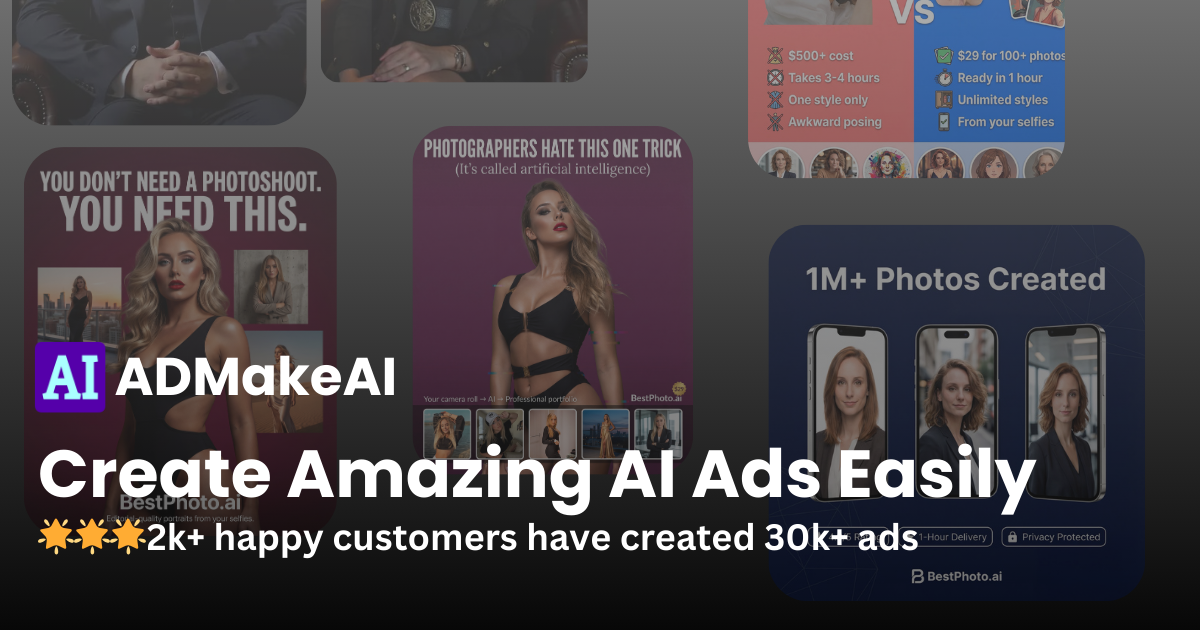
Spy on competitor Facebook ads, save winning creatives, and generate similar high-converting static ads for your brand with AI. Used by 500+ marketers.
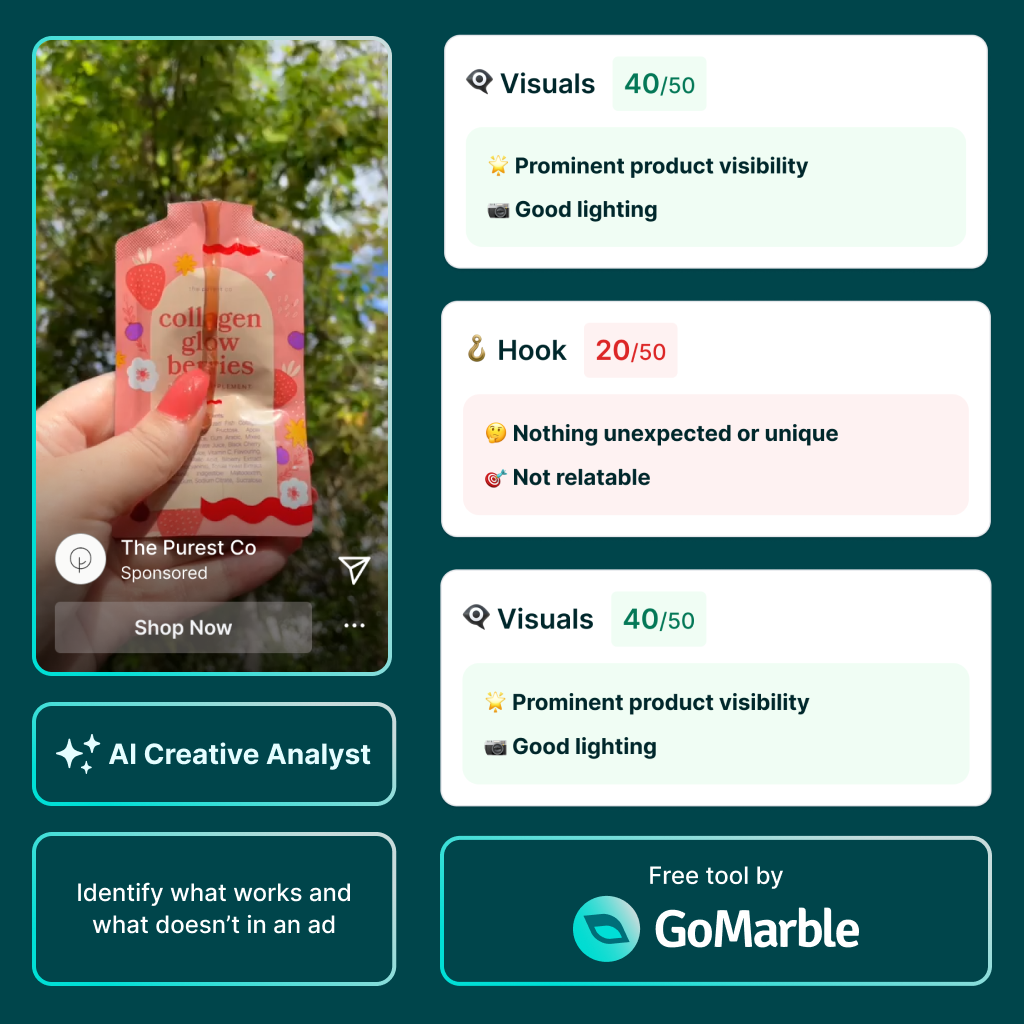
Use GoMarble's AI-powered tool for creative analysis of any video or static ad. Identify what works and what doesn’t with a single click.
Run a free AEO + signal audit for your domain.
AI Answer Engine Optimization (AEO)
List once. Convert intent from live AI conversations without heavy integration.
Ad performance analysis is the systematic process of measuring and evaluating the effectiveness of advertising campaigns across various channels. It utilizes metrics like click-through rate, conversion rate, and cost per acquisition to quantify the success of marketing investments. This enables marketers to allocate budgets efficiently, better target audiences, and maximize the overall profitability of their ad spend.
You collect and harmonize performance data from all ad channels like Google Ads, Meta, or LinkedIn Ads into a centralized report.
Your campaign performance is analyzed against industry benchmarks, historical data, and specific KPIs such as ROI and ROAS.
Based on the findings, concrete actionable recommendations are formulated to optimize ad copy, targeting, or budget allocation.
Identify the most profitable product ads and channels to increase Return on Ad Spend (ROAS) for direct sales.
Analyze the performance of lead generation campaigns to lower cost per qualified lead and optimize the sales pipeline.
Evaluate the compliance and effectiveness of financial advertising to acquire trustworthy customers within regulatory boundaries.
Measure the impact of awareness and branding campaigns on target audiences while adhering to strict data privacy regulations.
Optimize campaigns for industrial products to improve efficiency in generating sales inquiries and driving trade show attendance.
Bilarna evaluates every ad performance analysis provider using a proprietary 57-point AI Trust Score. This includes a review of technical expertise, case studies, and proven track record in boosting client ROI. Bilarna also continuously monitors customer satisfaction and operational reliability to list only qualified partners.
The most critical KPIs are Return on Ad Spend (ROAS), Cost Per Acquisition (CPA), Click-Through Rate (CTR), and Conversion Rate. These metrics provide direct insight into the profitability and efficiency of your advertising budgets. The choice of KPIs depends on your specific campaign objective.
Costs vary significantly based on the scope of channels analyzed, reporting frequency, and depth of consulting required. Pricing models range from monthly retainers for ongoing optimization to project-based fees for one-time audits. A detailed quote can only be provided after a requirements analysis.
An initial basic analysis can be completed within 1-2 weeks, provided all data is accessible. For an in-depth strategic analysis with A/B test evaluation and long-term recommendations, plan for 3-4 weeks. The duration depends on data volume and complexity.
Ad analysis evaluates the performance of past and ongoing campaigns to reveal weaknesses and opportunities. Media planning is the forward-looking process of budget allocation and channel selection for future campaigns. The analysis provides the data-driven foundation for effective planning.
Yes, efficiency is crucial, especially with small budgets. The analysis identifies costly channels or underperforming ads, allowing you to focus funds on the most profitable approaches. This often leads to a noticeable improvement in ROI without increasing the budget.
Synthetic fuels produced from captured carbon dioxide and renewable energy sources are increasingly able to compete with traditional fossil fuels in both price and performance. Advances in technology and scaling production have reduced costs, making these fuels economically viable. Additionally, synthetic fuels can be used in existing engines and infrastructure without modification, offering similar energy density and performance characteristics to fossil fuels while providing environmental benefits.
While most social media advertising agencies do not offer traditional performance guarantees due to uncontrollable variables like product quality and website conversion, some provide unique satisfaction assurances. A notable example is a 90-Day Results Guarantee, where the agency and client agree on specific, measurable goals for the first three months, such as lead targets or return on ad spend. If these agreed-upon results are not achieved within the initial ninety days, the agency continues working at no additional cost until the goals are met, often for up to an additional ninety days. This model demonstrates confidence in the agency's strategy and execution while sharing the risk with the client, making it a key differentiator in the industry.
Instant contract analysis is cost-effective for small businesses. 1. Access services priced at just a few dollars per analysis. 2. Avoid costly legal consultations by understanding contracts yourself. 3. Use the service for multiple contracts without high fees. 4. Improve contract management while saving money and time.
Customize advanced metamaterials for optimal acoustic performance by following these steps: 1. Analyze the specific sound frequency ranges and operational requirements of the target application. 2. Adjust the material thickness and design parameters to match these acoustic needs. 3. Use proprietary software tools to optimize the metamaterial architecture for maximum noise absorption. 4. Select modular and adaptable components to facilitate easy installation and configuration. 5. Test and validate the customized materials in real-world conditions to ensure performance meets expectations.
Nanotechnology coatings are optimized for maximum performance through a targeted and iterative development process. Starting from the nanoscale, each coating is designed with a specific application in mind. Throughout development, the properties of the coating—such as durability, adhesion, and functionality—are continuously tested and refined. This hyperoptimization ensures that the coating not only meets but exceeds performance requirements, adapting to the unique demands of its intended use. The result is a highly efficient, functional coating solution tailored to deliver superior results in its specific environment.
To choose a high-performance digital marketing agency for the Gulf region, a business should prioritize agencies with proven expertise in local markets like Saudi Arabia, the UAE, and Qatar, and a track record of delivering measurable, ROI-focused results. Key selection criteria include deep familiarity with the latest search engine algorithm updates from Google and Bing to ensure sustained visibility. The agency should offer data-driven strategies backed by real-time analytics and conversion optimization, moving beyond traditional marketing to focus on performance metrics. Expertise in culturally tailored, bilingual content for platforms dominant in the Gulf, such as Snapchat, Instagram, and TikTok, is essential. Furthermore, evaluate the agency's experience in developing customized strategies for major commercial hubs like Riyadh, Jeddah, and Dubai, and its ability to craft campaigns that align with specific local consumer behavior and market trends to drive tangible business growth and sales.
A business can implement artificial intelligence as a transversal layer to enhance digital performance by integrating it into key processes such as data analysis, personalization, and automation. The implementation focuses on optimizing costs and returns, using AI to power each phase of the optimization process for better decision-making, faster execution, and multiplied results. Common applications include using AI for advanced audience generation through SEO, paid ads, and social media targeting, as well as for hyper-personalization of user experiences. AI is also deployed for automating repetitive tasks to reduce operational costs and for behavioral analysis to inform CRO and UX design. Successful implementation often involves a hybrid approach, either complementing an in-house team with external AI expertise for specific challenges like checkout optimization or seasonal campaigns, or by embedding dedicated AI talent directly into the business operations.
A business can improve its performance advertising and conversion rates by implementing a data-driven strategy that focuses on optimization, targeting, and user experience. The first step involves precise campaign measurement and analytics to identify which channels and creatives deliver the best return on ad spend (ROAS). Utilizing advanced advertising services that connect across all digital touchpoints ensures consistent messaging and efficient budget allocation. To boost conversions, businesses should refine audience targeting using first-party data and lookalike modeling to reach high-intent users. On-site optimization is critical; this includes improving page load speeds, streamlining checkout processes, and employing AI search optimization (AIO) techniques to make websites more visible in AI answer engines. Additionally, integrating post-cookie solutions for privacy-compliant tracking and using AI agents for real-time bid management can significantly enhance campaign performance and drive sustainable growth.
A business management platform helps home service companies by centralizing and integrating data from various tools into a single source of truth. This allows businesses to monitor their most important key performance indicators (KPIs) in real time, enabling them to focus their time and attention on areas that need improvement. Features like automated KPI tracking and daily performance reviews help tie budgets to actual results, while benchmarking tools provide accurate forecasts and industry standards to keep teams accountable and grounded. Overall, such platforms streamline operations, improve decision-making, and support revenue growth.
A cloud platform helps service providers reduce costs and improve performance by optimizing infrastructure efficiency and providing advanced management capabilities. Cost reduction is achieved through high-efficiency storage solutions that offer up to 90% usable capacity and up to 6x better price-performance for object storage, along with unified management that minimizes license overhead and ensures predictable total cost of ownership (TCO). Performance enhancements stem from near bare-metal speed for virtual machines and containers via smart scheduling and optimized I/O paths, with storage performance up to 7x better for random writes and 3.9x for reads compared to alternatives like Ceph. Additional benefits include automated scaling and failover for reliability, GPU acceleration for AI/ML workloads to handle demanding applications, and data sovereignty features that enable entry into regulated markets without sacrificing speed. These combined efficiencies allow service providers to deliver competitive, high-performance cloud services while maintaining lower operational expenses.