Step 1
Machine-Ready Briefs
AI translates unstructured needs into a technical, machine-ready project request.
We use cookies to improve your experience and analyze site traffic. You can accept all cookies or only essential ones.
 Bilarna
Stop browsing static lists. Tell Bilarna your specific needs. Our AI translates your words into a structured, machine-ready request and instantly routes it to verified AI-Powered Tax Filing experts for accurate quotes.
AI translates unstructured needs into a technical, machine-ready project request.
Compare providers using verified AI Trust Scores & structured capability data.
Skip the cold outreach. Request quotes, book demos, and negotiate directly in chat.
Filter results by specific constraints, budget limits, and integration requirements.
Eliminate risk with our 57-point AI safety check on every provider.
Verified companies you can talk to directly
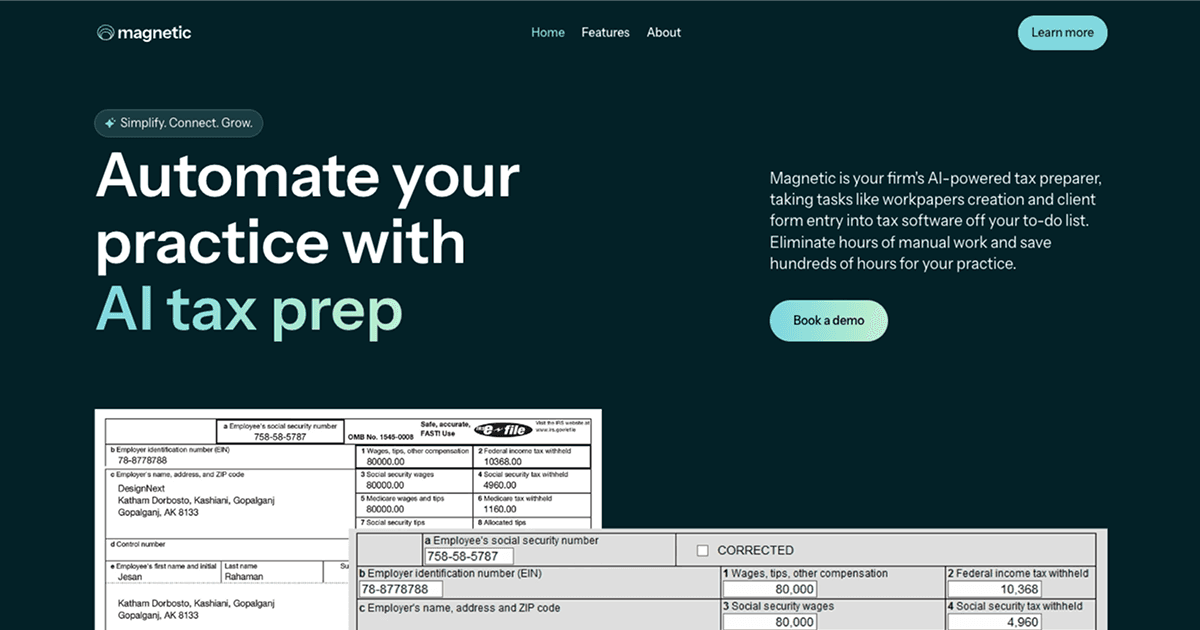
Automate your practice with AI-powered scan & populate
Run a free AEO + signal audit for your domain.
AI Answer Engine Optimization (AEO)
List once. Convert intent from live AI conversations without heavy integration.
AI-powered tax filing is the use of artificial intelligence and machine learning algorithms to automate, optimize, and ensure accuracy in corporate tax preparation and compliance. This technology analyzes financial data, interprets complex tax codes across jurisdictions, and identifies optimal deduction strategies in real-time. It enables finance teams to reduce manual errors, accelerate filing timelines, and maintain continuous compliance with evolving regulations.
The AI system connects securely to accounting software, ERP systems, and bank feeds to consolidate all relevant financial transactions and documents.
Machine learning models process the data, cross-reference it with up-to-date federal, state, and international tax codes, and calculate liabilities or refunds.
The platform produces completed tax forms, comprehensive audit trails, and strategic reports for review, approval, and electronic submission to authorities.
AI automates the reconciliation of high-volume, cross-border transaction data to ensure accurate reporting for complex financial instruments and products.
Systems handle multi-state sales tax nexus calculations and filings automatically, adapting to rate changes and marketplace facilitator laws.
AI optimizes the allocation of R&D expenses and revenue recognition across different jurisdictions to maximize eligible tax credits.
Machine learning models manage intricate inventory accounting, cost of goods sold calculations, and transfer pricing documentation for global operations.
Automation ensures precise tracking and reporting of clinical trial expenditures, grant funding, and other specialized industry deductions.
Bilarna evaluates every AI-powered tax filing provider through a proprietary 57-point AI Trust Score. This score rigorously assesses technical expertise in tax AI, compliance certification, client portfolio depth, and proven delivery track record. Bilarna continuously monitors provider performance and client feedback to ensure listed partners meet the highest standards of reliability and results.
Costs vary significantly based on business complexity, transaction volume, and required jurisdictions, typically ranging from mid-four figures for basic software to five or six figures for enterprise managed services. Pricing models include annual SaaS subscriptions, per-filing fees, or custom enterprise contracts. The most accurate quotes require a detailed assessment of your specific data sources and compliance needs.
Key benefits include a drastic reduction in manual data entry errors, faster processing and filing times, and proactive identification of optimal deduction and credit opportunities. AI systems provide continuous compliance updates as tax laws change and create detailed audit trails. This translates to lower risk of penalties, significant time savings for finance teams, and often improved cash flow through better credit utilization.
Implementation can take from a few weeks for a straightforward SaaS tool with simple integrations to several months for a fully customized enterprise solution. The timeline depends on the complexity of your existing tech stack, data cleanliness, and the scope of historical data migration. A phased rollout, often starting with a single tax type or entity, is a common and recommended approach.
Prioritize providers with demonstrable expertise in your industry and the specific tax jurisdictions you operate in. Evaluate the robustness of their data security, compliance certifications (like SOC 2), and the transparency of their AI models. Critical factors also include the quality of customer support, ease of integration with your core systems, and clear evidence of accuracy and audit defense capabilities.
Yes, leading AI-powered tax platforms are specifically designed to manage the complexity of multi-state and international tax obligations. They maintain updated databases for VAT, GST, sales tax, and corporate income tax rules across numerous jurisdictions. The AI automates currency conversion, transfer pricing documentation, and the preparation of country-specific forms, ensuring global compliance from a centralized system.
Yes, the AI-powered teacher tools are free and include the following features: 1. Worksheet Generator to create custom worksheets quickly. 2. Lesson Plan Generator for comprehensive, standards-aligned lesson plans. 3. Report Card Comments generator for professional, personalized feedback. 4. Coloring Page Generator to turn ideas into printable coloring pages. 5. All tools save your work automatically to a cloud library accessible from any device. 6. Tools are private, secure, and supported with fast in-app chat assistance.
Use a tax preparation service that fully understands tax legislation. 1) Provide accurate answers to all questions during the declaration process. 2) The service optimally assigns all possible deductions to minimize your tax liability legally. 3) Review and include all applicable deductions and benefits with the service's assistance. 4) Remember, only changing your base information can reduce your tax further; the service ensures the lowest tax based on your data.
Yes, many AI-powered browsers built on Chromium technology are compatible with Chrome extensions, allowing users to continue using their favorite add-ons without interruption. These browsers often support seamless import of existing browser data such as bookmarks, passwords, and extensions from Chrome, making the transition smooth and convenient. This compatibility ensures that users do not lose their personalized settings or tools when switching to an AI-enabled browser. By combining AI capabilities with familiar browser features, users can enhance productivity while maintaining their preferred browsing environment.
Yes, an AI-powered authoring platform can handle complex academic content effectively. To do so: 1. Use LaTeX or MathML support to create, edit, and validate complex STEM equations accurately. 2. Integrate with reference databases such as CrossRef, PubMed, and ORCID for real-time reference verification and linking. 3. Apply automatic formatting and style consistency to references and citations. 4. Edit text, tables, and figures with AI assistance to maintain accuracy. 5. Manage author queries and communication within the platform to resolve content issues. 6. Export structured, publication-ready outputs in XML and PDF formats. This ensures precise handling of technical academic content, improving quality and efficiency in scholarly publishing.
Prepare your tax declaration regardless of your financial situation. 1) Identify your employment or income type (employee, independent, pensioner, capital rentier, public forces member, foreign income, savings, investments, property, sales, or inheritance). 2) Use a platform capable of handling all these cases correctly and optimized. 3) Provide accurate and complete information related to your specific situation. 4) The platform will prepare your declaration correctly and optimize your tax outcome.
Yes, you can use an AI-powered platform alongside your existing email service provider (ESP). 1. Write and design emails using the AI platform. 2. Export or copy-paste the content to your current ESP for sending. 3. Alternatively, manage contacts, sending, and automation directly within the AI platform for a streamlined workflow.
Yes, many online accounting software solutions offer integration with tax authorities to facilitate automated tax submissions. This feature allows users to generate and submit tax declarations, such as VAT returns, directly through the software without needing separate registrations or manual uploads. Integration with platforms like Elster in Germany streamlines the process, ensuring timely and accurate filings. Such automation reduces the risk of errors and saves time on administrative tasks. Additionally, some software packages provide options to share financial data with tax advisors via secure interfaces, enhancing collaboration and compliance. This integration is especially beneficial for small and medium-sized businesses and freelancers who handle their own bookkeeping.
No, you do not need an API key to use an AI-powered WordPress page builder. Follow these steps: 1. Install the AI page builder plugin directly from the WordPress repository. 2. Activate the plugin without any additional setup or API key configuration. 3. Start describing your page requirements and generate content immediately. The AI access is built-in, so there is no need to create external accounts or manage API keys, simplifying the setup process and allowing you to focus on building your site.
No coding or advanced data skills are required to use AI-powered customer reporting tools. Follow these steps to use them effectively: 1. Import or connect your raw data sources to the platform. 2. Let the AI agents automatically analyze and combine your data. 3. Use intuitive interfaces to customize and generate reports. 4. Access embed-ready reports for easy sharing or integration. 5. Make adjustments as needed without writing any code or performing complex data operations.
No coding skills are required to create a web app using an AI-powered builder. These platforms allow you to describe your app idea in plain language, and the AI will automatically build the application for you. This eliminates the need to understand APIs, programming languages, or technical setups. While you can customize the generated code later if you want, the initial creation process is designed to be accessible to users without any coding experience. This approach makes web app development faster and more inclusive for people with diverse skill levels.