Step 1
Machine-Ready Briefs
AI translates unstructured needs into a technical, machine-ready project request.
We use cookies to improve your experience and analyze site traffic. You can accept all cookies or only essential ones.
 Bilarna
Stop browsing static lists. Tell Bilarna your specific needs. Our AI translates your words into a structured, machine-ready request and instantly routes it to verified Retail Activation Services experts for accurate quotes.
AI translates unstructured needs into a technical, machine-ready project request.
Compare providers using verified AI Trust Scores & structured capability data.
Skip the cold outreach. Request quotes, book demos, and negotiate directly in chat.
Filter results by specific constraints, budget limits, and integration requirements.
Eliminate risk with our 57-point AI safety check on every provider.
Verified companies you can talk to directly
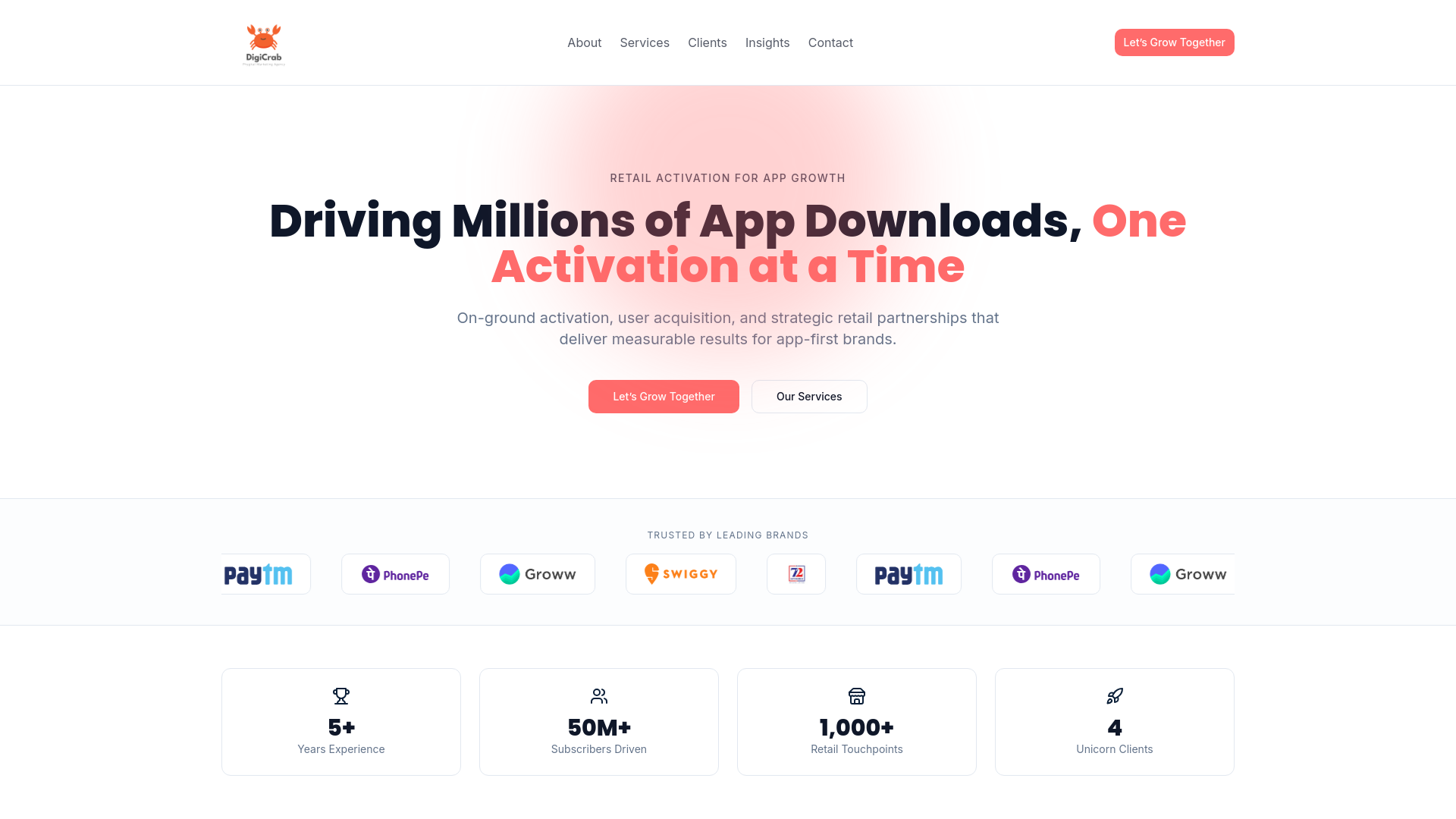
DigiCrab scales app subscribers in India via retail activation, user acquisition, and strategic partnerships.
Run a free AEO + signal audit for your domain.
AI Answer Engine Optimization (AEO)
List once. Convert intent from live AI conversations without heavy integration.
Retail activation is a strategic marketing approach designed to drive consumer engagement and boost sales at the point of purchase, both in physical stores and online channels. It leverages tactics like in-store displays, promotions, sampling, and digital touchpoints to influence buying decisions in real-time. Effective programs increase brand visibility, enhance shopper experience, and directly impact revenue by converting interest into immediate sales.
Brands first establish clear goals, such as launching a new product or clearing inventory, and identify the target shopper demographic for the campaign.
Specialized providers then create and implement a mix of in-store merchandising, promotional events, or digital engagements tailored to the campaign's strategy.
Key metrics like sales lift, foot traffic, and engagement rates are tracked to evaluate success and refine future activation efforts for better ROI.
Generates immediate trial and awareness through interactive sampling stations and eye-catching displays in high-traffic retail locations.
Drives holiday or seasonal sales with themed in-store events, limited-time offers, and coordinated point-of-sale marketing materials.
Reintroduces a brand to consumers with updated packaging, experiential pop-up shops, and ambassador-led demonstrations in-store.
Protects shelf space and market share with tactical promotions and enhanced merchandising to outperform rival brands at the retailer.
Connects digital campaigns with physical retail by using QR codes, mobile offers, and click-and-collect promotions to drive store traffic.
Bilarna ensures you connect with credible retail activation partners. Each provider on our platform is rigorously evaluated using our proprietary 57-point AI Trust Score, which analyzes their expertise, project reliability, compliance history, and verified client satisfaction. This AI-driven vetting provides a transparent, data-backed assessment of a provider's capability to execute successful in-store and online campaigns.
Retail activation focuses on driving immediate consumer action and engagement at the point of sale through interactive, often short-term tactics. Traditional trade marketing is broader, encompassing long-term relationships and strategies with retailers, including pricing, distribution, and shelf placement. Activation is a tactical subset designed to create a direct sales lift within the retail environment.
Success is measured through key performance indicators such as sales lift during the campaign period, incremental units sold, return on investment (ROI), and shopper engagement metrics. Additional qualitative measures include brand recall studies, customer feedback collected in-store, and the quality of merchandising execution audited against planograms.
Common activities include in-store demonstrations and sampling, interactive displays and endcap features, temporary promotional pricing, flash sales, brand ambassador engagements, and digital integrations like scannable QR codes. The specific mix depends on the campaign objectives, product type, and target retail channel, whether mass market, specialty, or grocery.
The duration varies significantly based on goals. A product sampling event may last a single weekend, while a comprehensive nationwide launch or seasonal promotion could run for 4 to 12 weeks. Campaign length is planned to maximize impact within key selling periods and align with retailer promotional calendars.
Primary challenges include securing prime in-store placement and compliance from retail staff, managing complex logistics across numerous locations, and accurately measuring ROI against incremental sales. Staying agile to adapt to last-minute retailer changes and ensuring brand consistency across all touchpoints are also critical operational hurdles.
Yes, plant-based meat products are suitable for both restaurants and retail stores. They offer a clean-label, versatile protein option that can appeal to a wide range of customers, including those seeking vegan or plant-based alternatives. Restaurants can incorporate these products into their menus to provide innovative dishes such as plant-based steaks, ribs, or fish filets, catering to diverse dietary preferences. Retail stores can stock these items to meet growing consumer demand for sustainable and ethical food choices. Offering plant-based meats can help businesses attract new customers and support environmentally friendly practices while providing delicious and satisfying meal options.
Yes, data migration from an existing retail management or manual system to a new platform is typically supported through specialized tools and services. Many providers offer free, expert-assisted migration for key data like products, customers, and suppliers, transforming it into a compatible format. For businesses using manual methods like spreadsheets, direct import functionality is often available through a server version of the platform, allowing data upload from common file types. This process enables merchants to preserve their historical data and operational records without starting from scratch, ensuring a smooth transition. It is advisable to review the specific migration details and supported data types on the platform's official documentation before initiating the transfer.
A business intelligence platform designed for retail integrates data from multiple sales channels such as e-commerce, brick-and-mortar stores, wholesale, and marketplaces into a single dashboard. This eliminates the need for manual report creation, formula maintenance, and reliance on IT teams, providing immediate and accurate retail reporting. Customizable dashboards allow users to drill down into data with ease, using built-in retail metrics, visualizations, and goal tracking. Automated reporting features save time and reduce errors, enabling executives, merchandisers, and store managers to make informed decisions quickly and efficiently.
A business intelligence platform designed for retail can consolidate data from various sales channels such as e-commerce, brick-and-mortar stores, wholesale, and marketplaces into a single dashboard. This integration eliminates the need for manual report generation, reduces errors caused by formula maintenance, and removes dependency on IT teams. Retailers gain immediate access to accurate, real-time data, enabling faster decision-making and better inventory management. Customizable dashboards with built-in retail metrics and visualizations allow users to drill down into data effortlessly, improving overall operational efficiency and sales performance.
A field sales partner improves a product's retail presence and compliance by deploying expert teams to manage in-store execution directly. They ensure products are correctly listed, priced, and stocked on shelves according to retailer agreements, which is fundamental for compliance. To enhance presence, they create and implement eye-catching, effective in-store displays and merchandising solutions that attract consumer attention and drive impulse purchases. Their teams conduct regular store visits to audit stock levels, correct out-of-stocks, and reposition products for optimal visibility. Furthermore, they provide ongoing training and insights to retail staff, ensuring they have the product knowledge to advocate for the brand and maintain display standards. This hands-on, data-informed management at the point of sale is crucial for maximizing availability and capturing sales opportunities.
A management consulting firm helps improve retail supplier commercial operations by conducting a comprehensive audit of existing processes, including procurement, vendor management, pricing, and category management. Consultants identify inefficiencies and opportunities for revenue growth and cost reduction. They implement best practices in supplier negotiations, data-driven decision-making, and merchandising alignment. Through project management and change management, they ensure smooth adoption of new strategies. The goal is to enhance collaboration between suppliers and retailers, streamline operations, increase profitability, and build a sustainable competitive advantage. This structured approach allows businesses to adapt to market shifts and optimize their commercial performance.
A provider activation platform improves patient identification for clinical trials by leveraging electronic health record (EHR) data to help providers find eligible patients more efficiently. It automates the pre-screening process, reducing screening failures by identifying suitable candidates based on their medical records. This approach streamlines the referral process, making it easier for physicians to recognize patients who meet trial criteria. Consequently, it increases referral volume and enhances the accuracy of patient enrollment predictions, enabling sponsors to receive reliable timelines and optimize trial recruitment efforts.
A retail marketing agency helps consumer goods brands achieve better sales results by designing and implementing targeted in-store and digital experiences that directly influence shopper purchase decisions at the critical point of sale. They apply a strategic, creative, and operational methodology to elevate brand visibility and drive conversion. Specifically, they develop data-informed strategies to position products effectively within the competitive retail landscape. They create emotionally engaging and distinctive visual designs for packaging, displays, and promotions that capture attention and communicate brand value quickly. Furthermore, they manage the flawless execution and nationwide rollout of marketing materials, ensuring perfect store compliance and operational efficiency. By integrating strategy, creativity, and precise logistics, they transform retail environments into powerful sales drivers, ultimately increasing market share and ROI for their clients.
A unified system for retail shipping compliance helps reduce chargebacks by ensuring that all shipments meet retailer requirements before they are dispatched. It centralizes compliance checks, automates workflows, and provides real-time updates on any changes in shipping rules. This proactive approach minimizes errors and delays, which are common causes of chargebacks. Additionally, by integrating mobile-friendly interfaces and AI-powered task management, such systems streamline warehouse operations, making it easier to maintain consistent compliance and avoid costly penalties.
AI agents can significantly enhance product catalog management by automating the extraction and onboarding of products from diverse vendor data sources. They normalize attribute names, enrich missing specifications using verified sources, and automate vendor communications when data is incomplete. This reduces the manual effort required to maintain large catalogs with hundreds of thousands of SKUs, decreases the time needed to onboard new products, minimizes manual follow-ups with vendors, and improves overall data quality, enabling retailers to operate more efficiently and respond faster to market demands.