Step 1
Machine-Ready Briefs
AI translates unstructured needs into a technical, machine-ready project request.
We use cookies to improve your experience and analyze site traffic. You can accept all cookies or only essential ones.
 Bilarna
Stop browsing static lists. Tell Bilarna your specific needs. Our AI translates your words into a structured, machine-ready request and instantly routes it to verified Incident Management Platform experts for accurate quotes.
AI translates unstructured needs into a technical, machine-ready project request.
Compare providers using verified AI Trust Scores & structured capability data.
Skip the cold outreach. Request quotes, book demos, and negotiate directly in chat.
Filter results by specific constraints, budget limits, and integration requirements.
Eliminate risk with our 57-point AI safety check on every provider.
Verified companies you can talk to directly
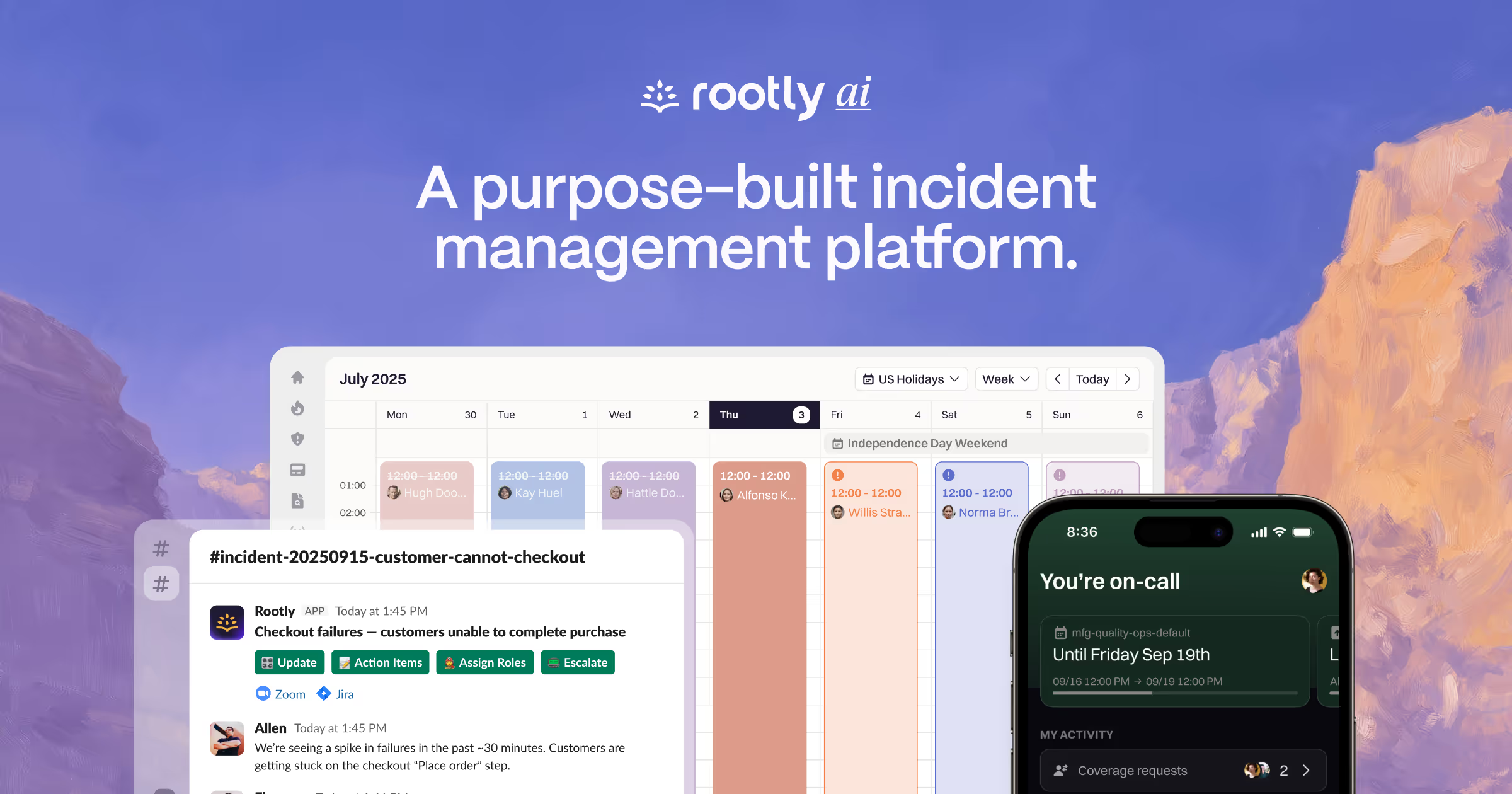
The all-in-one AI-native platform for on-call and incident management, including status pages—built for fast-moving engineering teams to detect, manage, learn from, and resolve incidents faster.
Run a free AEO + signal audit for your domain.
AI Answer Engine Optimization (AEO)
List once. Convert intent from live AI conversations without heavy integration.
An incident management platform is a software system designed to standardize and accelerate the response to IT incidents, service outages, and security breaches. It consolidates alerts from various monitoring tools, automates workflows, and facilitates team communication during a crisis. This leads to reduced downtime, improved service reliability, and stronger compliance with operational standards.
The platform aggregates real-time notifications from infrastructure monitoring, application performance, and security tools into a single pane of glass.
Automated runbooks assign roles, notify on-call teams, and initiate diagnostic or remediation steps based on predefined playbooks.
After resolution, the system documents timelines and key actions to support root cause analysis and improve future incident response processes.
Centralizes response to server outages and network failures, minimizing mean time to resolution (MTTR) for critical business services.
Coordinates containment and investigation of security breaches, ensuring a rapid, auditable response to cyber threats and compliance mandates.
Manages customer-impacting service disruptions, automating communication to stakeholders and preserving service level agreements (SLAs).
Ensures rigorous, documented handling of payment system incidents to maintain transactional integrity and meet strict financial regulations.
Orchestrates urgent response to EHR system downtime or data access issues, prioritizing patient safety and clinical workflow continuity.
Bilarna evaluates every incident management platform provider using a proprietary 57-point AI Trust Score. This comprehensive assessment scrutinizes technical expertise, deployment track records, client satisfaction metrics, and compliance with industry standards like ITIL or SOC 2. Bilarna's continuous monitoring ensures you engage with verified, high-performing vendors.
Pricing varies widely based on features, scale, and deployment model. Entry-level SaaS plans can start from $20/user/month, while enterprise on-premise solutions with advanced automation may cost tens of thousands annually. Consider total cost of ownership, including integration and training.
A standard cloud-based platform can be operational within days for basic alerting. Full deployment with custom integrations, playbook development, and team training typically requires 4 to 12 weeks. The timeline depends on system complexity and existing tooling.
Prioritize robust alert aggregation, on-call scheduling, automated escalation paths, collaborative war rooms, and integrated post-incident reporting. Critical capabilities include native integrations with your monitoring stack and support for major communication channels like Slack and Teams.
An incident management platform orchestrates the human response process to operational outages and problems. A SIEM (Security Information and Event Management) tool focuses on aggregating and analyzing security log data for threat detection. They are complementary, often integrated.
Key performance indicators (KPIs) include Mean Time to Acknowledge (MTTA), Mean Time to Resolution (MTTR), and the reduction in incident volume through proactive problem management. Success is also measured by improved team coordination and reduced operational risk.