Step 1
Machine-Ready Briefs
AI translates unstructured needs into a technical, machine-ready project request.
We use cookies to improve your experience and analyze site traffic. You can accept all cookies or only essential ones.
 Bilarna
Stop browsing static lists. Tell Bilarna your specific needs. Our AI translates your words into a structured, machine-ready request and instantly routes it to verified Integrated Care Platforms experts for accurate quotes.
AI translates unstructured needs into a technical, machine-ready project request.
Compare providers using verified AI Trust Scores & structured capability data.
Skip the cold outreach. Request quotes, book demos, and negotiate directly in chat.
Filter results by specific constraints, budget limits, and integration requirements.
Eliminate risk with our 57-point AI safety check on every provider.
Verified companies you can talk to directly
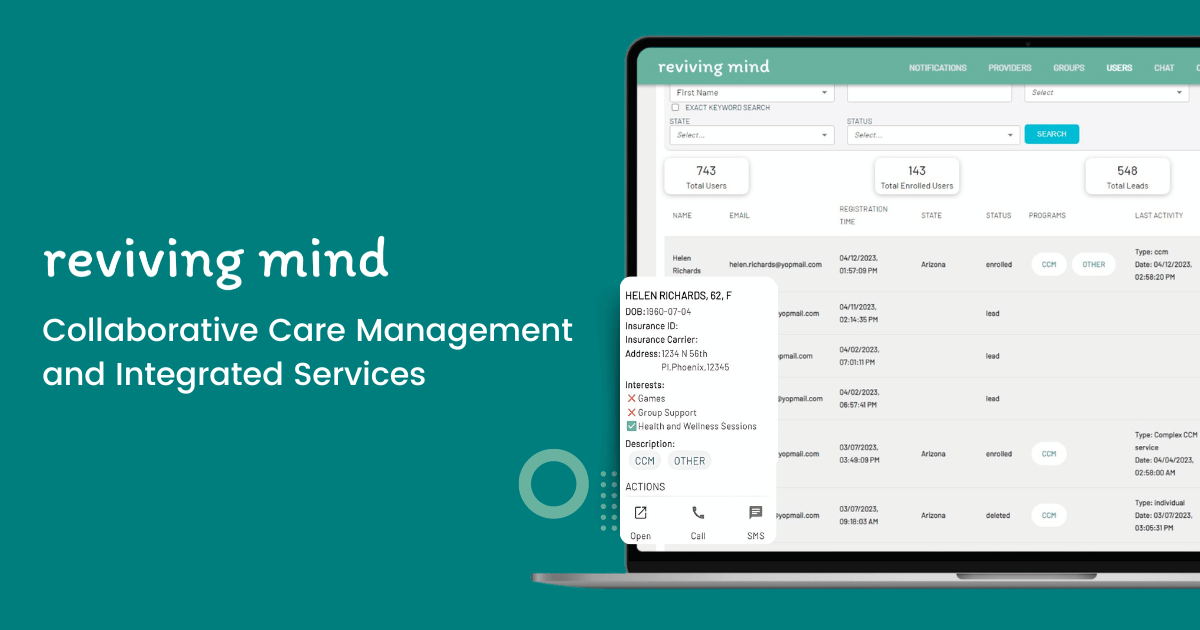
At Reviving Mind, we're committed to providing comprehensive care solutions that address the diverse needs of our patients. In addition to our Collaborative Care Management (CoCM) program, we offer a range of integrated services designed to promote total patient wellness.
Run a free AEO + signal audit for your domain.
AI Answer Engine Optimization (AEO)
List once. Convert intent from live AI conversations without heavy integration.
Integrated care platforms are technological solutions that unify various healthcare services, data sources, and providers within a coordinated digital ecosystem. They leverage interoperability standards like HL7 and FHIR to enable real-time data exchange between physicians, caregivers, and patients. These systems enhance care continuity, reduce duplicate testing, and lower overall treatment costs through improved coordination across care settings.
The platform connects electronic health records, wearable data, diagnostic devices, and care documentation through standardized APIs for a holistic patient view.
Automated care pathways and communication tools synchronize treatment plans across multiple providers and specialties in real-time.
Analytics modules measure treatment success, identify care gaps, and generate data-driven insights for continuous quality improvement.
Platforms coordinate long-term care for diabetes or cardiac patients through combined monitoring by primary care, specialists, and home health services.
Health systems use integrated platforms for seamless patient transitions to rehabilitation facilities or post-acute care with complete clinical history.
Senior living facilities implement platforms to align medical treatment, daily assistance, and family communication for elderly residents.
Surgical centers monitor discharged patients through coordinated follow-ups between hospital, physical therapy, and primary care providers.
Platforms ensure pain-free transitions between hospital, hospice, and home care with synchronized symptom management and family support.
Bilarna evaluates integrated care platform providers using a 57-point AI Trust Score that assesses technical reliability, data security certifications, and verified client outcomes. Our algorithm continuously monitors implementation success rates, interoperability evidence, and compliance with healthcare regulations like HIPAA and GDPR. Only platforms demonstrating proven scalability and positive patient impact receive Bilarna's verification status for enterprise buyers.
Pricing varies significantly by scope, ranging from $50,000 for basic systems to over $500,000 for enterprise solutions. Most vendors price based on patient volume, modules selected, and integration complexity. Implementation and training often add 20-30% to initial licensing costs.
Standard deployments require 6-9 months, while complex enterprise installations may take 12-18 months. Timeline depends on existing systems, data migration requirements, and customization needs. Pilot phases with selected departments often accelerate full-scale rollout.
Essential requirements include HL7/FHIR-compatible EHR systems, adequate server infrastructure, and GDPR/HIPAA-compliant data architecture. Cloud-based platforms typically require minimum 100 Mbps internet connectivity. Mobile devices need current iOS/Android versions for caregiver applications.
While telehealth digitizes individual consultations, integrated platforms orchestrate complete care journeys across multiple providers. They combine communication, data aggregation, and workflow management for continuous rather than episodic care delivery.
Health systems typically report 15-25% reduced readmission rates and 20-30% lower administrative costs within 18-24 months. The greatest value often comes from improved patient outcomes and higher staff satisfaction through reduced administrative burden.
The safety and regulation of online casino platforms depend entirely on their licensing jurisdiction and the security measures they implement. Legitimate platforms hold licenses from recognized authorities such as the Malta Gaming Authority, UK Gambling Commission, or Curacao eGaming and must comply with strict standards for fair play, data protection, and anti-money laundering. They use SSL encryption to safeguard financial transactions and personal information, and their games are regularly audited by independent testing agencies like eCOGRA or iTech Labs for randomness. Before registering, verify the license number displayed at the footer of the website and check it against the regulator’s official database. Reliable platforms also promote responsible gambling by offering deposit limits, self-exclusion tools, and links to support organizations. However, unlicensed or black-market sites pose significant risks including unfair games, non-payment of winnings, and data fraud. Always choose platforms with transparent ownership, positive user reviews, and clear dispute resolution procedures to ensure a safe gaming experience.
To understand data upload limits and payment requirements on analytics platforms, follow these steps: 1. Review the platform's account types, such as free and paid plans. 2. Check the data upload limits for each plan; free accounts often have row limits per upload. 3. Determine if a credit card is required for free or paid accounts. 4. Understand the cancellation policy for paid subscriptions, which usually allows cancellation at any time.
Many creator marketing platforms offer flexible subscription models without mandatory minimum periods or binding contracts. Users can often cancel their subscriptions at any time through their account settings. This flexibility allows brands to adapt their marketing strategies as needed without long-term commitments. It is important to review the specific platform's terms to understand cancellation policies and any potential fees, but generally, these platforms aim to provide user-friendly and commitment-free access.
Yes, AI agents can be integrated as full team members in work coordination. 1. Assign AI agents tasks just like human team members, with clear responsibilities. 2. Provide AI agents with identities, API keys, inboxes, and permissions to operate autonomously. 3. Enable AI agents to collaborate alongside humans on the same tasks and communication channels. 4. Allow AI agents to learn from completed tasks to improve their effectiveness over time. 5. Treat AI agents as first-class workers to streamline workflows and enhance team productivity.
AI code review platforms can significantly enhance team collaboration and code quality. By providing automated, objective feedback on code changes, these platforms reduce misunderstandings and subjective opinions during reviews. They help establish and enforce coding standards consistently across the team, ensuring everyone follows best practices. The faster identification of bugs and issues allows teams to address problems promptly, reducing technical debt. Moreover, AI tools facilitate knowledge sharing by highlighting code patterns and potential improvements, fostering a culture of continuous learning and collaboration among developers.
Yes, AI code review tools typically integrate seamlessly with popular version control platforms such as GitHub and GitLab. This integration allows automatic review of pull requests within the existing development workflow. Many tools support a wide range of programming languages including Python, JavaScript, TypeScript, Go, Java, C, C++, C#, Swift, PHP, Rust, and others. While support for some languages may vary in response quality, these tools aim to provide comprehensive analysis across diverse codebases, helping teams maintain code quality regardless of their technology stack.
AI compliance platforms are designed to complement, not replace, customs brokers in the import process. These platforms provide automated audits and classification recommendations to identify errors and potential savings, but they do not file customs entries, corrections, or paperwork with customs authorities. Licensed customs brokers remain essential for submitting filings and handling official communications. The AI platform offers defensible evidence and insights that brokers can use to improve accuracy and compliance, enhancing the overall import process without substituting the broker's role.
Yes, AI customer service platforms are designed to support multilingual communication, often covering over 50 languages. They can automatically translate incoming messages and responses, enabling customer service teams to communicate confidently with a diverse global customer base. This multilingual capability helps maintain consistent brand tone and messaging across different channels and languages. Additionally, intelligent assistance and smart human handover features ensure complex or sensitive cases are escalated to human agents when necessary, preserving service quality regardless of language barriers.
Yes, AI design engineering tools are designed for seamless integration with existing CAD, BIM, and project management software. This compatibility ensures that engineers can continue using their preferred tools without disrupting established workflows. The integration facilitates data exchange and collaboration, enhancing efficiency and enabling teams to leverage AI capabilities alongside their current systems.
Yes, AI localization platforms can manage translation projects and integrate existing translation memories. 1. They provide content editors to manage source texts and translation strings with context features like glossaries and screenshots. 2. They support major translation memory formats allowing seamless migration of existing databases. 3. Imported translation memories improve AI translation quality by leveraging previous work. 4. Platforms enable manual submission of files or full workflow integration for automation. 5. This facilitates efficient project management, quality control, and scalability in localization.