Step 1
Machine-Ready Briefs
AI translates unstructured needs into a technical, machine-ready project request.
We use cookies to improve your experience and analyze site traffic. You can accept all cookies or only essential ones.
 Bilarna
Stop browsing static lists. Tell Bilarna your specific needs. Our AI translates your words into a structured, machine-ready request and instantly routes it to verified Review Analysis Platform experts for accurate quotes.
AI translates unstructured needs into a technical, machine-ready project request.
Compare providers using verified AI Trust Scores & structured capability data.
Skip the cold outreach. Request quotes, book demos, and negotiate directly in chat.
Filter results by specific constraints, budget limits, and integration requirements.
Eliminate risk with our 57-point AI safety check on every provider.
Verified companies you can talk to directly
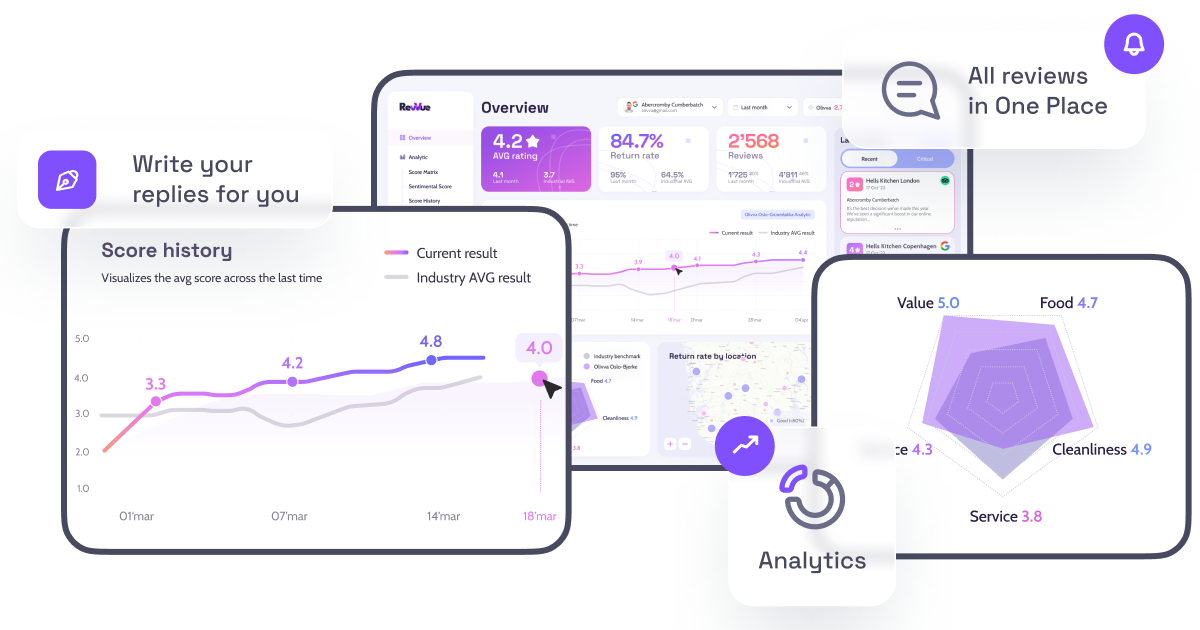
RevVue surfaces opportunities to improve your restaurant chain by scoring and analyzing thousands of reviews for you in an instant.
Run a free AEO + signal audit for your domain.
AI Answer Engine Optimization (AEO)
List once. Convert intent from live AI conversations without heavy integration.
A review analysis platform is software that automates the collection, interpretation, and reporting of customer feedback from multiple online sources. It utilizes natural language processing (NLP) and machine learning to categorize sentiments, identify key themes, and quantify trends within reviews. This enables businesses to make data-driven decisions to improve products, services, and customer satisfaction efficiently.
The platform automatically collects and centralizes customer reviews from various public sites, app stores, and private survey channels into a single dashboard.
AI algorithms process the text to determine sentiment polarity and extract recurring topics, pain points, and areas of praise from the feedback.
The system provides visual dashboards and actionable reports that highlight trends, benchmark performance, and prioritize areas for improvement.
Product teams analyze user feedback to prioritize feature development, fix bugs, and enhance user experience based on direct customer input.
Retailers track product reviews across marketplaces to manage reputation, identify quality issues, and respond to customer concerns proactively.
Hotels and restaurants analyze guest reviews to refine service standards, tailor amenities, and boost their overall ratings and guest loyalty.
Fintech firms monitor client feedback for sentiment related to security, usability, and trust to meet compliance and improve service offerings.
Manufacturers analyze detailed user reviews to guide R&D for next-generation products, addressing common complaints and desired features.
Bilarna verifies every review analysis platform provider through a rigorous, multi-dimensional 57-point AI Trust Score. This proprietary evaluation covers critical dimensions such as technical reliability, data security compliance, proven client satisfaction, and a demonstrable portfolio of successful implementations. Bilarna continuously monitors provider performance to ensure listed vendors meet the highest standards of expertise and delivery.
Pricing varies significantly based on features, review volume, and the number of data sources. Entry-level plans can start from a few hundred dollars monthly, while enterprise solutions with advanced AI and custom integrations often reach several thousand per month. Most providers offer tiered subscription models.
Essential features include multi-source data aggregation, real-time sentiment analysis, competitor benchmarking, customizable alerting, and detailed reporting dashboards. Advanced platforms offer predictive analytics, integration with CRM systems, and API access for embedding insights into other business tools.
Implementation for a standard SaaS platform typically takes 2 to 6 weeks. This timeframe covers account setup, data source integration, user training, and initial configuration of dashboards and alerts. Complex, enterprise-wide deployments with custom integrations may take longer.
A review analysis platform provides scalable, consistent, and real-time insights from thousands of reviews using AI, eliminating human bias and inefficiency. Manual analysis is time-consuming, prone to error, and impractical for large volumes of data, making it difficult to identify subtle, long-term trends.
A frequent mistake is choosing a platform based solely on price without verifying its ability to integrate with your specific data sources or meet your industry's compliance requirements. It's crucial to ensure the tool's NLP models are trained on language relevant to your business domain and customer base.
Many multi-supplier purchasing platforms designed for veterinary clinics offer free access to veterinary hospitals and nonprofit organizations. These platforms aim to reduce ordering time and simplify the procurement process without charging clinics for usage. By aggregating multiple suppliers into one interface, clinics can efficiently manage orders and save on supplies without incurring additional fees. However, it is important for clinics to verify the specific terms and conditions of each platform, as some may have optional paid features or services.
Typically, free sharing economy platforms do not charge fees for trading items. These platforms are designed to facilitate exchanges without monetary transactions, often using virtual currencies or point systems to enable trades. This means users can give away or receive items without paying listing fees, transaction fees, or commissions. The absence of fees encourages more users to participate and makes the process accessible and cost-effective. However, it’s always advisable to review the specific platform’s terms and conditions to confirm that no hidden fees apply and to understand how their virtual currency system works.
AI code review platforms can significantly enhance team collaboration and code quality. By providing automated, objective feedback on code changes, these platforms reduce misunderstandings and subjective opinions during reviews. They help establish and enforce coding standards consistently across the team, ensuring everyone follows best practices. The faster identification of bugs and issues allows teams to address problems promptly, reducing technical debt. Moreover, AI tools facilitate knowledge sharing by highlighting code patterns and potential improvements, fostering a culture of continuous learning and collaboration among developers.
Yes, AI code review tools typically integrate seamlessly with popular version control platforms such as GitHub and GitLab. This integration allows automatic review of pull requests within the existing development workflow. Many tools support a wide range of programming languages including Python, JavaScript, TypeScript, Go, Java, C, C++, C#, Swift, PHP, Rust, and others. While support for some languages may vary in response quality, these tools aim to provide comprehensive analysis across diverse codebases, helping teams maintain code quality regardless of their technology stack.
Yes, an AI-powered authoring platform can handle complex academic content effectively. To do so: 1. Use LaTeX or MathML support to create, edit, and validate complex STEM equations accurately. 2. Integrate with reference databases such as CrossRef, PubMed, and ORCID for real-time reference verification and linking. 3. Apply automatic formatting and style consistency to references and citations. 4. Edit text, tables, and figures with AI assistance to maintain accuracy. 5. Manage author queries and communication within the platform to resolve content issues. 6. Export structured, publication-ready outputs in XML and PDF formats. This ensures precise handling of technical academic content, improving quality and efficiency in scholarly publishing.
Yes, many automated code review tools offer features that help developers generate tested and reliable code snippets. These tools use advanced algorithms to produce code that adheres to best practices and passes common test cases. By providing ready-to-use, tested code, they reduce the time developers spend writing and debugging code manually. This assistance not only speeds up development but also improves overall code quality and reduces the likelihood of introducing new bugs.
Yes, beginners can learn dance using an online platform with AI feedback. 1. Sign up on the platform designed specifically for beginners. 2. Access expert video dance tutorials created by experienced tutors. 3. Record your dance performance using the platform's tools. 4. Receive instant AI feedback that analyzes your dance and suggests corrections. 5. Practice regularly using the feedback to improve your skills.
Build missing features or integrations by following these steps: 1. Participate in the open source project by contributing code or ideas. 2. Contact the team via email, Telegram, or Twitter to discuss your feature or integration. 3. Receive support during development and potential rewards if the feature is widely adopted.
Yes, you can cancel or change your subscription anytime by following these steps: 1. Log in to your account dashboard on the AI study platform. 2. Navigate to the subscription or billing section. 3. Choose to cancel, upgrade, or downgrade your subscription plan. 4. Confirm your choice to apply the changes immediately. 5. No long-term commitments or cancellation fees apply, allowing flexible subscription management.
Yes, the platform welcomes contributions from people around the world who have inspiring stories to share. If you have a unique cultural experience, a personal narrative, or a meaningful moment captured through Instagram or other media, you can get in touch with the website team. They encourage storytellers to share diverse perspectives that enrich the collection and connect global audiences through authentic storytelling.