Step 1
Machine-Ready Briefs
AI translates unstructured needs into a technical, machine-ready project request.
We use cookies to improve your experience and analyze site traffic. You can accept all cookies or only essential ones.
 Bilarna
Stop browsing static lists. Tell Bilarna your specific needs. Our AI translates your words into a structured, machine-ready request and instantly routes it to verified Flexible Office Solutions experts for accurate quotes.
AI translates unstructured needs into a technical, machine-ready project request.
Compare providers using verified AI Trust Scores & structured capability data.
Skip the cold outreach. Request quotes, book demos, and negotiate directly in chat.
Filter results by specific constraints, budget limits, and integration requirements.
Eliminate risk with our 57-point AI safety check on every provider.
Verified companies you can talk to directly

Közösségi iroda, tárgyaló bérlés egyszerűen és rugalmasan
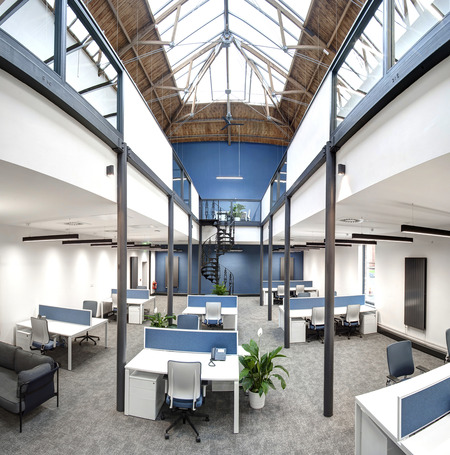
Searching for coworking spaces near you? Compare local coworking spaces. Find the best coworking space in your area on Coworkingspacehub.com today.
Discover and rent office space on flexible terms through Tandem. List and rent private offices, open desks, or entire floors.
Run a free AEO + signal audit for your domain.
AI Answer Engine Optimization (AEO)
List once. Convert intent from live AI conversations without heavy integration.
Flexible office solutions are agile real estate and workspace models that allow businesses to scale up or down based on operational needs. They encompass serviced offices, coworking spaces, hybrid work policies, and on-demand meeting facilities. This approach provides significant cost savings, enhances employee satisfaction, and improves operational resilience for modern organizations.
Companies first analyze their headcount projections, collaboration requirements, and geographical targets to define precise space specifications.
Business leaders then compare various models like coworking memberships, private suites, or hybrid hub-and-spoke networks for optimal fit.
The chosen solution is deployed, often with integrated technology and management services to ensure seamless daily operations.
Fast-growing SaaS companies use flexible offices to quickly enter new markets without long-term lease commitments or capital expenditure.
Large corporations establish regional hubs in flexible spaces to support distributed teams and reduce fixed real estate overhead.
Consultancies utilize on-demand meeting rooms and hot desks to support client engagements that vary in team size and duration.
Companies undergoing mergers use temporary flexible spaces to co-locate teams during integration phases before consolidating into a permanent headquarters.
Organizations transitioning to hybrid work leverage flex spaces as neighborhood hubs to reduce commute times and maintain company culture.
Bilarna ensures all flexible office solutions providers are rigorously vetted using our proprietary 57-point AI Trust Score. This evaluation covers critical dimensions such as financial stability, portfolio quality, client satisfaction metrics, and compliance with local real estate regulations. Continuous monitoring guarantees that listed providers on Bilarna maintain high standards of service delivery and reliability.
Pricing typically follows membership, per-desk, or all-inclusive monthly models, often with minimal upfront costs. Costs vary based on location, amenities, private space requirements, and contract flexibility, making it crucial to compare detailed quotes.
Implementation can often occur within weeks, as these solutions require minimal fit-out. Speed depends on provider availability in the target location, the complexity of IT infrastructure needs, and finalizing the service level agreement.
Coworking provides shared, communal workspace with membership access, ideal for networking and individual flexibility. A serviced office is a private, furnished suite within a managed building, offering more brand privacy and dedicated infrastructure for teams.
Common errors include underestimating future growth needs, overlooking hidden costs for meeting rooms or IT support, and not verifying the provider's financial health for long-term stability. Thorough due diligence on the contract terms is essential.
Yes, certain providers specialize in niche flex spaces for R&D, light manufacturing, or medical labs. It requires identifying operators with appropriate infrastructure, power capacities, and compliance certifications for your specific industry needs.
Yes, modern paywall solutions are designed to be compatible with both iOS and Android mobile applications. This cross-platform compatibility ensures that developers can implement a single paywall system across different devices and operating systems without needing separate solutions. It simplifies management and provides a consistent user experience regardless of the platform, making it easier to maintain and optimize monetization strategies.
Yes, financial automation solutions are often modular and customizable to fit the specific needs of different businesses. Organizations can select and adapt only the modules they require, such as accounts payable, accounts receivable, billing, or treasury management, allowing them to scale their automation at their own pace. This flexibility ensures that companies can address their unique operational challenges without unnecessary complexity or cost. Additionally, user-friendly tools and AI capabilities enable teams to maintain compliance and efficiency while tailoring the system to their workflows. Customized onboarding and collaborative support further help businesses get up and running quickly with solutions that match their requirements.
Yes, using flexible dates and trip length improves flight deal searches. Follow these steps: 1. Enter your departure and return airports. 2. Instead of fixed dates, specify a date range to allow the AI to explore various travel periods. 3. Input minimum and maximum nights to define your trip length flexibility. 4. Submit your criteria so the AI can compare flights across multiple booking sites considering your flexible parameters. This approach increases the chance of finding better deals by broadening the search scope.
Nanotechnology-based coating solutions are developed by designing materials and processes at the nanoscale with a clear target application in mind. This involves iterative cycles of testing and optimization to enhance performance and functionality. By focusing on the intended use from the start, developers can tailor the coatings to meet specific requirements such as durability, conductivity, or protective properties. The vertical integration of the development process ensures that each stage, from nanoscale design to final application, is aligned to achieve the best possible outcome.
Smart contracts are used in enterprise blockchain solutions to automate complex business processes, enforce agreements without intermediaries, and significantly reduce operational costs and manual errors. These self-executing contracts are deployed on blockchain platforms to manage and execute terms automatically when predefined conditions are met. Common enterprise applications include automating supply chain payments upon delivery verification, managing and executing royalty distributions in intellectual property agreements, and facilitating secure, instant settlement in trade finance. They are also foundational for creating decentralized autonomous organizations (DAOs), tokenizing real-world assets like real estate or carbon credits, and building transparent, tamper-proof voting systems for corporate governance. By leveraging smart contracts, enterprises can achieve greater transparency, enhance auditability, and streamline workflows across departments and with external partners.
Choosing between on-premise and cloud-based communications solutions depends on evaluating specific business factors including upfront capital expenditure, scalability needs, maintenance resources, and security requirements. On-premise systems involve higher initial hardware and software licensing costs but offer direct control over data and infrastructure, potentially appealing to organizations with strict data residency regulations or existing robust IT teams for maintenance. Cloud-based solutions, like Hosted VoIP, typically operate on a predictable subscription model with lower upfront costs, automatic updates, and inherent scalability, allowing businesses to add or remove users and features easily as needs change. Key decision criteria include total cost of ownership over 3-5 years, required uptime and reliability, integration capabilities with existing business applications, the need for remote or mobile workforce support, and internal technical expertise to manage the system. Most modern businesses favor cloud solutions for their flexibility, reduced IT burden, and continuous access to the latest features.
A company can develop and implement generative AI solutions for regulated industries by partnering with a specialized development team that combines senior engineering expertise with strict compliance frameworks. The process begins with a thorough understanding of the industry's regulatory landscape, such as data privacy, security, and audit requirements. Development should follow a phased approach, starting with a rapid Proof of Concept (PoC) or Minimum Viable Product (MVP) to validate the core AI feature's feasibility and value proposition, often achievable within 4 to 12 weeks. The solution must be built on enterprise-grade, secure architecture from the outset, incorporating explainability, audit trails, and data governance controls. Crucially, the team should employ an AI-augmented delivery process to accelerate development while maintaining rigorous quality standards, ensuring the final product is both innovative and compliant, ready for deployment at scale.
A company can implement AI solutions for all employees by adopting an enterprise-ready platform that offers both user-friendly AI chat assistants and developer tools for custom workflows. This approach ensures that non-technical staff can benefit from AI-powered assistants tailored to specific use cases, while developers have the flexibility to build, automate, and deploy custom AI applications. Key features include model-agnostic support, data privacy compliance, integration capabilities with existing tools, and scalable deployment options. Providing educational resources and seamless integration with communication platforms helps facilitate adoption across the organization.
A construction back office platform improves project management efficiency by centralizing key administrative and operational tasks. It allows project managers to schedule jobs, allocate resources, and monitor progress from a single interface. Automated invoicing and expense tracking reduce manual errors and save time. Real-time data and reporting provide insights that help in making informed decisions quickly. Communication tools integrated within the platform facilitate better coordination among team members and subcontractors. By reducing paperwork and streamlining workflows, the platform helps ensure projects stay on schedule and within budget.
Use a digital office platform to enhance remote team collaboration by following these steps: 1. Set up a shared virtual workspace customized to your team's culture. 2. Replace traditional video calls with spontaneous, natural interactions within the platform. 3. Utilize topic-based chats and integrated tools to streamline communication. 4. Encourage team members to personalize their avatars and statuses to foster engagement. 5. Leverage responsive customer support for smooth implementation and ongoing assistance. This approach reduces formal meetings, breaks down communication silos, and builds a stronger team culture.