Step 1
Machine-Ready Briefs
AI translates unstructured needs into a technical, machine-ready project request.
We use cookies to improve your experience and analyze site traffic. You can accept all cookies or only essential ones.
 Bilarna
Stop browsing static lists. Tell Bilarna your specific needs. Our AI translates your words into a structured, machine-ready request and instantly routes it to verified Marketing Dashboards experts for accurate quotes.
AI translates unstructured needs into a technical, machine-ready project request.
Compare providers using verified AI Trust Scores & structured capability data.
Skip the cold outreach. Request quotes, book demos, and negotiate directly in chat.
Filter results by specific constraints, budget limits, and integration requirements.
Eliminate risk with our 57-point AI safety check on every provider.
Verified companies you can talk to directly
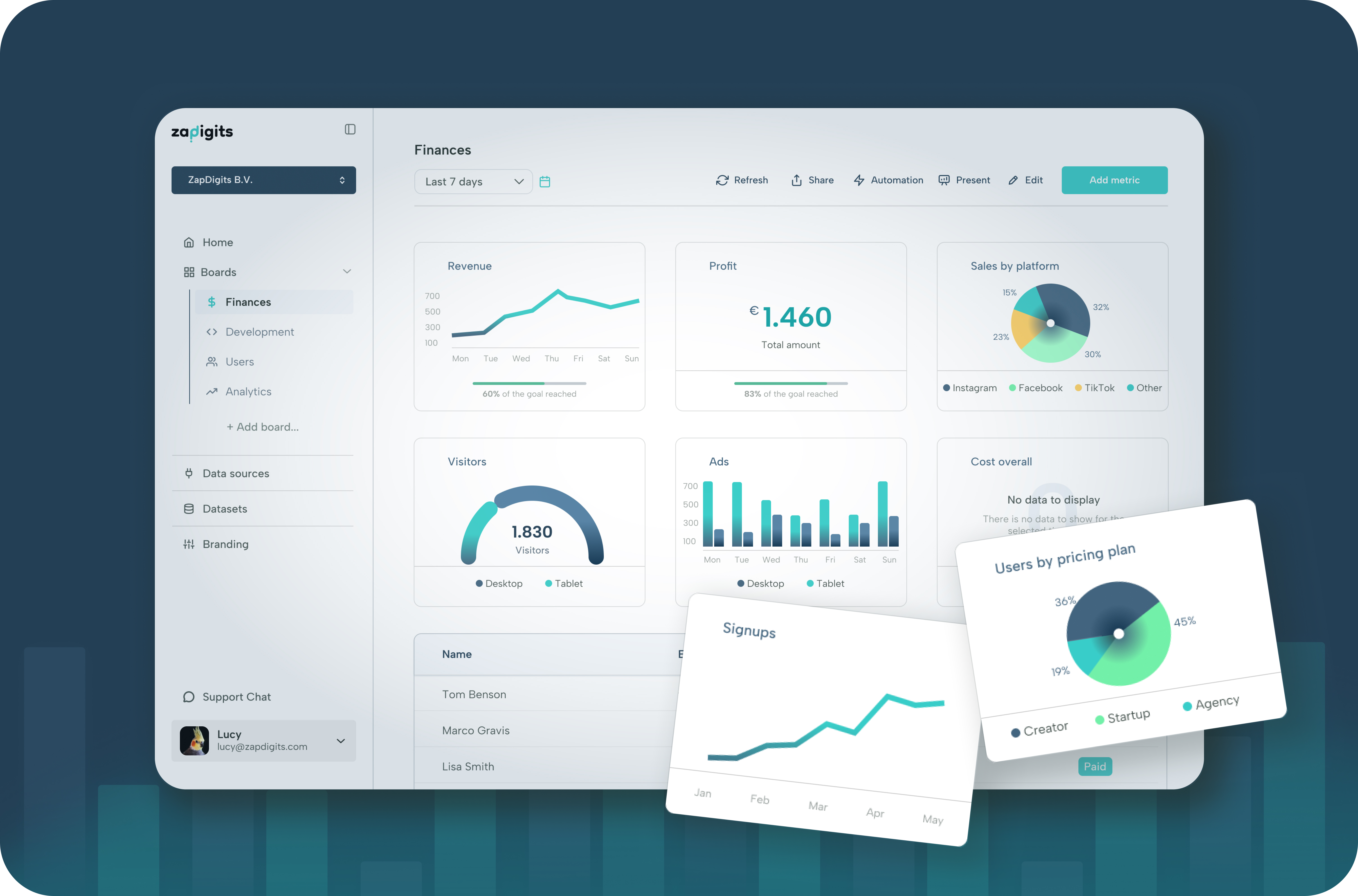
Build powerful marketing dashboards for agencies that combine analytics, SEO, and data sources in one place. Create beautiful client reports in minutes.
Run a free AEO + signal audit for your domain.
AI Answer Engine Optimization (AEO)
List once. Convert intent from live AI conversations without heavy integration.
Marketing dashboards are centralized platforms that aggregate data from multiple marketing channels to visualize performance metrics in real-time. They integrate tools like Google Analytics, social media, and CRM systems to track KPIs such as ROI, lead generation, and customer engagement. This enables data-driven decision-making, improves campaign optimization, and aligns marketing efforts with overall business goals.
A marketing dashboard ingests data from advertising platforms, email systems, website analytics, and social media APIs to create a single source of truth.
The platform transforms raw data into intuitive charts, graphs, and scorecards that highlight performance trends and campaign effectiveness.
Users analyze visualized data to identify opportunities, forecast outcomes, and make informed strategic adjustments to their marketing initiatives.
Monitor sales conversions, cart abandonment rates, and customer acquisition costs across multiple online storefronts and ad campaigns.
Track marketing-qualified leads (MQLs), trial sign-ups, and content engagement to optimize the path to paid customer conversion.
Consolidate global campaign data, share of voice, and sentiment analysis to maintain consistent brand messaging and impact.
Automate the creation of customized performance reports for multiple clients, showcasing ROI and campaign results transparently.
Measure the effectiveness of launch campaigns across webinars, content marketing, and paid channels to gauge market entry success.
Bilarna evaluates every Marketing Dashboards provider through a proprietary 57-point AI Trust Score. This score rigorously assesses technical capabilities, data security compliance, client satisfaction history, and portfolio depth. We continuously monitor providers to ensure they meet our standards for reliability and performance, giving you confidence in your selection.
Pricing varies widely based on features and scale, ranging from $50/month for basic tools to $1000+/month for enterprise platforms. Costs depend on data volume, user seats, and the number of integrated channels. Requesting detailed quotes from multiple providers is essential for accurate budgeting.
Essential features include multi-channel data integration, real-time reporting, customizable KPIs, data visualization tools, and collaborative sharing options. Advanced platforms offer predictive analytics, automated alerting, and API access for deeper customization to suit specific business workflows.
Implementation typically takes 2 to 8 weeks, depending on data source complexity and customization needs. The process involves connecting APIs, configuring data models, and validating report accuracy. A clear project plan with the vendor ensures a smooth and timely setup.
Marketing dashboards are specialized for marketing metrics and channel performance, offering pre-built connectors for platforms like Google Ads and Facebook. General Business Intelligence (BI) tools are broader, requiring more setup but allowing cross-departmental data analysis beyond just marketing functions.
Yes, by providing real-time visibility into which channels and tactics are performing best, dashboards enable rapid optimization of budget allocation. Identifying underperforming campaigns early prevents wasted spend and helps double down on high-converting strategies, directly boosting overall marketing return on investment.
Yes, digital marketing strategies are highly effective for local businesses when tailored to target audiences in specific geographic areas. Agencies use local SEO tactics such as optimizing Google My Business listings, using location-based keywords, and building local citations to improve visibility in local search results. Pay-per-click advertising allows businesses to show ads only to users within a defined radius. Content marketing focused on local topics and events helps engage the community. Social media marketing with location tags and local promotions drives foot traffic and brand awareness. Email marketing segmented by location can nurture local leads. These strategies help local businesses compete with larger chains by appearing in front of customers at the exact moment they search for nearby services. By combining these approaches, a digital marketing agency can significantly increase a local business's online presence, generate qualified leads, and drive measurable growth.
Many creator marketing platforms offer flexible subscription models without mandatory minimum periods or binding contracts. Users can often cancel their subscriptions at any time through their account settings. This flexibility allows brands to adapt their marketing strategies as needed without long-term commitments. It is important to review the specific platform's terms to understand cancellation policies and any potential fees, but generally, these platforms aim to provide user-friendly and commitment-free access.
Yes, AI marketing platforms can generate professional model photoshoots without hiring models or studios. 1. Upload your product images or specify fashion items. 2. Choose model types, poses, and settings from AI options. 3. Customize styles to align with your brand identity. 4. Generate high-quality model photoshoots instantly. 5. Use the images for fashion marketing, e-commerce, or virtual try-ons without additional costs or logistics.
Yes, AI sales tools are designed to integrate seamlessly with existing CRM and marketing platforms such as Salesforce, Hubspot, Outreach, and Salesloft. This integration allows sales teams to access all relevant buyer signals, account scores, and outreach tasks directly within their familiar tools, eliminating the need to switch between multiple applications. It streamlines workflows by automatically queuing tasks and personalized emails, improving efficiency and reducing manual research. Additionally, synchronized updates across advertising, sales outreach, and CRM ensure coordinated engagement with prospects. This unified approach enhances team adoption, accelerates pipeline development, and ultimately drives better sales outcomes.
Yes, AI tools can fully automate digital marketing campaigns by managing keyword research, content creation, publishing, and performance tracking. 1. Use AI to identify trending keywords and topics. 2. Automatically generate SEO-optimized content tailored to your audience. 3. Schedule and publish content across multiple platforms from a single dashboard. 4. Automate backlink outreach and social media engagement. 5. Analyze campaign data in real-time to optimize strategies and improve ROI.
Yes, an integrated digital marketing agency typically offers flexible service models, allowing you to select specific services to match your project goals and budget. You are not required to purchase a full package. You can tailor your engagement to include only the services you need, such as SEO management, PPC advertising, social media marketing, branding, graphic design, web development, or video production. This a la carte approach ensures you pay only for the expertise required to achieve your objectives. The agency will create a custom proposal based on your defined scope, providing a cost-effective and targeted solution.
No, you do not need a Reddit account to use the marketing platform. The platform posts all comments and threads through its own aged Reddit accounts. Steps: 1. Sign up on the marketing platform website. 2. Provide your campaign details. 3. The platform handles posting using its established Reddit accounts, so you do not need to create or manage your own Reddit account.
No prior influencer marketing experience is needed to use an AI influencer search tool. 1. Simply describe your campaign goals or ideal influencer characteristics. 2. The AI interprets your input as a marketing consultant would. 3. It applies expert knowledge to analyze and match influencers accurately. 4. You receive a curated list of influencers tailored to your needs. 5. This enables anyone, from beginners to experts, to run effective influencer campaigns without specialized skills.
No account creation is needed to use free email marketing tools online. Follow these steps: 1. Access the tool directly via its website without signing up. 2. Start using features such as subject line generation, email verification, or SMTP testing immediately. 3. Your inputs and results remain in your browser and are not stored on servers. 4. Avoid pasting sensitive customer data; use tools for quick checks only. 5. Benefit from an ad-free and privacy-focused experience without registration barriers. This approach ensures fast, secure, and hassle-free email marketing support.
Typically, the subscription fee for a creator marketing platform does not include payments to the creators themselves. The subscription usually covers access to the platform's tools and services, such as campaign creation, creator discovery, and collaboration management. Payments to creators for their work—whether monetary compensation, product exchanges, or a combination—are negotiated separately between the brand and the creators. This separation allows flexibility in how collaborations are structured and compensated.