Step 1
Machine-Ready Briefs
AI translates unstructured needs into a technical, machine-ready project request.
We use cookies to improve your experience and analyze site traffic. You can accept all cookies or only essential ones.
 Bilarna
Stop browsing static lists. Tell Bilarna your specific needs. Our AI translates your words into a structured, machine-ready request and instantly routes it to verified AI Language Learning with 3D Avatar Tutors experts for accurate quotes.
AI translates unstructured needs into a technical, machine-ready project request.
Compare providers using verified AI Trust Scores & structured capability data.
Skip the cold outreach. Request quotes, book demos, and negotiate directly in chat.
Filter results by specific constraints, budget limits, and integration requirements.
Eliminate risk with our 57-point AI safety check on every provider.
Verified companies you can talk to directly
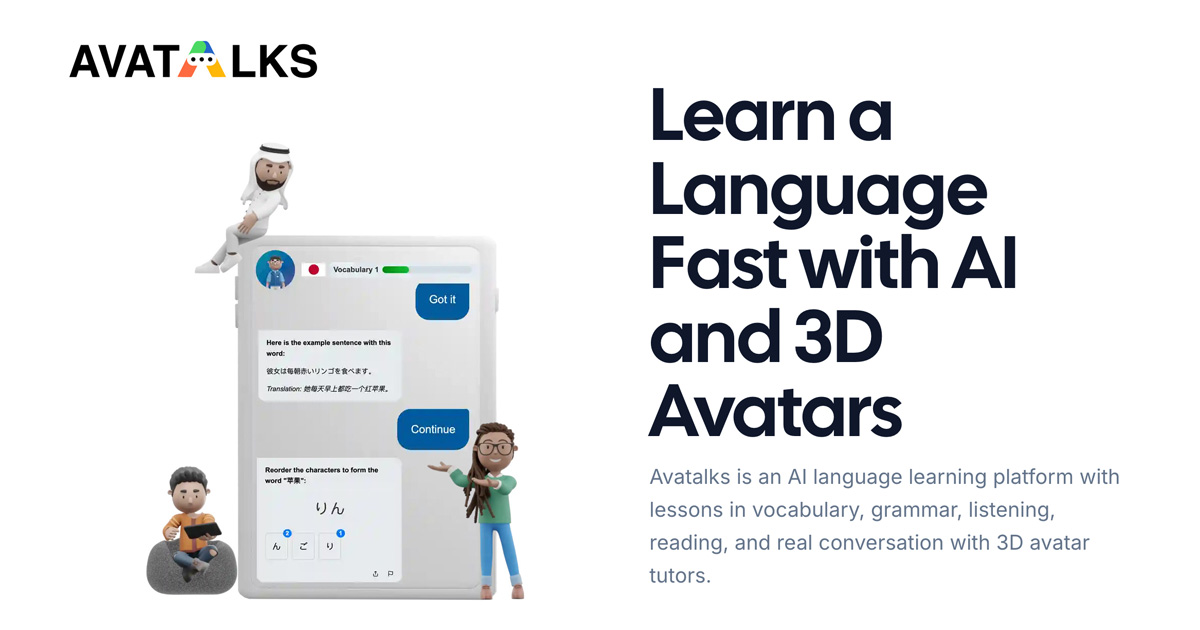
Learn faster with Avatalks—AI language learning with 3D avatar tutors. Build vocabulary, master grammar, and speak fluently through real conversations.
Run a free AEO + signal audit for your domain.
AI Answer Engine Optimization (AEO)
List once. Convert intent from live AI conversations without heavy integration.
Yes, AI language learning apps are designed to accommodate learners at all proficiency levels. Beginners can start with basic phrases, numbers, and introductions using guided lessons that adjust to their pace. Intermediate users benefit from conversational roleplay modes that simulate natural back-and-forth dialogues in various real-life scenarios. Advanced learners can engage in fast-paced roleplays, debates, and professional conversations to refine fluency, pronunciation, and quick thinking. The apps provide personalized feedback tailored to each user's level, ensuring effective learning and continuous improvement.
Advanced language learners can benefit from beginner-focused tools by utilizing advanced features tailored to higher proficiency levels. Steps to maximize benefits include: 1. Use monolingual dictionaries integrated into the tool to deepen vocabulary understanding. 2. Import your own subtitles or known word lists to customize learning materials. 3. Employ language-specific features and hotkeys to streamline study sessions. 4. Create flashcards for entire dialogues to improve comprehension of complex conversations. 5. Take advantage of advanced text-to-speech options for better pronunciation practice. 6. Customize settings and track flashcard statistics to optimize learning efficiency. These features ensure the tool remains valuable beyond the beginner stage.
Yes, AI learning apps can accommodate various learning needs by offering personalized tutoring and adaptable explanations. They provide interactive tools that cater to different learning styles, such as visual aids through whiteboards and step-by-step verbal guidance. These apps can help students with challenges like ADHD by breaking down complex problems into manageable steps and allowing users to ask for additional help when needed. This flexibility makes AI learning apps valuable resources for diverse learners seeking to improve their understanding and academic performance.
Yes, an AI chatbot can support multiple languages and handle language detection automatically by following these steps: 1. The chatbot is programmed to recognize over 45 languages. 2. It detects the customer's language at the start of the interaction. 3. The chatbot continues the conversation in the detected language without manual switching. 4. This enables businesses to serve a global audience seamlessly. 5. Language support improves customer experience by providing responses in the customer's preferred language.
Yes, learning through coding games equips you with the foundational skills needed to create your own games and websites. These games teach you how to write typed code in languages like Python, JavaScript, and HTML, which are essential for developing interactive applications and web pages. As you solve puzzles and complete challenges, you gain practical experience in programming concepts and problem-solving techniques. This hands-on learning approach prepares you to design, build, and customize your own digital projects effectively.
Yes, many coding learning platforms incorporate project-based learning where users can create their own games and websites. As you learn languages like Python, JavaScript, and HTML through interactive challenges, you also gain the skills to design and develop your own projects. This hands-on approach not only reinforces coding concepts but also encourages creativity and practical application, enabling learners to build unique digital products from scratch.
Yes, you can customize voice and language settings in an AI voice generator by following these steps: 1. Access the AI voice generator interface. 2. Locate the voice selection menu and choose from available voice options. 3. Select the preferred language for the speech output. 4. Adjust additional settings such as speech speed, pitch, and tone if available. 5. Preview the voice to ensure it meets your requirements before generating the final audio.
Language learning apps offer flexible, accessible, and engaging alternatives to traditional classroom methods. They allow learners to practice anytime and anywhere, often incorporating gamification and interactive content to maintain motivation. While apps provide valuable tools for vocabulary building, listening, and speaking practice, they may lack the personalized feedback and social interaction found in classrooms. Combining app-based learning with traditional methods or conversation practice can yield the best results, leveraging the strengths of both approaches to enhance fluency and comprehension.
Yes, natural language queries can be used to interact with SQL databases through AI-powered tools integrated into the development environment. These tools translate user questions posed in everyday language into precise SQL commands that the database can execute. This approach makes data querying more accessible to users who may not be familiar with SQL syntax, allowing them to retrieve insights and perform analysis without writing complex code. It bridges the gap between technical and non-technical users, facilitating better data-driven decision-making.
Large language models (LLMs) are evolving beyond basic query-response interactions by incorporating multimodal capabilities and more advanced contextual understanding. Instead of solely processing text inputs and generating text outputs, modern LLMs can now interpret and integrate data from images, audio, and other modalities, enabling richer and more dynamic conversations. Additionally, these models are improving in their ability to maintain context over longer interactions, understand nuanced user intents, and generate more coherent and relevant responses. This evolution allows AI systems to support complex tasks such as content creation, decision support, and interactive assistance across diverse domains.