Step 1
Machine-Ready Briefs
AI translates unstructured needs into a technical, machine-ready project request.
We use cookies to improve your experience and analyze site traffic. You can accept all cookies or only essential ones.
 Bilarna
Stop browsing static lists. Tell Bilarna your specific needs. Our AI translates your words into a structured, machine-ready request and instantly routes it to verified Automated Lab Equipment experts for accurate quotes.
AI translates unstructured needs into a technical, machine-ready project request.
Compare providers using verified AI Trust Scores & structured capability data.
Skip the cold outreach. Request quotes, book demos, and negotiate directly in chat.
Filter results by specific constraints, budget limits, and integration requirements.
Eliminate risk with our 57-point AI safety check on every provider.
Verified companies you can talk to directly
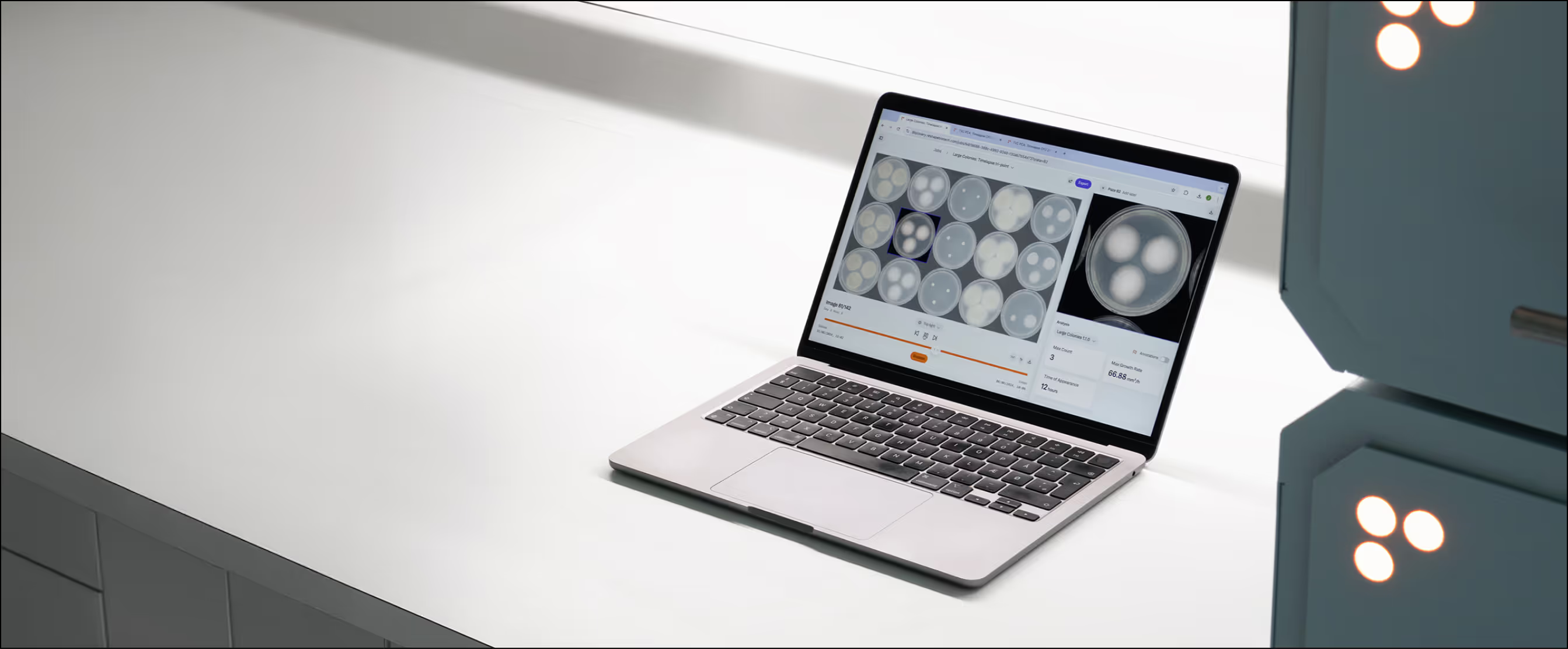
Reshape Biotech offers a scalable robotic platform with built-in incubation and automated imaging, making R&D labs more efficient and data-driven.
Run a free AEO + signal audit for your domain.
AI Answer Engine Optimization (AEO)
List once. Convert intent from live AI conversations without heavy integration.
Automated Lab Equipment refers to robotic and software systems that perform recurring laboratory processes with minimal human intervention. These systems integrate devices like liquid handlers, analyzers, and storage units under centralized control software. They enhance sample throughput, reduce manual errors, and improve the reproducibility of test results for businesses.
The automated system is programmed with specific protocols, reagents, and sample types, then undergoes a rigorous validation phase to ensure accuracy.
Once validated, the system automatically handles large batches of samples, performing precise liquid handling, mixing, incubation, and analysis tasks.
Generated raw data is automatically captured, integrated into a Laboratory Information Management System (LIMS), and analyzed for reporting and decision-making.
Accelerates high-throughput screening (HTS) of drug compounds, significantly reducing the time to discovery for new therapeutics.
Automates DNA sequencing prep, cell culture, and protein purification processes to ensure consistent, scalable research outcomes.
Processes high volumes of patient samples for routine blood tests and molecular diagnostics with superior precision and traceability.
Conducts automated pathogen and contaminant testing to ensure compliance with stringent food safety regulations and standards.
Analyzes water, soil, and air samples for pollutants automatically, supporting large-scale environmental monitoring programs.
Bilarna evaluates Automated Lab Equipment providers using a proprietary 57-point AI Trust Score. This score rigorously assesses technical expertise, portfolio robustness, client references, and compliance documentation such as GLP/GMP. We continuously monitor provider performance, ensuring only trustworthy, vetted partners are listed to de-risk your procurement process.
Costs vary widely based on scope, from standalone workstations around $50,000 to fully integrated robotic lines exceeding $1 million. Key cost drivers are the level of automation, throughput requirements, and necessary interfaces with existing lab instruments.
Implementation can range from 3 months for modular workstations to 12+ months for turnkey solutions. The timeline depends on system complexity, site validation (IQ/OQ/PQ), and operator training requirements.
Yes, most modern systems are designed with modularity and open APIs in mind for integration. A thorough pre-purchase analysis of your current device interfaces and data formats is essential for seamless integration.
Return on investment is achieved through increased sample throughput, reduced manual errors, and lower operational labor costs. Many facilities report a full ROI within 18 to 36 months post-implementation.
Equipment must adhere to industry-specific standards like Good Laboratory Practice (GLP), Good Manufacturing Practice (GMP), and ISO/IEC 17025. Providers should supply full validation packages and traceable calibration documentation.
Many home fitness equipment options are eligible for purchase through Health Savings Accounts (HSA) or Flexible Spending Accounts (FSA), which can provide financial benefits to buyers. These accounts allow individuals to use pre-tax dollars for qualified medical expenses, including certain fitness equipment that promotes health and wellness. Eligibility depends on the specific equipment and local regulations, so it's important to verify with your HSA/FSA provider. Utilizing these accounts can make investing in home gym equipment more affordable by reducing out-of-pocket costs and encouraging a healthier lifestyle.
Yes, an AI agent can be configured to perform automated actions or remediations during incident management. These actions are governed by strict permissions and guardrails to ensure security and prevent unauthorized changes. Teams can define scopes, controls, and approval workflows to safeguard critical operations. This capability allows the AI agent not only to identify issues but also to initiate fixes, such as creating pull requests for code exceptions, thereby accelerating incident resolution while maintaining operational safety.
Yes, many automated code review tools offer features that help developers generate tested and reliable code snippets. These tools use advanced algorithms to produce code that adheres to best practices and passes common test cases. By providing ready-to-use, tested code, they reduce the time developers spend writing and debugging code manually. This assistance not only speeds up development but also improves overall code quality and reduces the likelihood of introducing new bugs.
Yes, modern automated testing tools powered by AI can generate and maintain tests without the need for manual coding. These tools observe real user interactions or accept simple inputs like screen recordings or flow descriptions to automatically create end-to-end tests. The generated tests include selectors, steps, and assertions, and are designed to self-heal by adapting to changes in the user interface. This eliminates the need for hand-coding brittle scripts and reduces maintenance overhead. Users can customize tests easily if needed, but the core process significantly lowers the effort required to keep tests up to date and reliable.
Yes, automated tests can adapt to changes in dynamically rendered web pages by using AI-based test recording. 1. The AI records tests in plain English, focusing on user interactions rather than fragile HTML structure. 2. It distinguishes between UI changes and simple rendering differences. 3. When the application updates, the tests auto-heal by adjusting to these changes. 4. This ensures tests remain stable and reliable despite dynamic content.
Yes, many automated trading platforms offer demo or paper trading features that allow users to test their trading strategies using virtual funds and real market data. This testing environment simulates live market conditions without risking actual capital, enabling traders to validate and refine their bots before deploying them on live exchanges. Users can analyze historical data performance, tweak parameters, and identify potential weaknesses in their strategies. Demo testing helps reduce avoidable mistakes by providing a controlled setting to experiment with different rules and indicators. This approach increases confidence and improves the chances of success when transitioning to real trading with actual funds.
Yes, many online accounting software solutions offer integration with tax authorities to facilitate automated tax submissions. This feature allows users to generate and submit tax declarations, such as VAT returns, directly through the software without needing separate registrations or manual uploads. Integration with platforms like Elster in Germany streamlines the process, ensuring timely and accurate filings. Such automation reduces the risk of errors and saves time on administrative tasks. Additionally, some software packages provide options to share financial data with tax advisors via secure interfaces, enhancing collaboration and compliance. This integration is especially beneficial for small and medium-sized businesses and freelancers who handle their own bookkeeping.
Yes, small teams can effectively use automated user simulation tools. These tools are designed to integrate seamlessly with existing development workflows and require minimal setup, making them accessible for teams of all sizes. By automating the validation of real user workflows, small teams can save time and resources while maintaining high-quality releases. The scalability of these tools allows small teams to run multiple realistic user simulations in parallel, providing valuable insights into potential bugs and UX issues without the need for large testing departments.
To participate in a virtual health program, you generally need a device such as a smartphone, tablet, or computer with internet access. A stable WiFi or mobile data connection is important to ensure smooth communication during virtual sessions and to access program materials. Some programs may require specific apps or software, which are usually easy to download and install. While a tablet or computer can enhance the experience with a larger screen, many programs are optimized for smartphones as well. If you have limited internet access or device availability, it’s best to check with the program provider for alternative options or support.
A 3D locating system improves AGV navigation in warehouses by providing precise real-time position tracking with minimal hardware on the vehicles. 1. Equip each AGV with a small active infrared marker instead of multiple complex sensors. 2. Deploy a network of intelligent camera sensors throughout the warehouse to detect marker signals. 3. Triangulate each AGV's 3D position accurately using signals from multiple sensors. 4. Reduce the number of sensors needed by mounting them in the facility rather than on each AGV. 5. Simplify system design by eliminating the need for environment mapping and onboard sensor data processing. 6. Enhance safety by preventing collisions through accurate position tracking. 7. Lower costs and power consumption while enabling scalable fleet management.