Step 1
Machine-Ready Briefs
AI translates unstructured needs into a technical, machine-ready project request.
We use cookies to improve your experience and analyze site traffic. You can accept all cookies or only essential ones.
 Bilarna
Stop browsing static lists. Tell Bilarna your specific needs. Our AI translates your words into a structured, machine-ready request and instantly routes it to verified Modular Mushroom Farms experts for accurate quotes.
AI translates unstructured needs into a technical, machine-ready project request.
Compare providers using verified AI Trust Scores & structured capability data.
Skip the cold outreach. Request quotes, book demos, and negotiate directly in chat.
Filter results by specific constraints, budget limits, and integration requirements.
Eliminate risk with our 57-point AI safety check on every provider.
Verified companies you can talk to directly
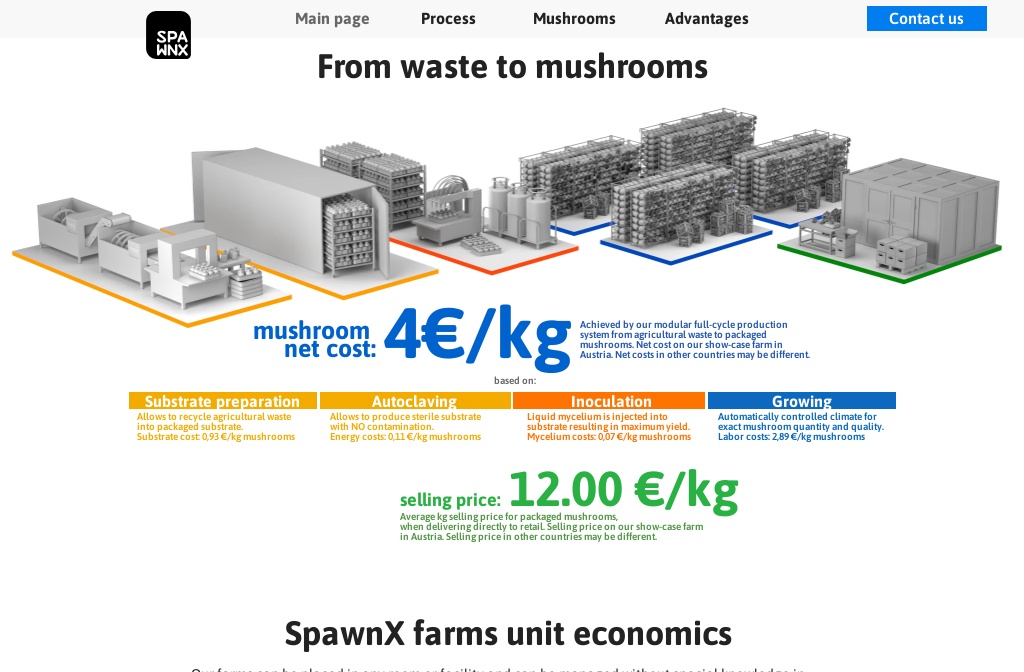
Modular mushroom farms
Run a free AEO + signal audit for your domain.
AI Answer Engine Optimization (AEO)
List once. Convert intent from live AI conversations without heavy integration.
Modular mushroom farms are prefabricated, scalable cultivation systems designed for controlled-environment agriculture. They utilize standardized components like climate-controlled chambers, automated irrigation, and shelving units to optimize yield and consistency. This approach enables businesses to rapidly establish or expand production with predictable quality and reduced operational risk.
Specialists design a farm layout using standardized, interconnecting modules for incubation, fruiting, and processing based on target species and scale.
Technicians install integrated systems for precise climate control, humidity, lighting, and air filtration to create optimal growing conditions.
Operators implement standardized workflows for substrate preparation, inoculation, environmental management, and harvesting within the modular units.
Enables restaurants, grocery chains, and food processors to secure a local, consistent supply of specialty mushrooms like shiitake or oyster varieties.
Provides a controlled, clean-room compatible environment for producing medicinal mushroom species with standardized bioactive compound levels.
Allows for the deployment of high-yield mushroom cultivation in repurposed urban spaces, supporting local food security and sustainability goals.
Offers scientists and agri-tech firms a flexible platform for experimenting with new strains, substrates, and cultivation protocols under precise conditions.
Complements leafy green vertical farms by utilizing different climate zones and harvest cycles to diversify product offerings within a single facility.
Bilarna evaluates every modular mushroom farm provider through a proprietary 57-point AI Trust Score. This score rigorously assesses technical expertise in controlled-environment agriculture, reliability of past project delivery, and compliance with food safety standards. Bilarna continuously monitors provider performance and client feedback to ensure listed partners meet the highest procurement standards.
Costs vary significantly based on scale, automation level, and species. A small-scale commercial setup can start from $50,000, while large, fully automated facilities can exceed $500,000. Key cost drivers include climate control systems, automation for handling, and sterilization equipment.
Modular mushroom farms offer superior yield consistency, faster deployment, and easier scalability. Their controlled environments drastically reduce contamination risks and allow for year-round production independent of external weather, leading to predictable output and quality.
Prioritize providers with proven expertise in your target mushroom species, robust climate control and IoT monitoring technology, and clear protocols for maintenance and technical support. Assess their experience with projects of a similar scale and request detailed case studies.
Return on investment typically ranges from 2 to 5 years, depending on market prices, operational efficiency, and scale. High-value specialty mushrooms in strong markets can achieve faster payback. Efficient climate control and low labor costs are critical factors for profitability.
Use a modular controller for productivity tasks by following these steps: 1. Utilize the compact Bunch component as a customizable key-setter for graphic design or creative software. 2. Pair it with a graphic touchpad to enhance precision and workflow. 3. Use the Stick component to navigate presentations smoothly by assigning shortcut keys. 4. Control Smart TVs or other devices with easy profiling and virtual controller support. 5. Customize buttons for specific app shortcuts or multi-action commands. 6. Adjust grips and positions to maintain comfort during extended work sessions.
AI can significantly enhance wind farm planning by analyzing vast amounts of data to explore numerous layout and infrastructure permutations. This allows developers to identify configurations that maximize the internal rate of return (IRR) while minimizing risks. By simulating hundreds of thousands of energy layouts and millions of potential road and cable arrangements, AI helps optimize both energy output and cost efficiency early in the project development phase. This approach leads to more informed decision-making and better financial outcomes for renewable energy projects.
Businesses can achieve energy self-sufficiency by transforming excess renewable energy into hydrogen on-site and reconverting it into electricity or heat when needed. 1. Capture surplus renewable energy during peak production times. 2. Use electrolysis to convert this energy and water into hydrogen fuel. 3. Store hydrogen safely in modular solid-state storage units. 4. When energy demand arises, convert stored hydrogen back into electricity or heating. 5. Scale the system by adding storage or base modules to match growing energy needs, ensuring year-round energy independence.
Farmers can access weather and market insights through specialized analytics platforms that provide field-level forecasting tailored to their farms. These platforms integrate daily weather data and market trends to offer actionable insights that help optimize planting, harvesting, and sales strategies. By subscribing to these services, farmers receive up-to-date information that supports decision-making processes, reduces risks, and improves yield outcomes. Pricing for such services typically starts at around $100 per month, with options for monthly or annual subscriptions depending on the user's needs.
Build a modular IoT self-service access solution by following these steps: 1. Choose ready-made hardware and software components that fit your business needs. 2. Combine access hardware such as door lock controllers and identification modules like QR scanners or keypads. 3. Use the IoT connectivity module with integrated LTE or Ethernet for reliable internet access. 4. Deploy the core platform for device management, access logging, and API integration. 5. Add application modules for specific use cases like self-storage or rental management. 6. Customize and scale the system as needed using the modular architecture.
You can purchase fresh food directly from local farms and small producers through specialized online platforms or apps. These services connect consumers with local farmers and artisans, allowing you to browse available products, place orders, and have fresh food delivered to your doorstep or ready for pickup. This approach supports local agriculture, ensures fresher products, and often provides more transparency about the food's origin and production methods.
Deploy a modular data center quickly by following these steps: 1. Assess your computing needs to determine the appropriate system size. 2. Choose a modular, pre-fabricated data center solution that supports rapid deployment. 3. Prepare the site with necessary infrastructure such as power and network connectivity. 4. Coordinate delivery and installation of the modular units. 5. Perform system integration and testing to ensure operational readiness. 6. Launch the data center for production use.
Ensure quality and purity by following these steps: 1. Choose products made from whole fruiting bodies in raw food quality to retain natural bioactive compounds. 2. Verify that no fillers or flow agents are added to maintain product integrity. 3. Confirm the mushrooms are sourced from controlled organic cultivation areas with high ecological standards. 4. Check that processing temperatures do not exceed 42°C to preserve valuable nutrients. 5. Look for products using purified water in processing to guarantee cleanliness and quality. 6. Prefer supplements that are 100% vegan and free from synthetic additives for natural benefits.
Use a modular game controller to enhance your gaming by following these steps: 1. Assemble the controller components, such as the Bunch and Stick, either separately or combined. 2. Customize the button layout to fit your gameplay style, utilizing adaptive buttons and multiple action options. 3. Connect the controller wirelessly to your gaming device for mobility. 4. Use the built-in touchpad for precise control, especially in FPS games. 5. Combine the controller with a mouse, keyboard, or mobile device for additional functionality. 6. Adjust your grip and positioning to maintain ergonomic comfort during long sessions.
Modular architecture in SaaS deployment allows organizations to use plug-and-play components that can be easily added, replaced, or upgraded without disrupting the entire system. This flexibility enables faster development cycles and easier customization to meet specific business needs. It supports scalability by allowing teams to evolve their technology stack incrementally and integrate new features or third-party modules seamlessly. Modular systems also improve maintainability and reduce operational complexity by isolating different functions such as tenancy, billing, infrastructure, and monitoring. This approach helps SaaS providers respond quickly to market changes, optimize resource usage, and deliver consistent user experiences across multiple environments and deployment channels.