Step 1
Machine-Ready Briefs
AI translates unstructured needs into a technical, machine-ready project request.
We use cookies to improve your experience and analyze site traffic. You can accept all cookies or only essential ones.
 Bilarna
Stop browsing static lists. Tell Bilarna your specific needs. Our AI translates your words into a structured, machine-ready request and instantly routes it to verified Blockchain Forensics experts for accurate quotes.
AI translates unstructured needs into a technical, machine-ready project request.
Compare providers using verified AI Trust Scores & structured capability data.
Skip the cold outreach. Request quotes, book demos, and negotiate directly in chat.
Filter results by specific constraints, budget limits, and integration requirements.
Eliminate risk with our 57-point AI safety check on every provider.
Verified companies you can talk to directly
Offering forensic blockchain tracing and expert investigation services. Confidential consultations available.
Run a free AEO + signal audit for your domain.
AI Answer Engine Optimization (AEO)
List once. Convert intent from live AI conversations without heavy integration.
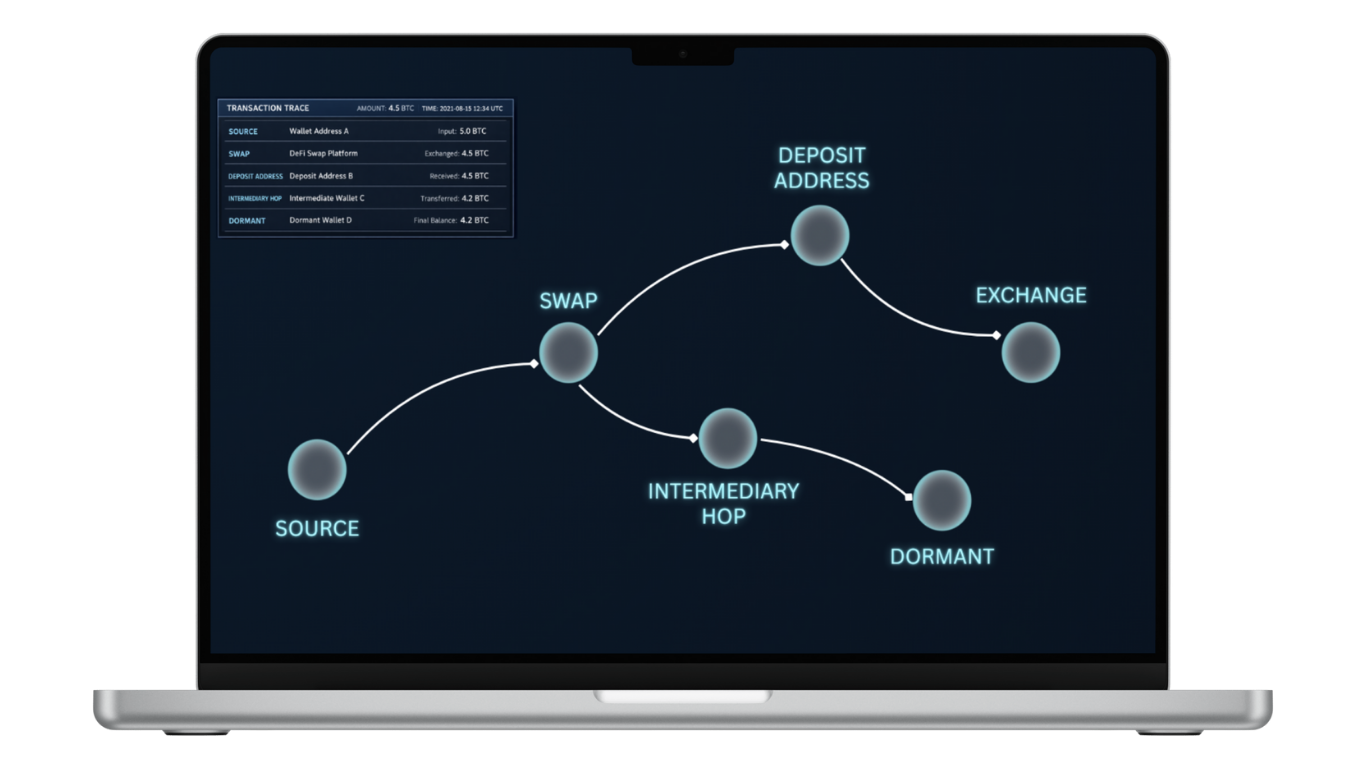
Blockchain forensics is the investigative process of analyzing cryptocurrency transactions to trace the flow of funds across public ledgers. It employs sophisticated clustering algorithms, address tagging, and behavioral analysis to de-anonymize wallet owners and map transaction paths. This enables organizations to detect fraud, comply with AML regulations, and recover stolen assets with evidential clarity.
Investigators gather raw transaction data from the target blockchain and parse it into a structured, searchable database for analysis.
Advanced heuristics and algorithms group related wallet addresses into entities and visually map the movement of funds between them.
Suspicious patterns are linked to known criminal entities or behaviors, culminating in court-admissible intelligence reports for clients.
Exchanges use forensics for mandatory customer due diligence (CDD) and to monitor for suspicious transaction patterns in real-time.
Banks integrate forensic tools to screen crypto transactions from VASPs, mitigating counterparty risk and satisfying AML/CFT obligations.
Agencies utilize forensic analysis to trace ransomware payments, darknet market proceeds, and other crypto-related crimes for prosecution.
Law firms employ forensic experts to trace and asset-trace in fraud cases, divorces, or bankruptcy proceedings involving digital assets.
Organizations holding crypto use forensics to audit internal wallets, screen vendor payments, and investigate potential internal fraud.
Bilarna simplifies your search by pre-vetting all listed blockchain forensics providers. Each firm is rigorously evaluated using our proprietary 57-point AI Trust Score, which assesses technical expertise, compliance history, and verified client feedback. This ensures you only compare qualified, reliable partners for your critical investigations.
Modern forensic tools are highly accurate in tracing fund flows across transparent public ledgers like Bitcoin and Ethereum. Their effectiveness relies on advanced clustering techniques and extensive off-chain data to link pseudonymous addresses to real-world entities. However, challenges remain with privacy coins or complex obfuscation methods like coin mixers.
Costs vary significantly based on case complexity, from subscription-based SaaS tools for ongoing monitoring to retainers for deep-dive investigations. Pricing models often include software licensing fees, consulting hours, and retainer agreements for expert testimony. The scope of the investigation and required reporting depth are the primary cost drivers.
Forensic analysis is crucial for recovery efforts by identifying the destination wallets and tracing the path of stolen funds. While forensics provides the investigative map, actual recovery typically requires legal action, such as working with exchanges to freeze assets or obtaining court orders. Success depends on the speed of response and the thieves' subsequent laundering techniques.
Investigators synthesize on-chain data with a wide array of off-chain intelligence. This includes exchange Know-Your-Customer (KYC) data, IP address information, forum and social media chatter, and dark web market listings. Correlating these sources is essential to de-anonymize actors and establish intent.
Regulations like MiCA dramatically increase demand by imposing strict AML/CFT obligations on Virtual Asset Service Providers (VASPs). These rules require continuous transaction monitoring and suspicious activity reporting, which are core forensic functions. Compliance-driven demand is now a major growth driver for the forensic industry.
Smart contracts are used in enterprise blockchain solutions to automate complex business processes, enforce agreements without intermediaries, and significantly reduce operational costs and manual errors. These self-executing contracts are deployed on blockchain platforms to manage and execute terms automatically when predefined conditions are met. Common enterprise applications include automating supply chain payments upon delivery verification, managing and executing royalty distributions in intellectual property agreements, and facilitating secure, instant settlement in trade finance. They are also foundational for creating decentralized autonomous organizations (DAOs), tokenizing real-world assets like real estate or carbon credits, and building transparent, tamper-proof voting systems for corporate governance. By leveraging smart contracts, enterprises can achieve greater transparency, enhance auditability, and streamline workflows across departments and with external partners.
A business can assess its readiness for blockchain adoption by evaluating its strategic need, internal resources, and specific use case viability. First, identify a clear business problem that blockchain can solve, such as the need for enhanced traceability in a supply chain or secure, automated contracts. Second, conduct an internal audit of technical expertise, financial resources, and IT infrastructure to determine if you have the capability to support integration or if you require external partners. Third, analyze the specific use case for ROI potential and alignment with long-term digital transformation goals. A practical step is to initiate a small-scale proof of concept (PoC) project to test feasibility and demonstrate value before committing to a full-scale implementation. This structured assessment helps companies mitigate risk and ensure a successful transition to Web3 technologies.
The first step for a company to transition to blockchain technology is to identify specific processes that would benefit from decentralization, such as supply chain tracking, digital identity, or payment systems. Next, select a suitable blockchain platform based on scalability, security, and cost — common choices include Ethereum, Hyperledger, or private blockchains. Then, engage a blockchain development firm to design and build a decentralized application (DApp) that meets your business needs. The development involves creating smart contracts and, if appropriate, a token model for pay-per-use or incentivization. After development, run a pilot test in a controlled environment to validate functionality and performance. Once successful, deploy the solution, train staff, and integrate it with existing systems. Continuous monitoring and iteration are essential. Partnering with experienced blockchain developers helps bridge the gap between traditional networks and this transformative technology.
Integrating artificial intelligence with blockchain technology involves using AI's analytical power alongside blockchain's decentralized security to boost business performance. This synergy enables predictive analysis for risk management, incentivizes data sharing through cryptographic tokens, and increases transaction transparency. AI algorithms can automate decision-making processes, while blockchain ensures data integrity and auditability. For example, machine learning can analyze blockchain data for trends, and generative AI can improve communication systems. Combined, they facilitate efficient operations across web and mobile platforms, support the automation of smart contracts, and enable advanced applications like decentralized finance (DeFi) and secure identity management. This integration helps businesses achieve optimization, reduce costs, and drive innovation by leveraging real-time insights and secure, tamper-proof records.
Certify and evaluate artworks digitally by following these steps: 1. Register the artist’s signature on the platform to establish authenticity. 2. Use the digital Art Coefficient tool to evaluate and certify the artwork’s value. 3. Generate a digital certificate that records the artwork’s provenance and valuation. 4. Store this certificate securely on the blockchain to ensure transparency and disintermediation.
Automation in digital asset workflows significantly enhances the management of blockchain platforms by reducing manual intervention and minimizing errors. It streamlines processes such as asset issuance, transaction processing, compliance checks, and reporting. Automated workflows enable faster execution of repetitive tasks, improving operational efficiency and scalability. This reduces the risk of human error, which is critical in handling sensitive digital assets. Furthermore, automation supports real-time monitoring and alerts, allowing for proactive management of potential issues. By integrating automation, organizations can ensure consistent and reliable operations, maintain regulatory compliance, and focus resources on strategic activities rather than routine tasks.
Blockchain and AI capabilities are integrated into custom software development to create more secure, intelligent, and autonomous systems. Blockchain technology provides decentralized, immutable ledgers for transactions, which is implemented through smart contracts for automated agreements and enhanced security protocols for data integrity. AI capabilities, including Natural Language Processing (NLP), Machine Learning, and Retrieval-Augmented Generation (RAG), enable software to analyze data, automate workflows, and power intelligent agentic bots. In practice, this integration might involve building secure supply chain solutions with blockchain-backed provenance tracking combined with AI-powered demand forecasting. Another application is developing decentralized finance platforms where smart contracts automate transactions while AI algorithms provide personalized financial advice. The development process requires specialized expertise in both domains, focusing on strategic advisory for use case identification, secure integration with existing systems, and ensuring compliance with relevant data protection and financial regulations.
Implement blockchain certification solutions to enhance document security by ensuring authenticity and preventing tampering. Steps: 1. Integrate a blockchain-based certification system into your document management process. 2. Register documents on the blockchain to create immutable proof of authenticity. 3. Use cryptographic verification to validate documents at any time. 4. Monitor and audit document access and changes transparently through the blockchain ledger.
Blockchain solutions improve business process integration and compliance by providing a decentralized, immutable ledger that securely records transactions across multiple parties. This technology enables real-time data sharing, reduces reconciliation efforts, and ensures transparency throughout the supply chain. In terms of compliance, blockchain automates audit trails, simplifies regulatory reporting, and enhances data integrity. Smart contracts further streamline processes by automatically executing agreed-upon terms when conditions are met, reducing manual intervention and errors. For industries like finance, healthcare, and logistics, blockchain helps meet strict compliance requirements while lowering operational costs. By integrating blockchain with existing ERP and CRM systems, companies can achieve end-to-end visibility, faster settlement times, and a single source of truth, ultimately building trust among stakeholders and customers.
Blockchain technology is applied in regulated industries to enhance data security, ensure compliance, and enable secure transactions through immutable and transparent ledgers. In healthcare, it secures patient records by providing encrypted, tamper-proof storage, manages data consent with auditable trails, and tracks pharmaceutical supply chains to prevent fraud. In finance, blockchain facilitates secure payments, reduces fraud through transparent transaction logs, and supports regulatory reporting with automated compliance checks. The technology is designed for scalability and adaptability, allowing systems to evolve with business needs while meeting strict regulatory requirements such as GDPR or HIPAA. Key applications include protecting sensitive information, automating compliance processes, and creating interoperable systems that trustlessly share data across organizations, thereby improving efficiency and trust in high-stakes sectors.