Step 1
Machine-Ready Briefs
AI translates unstructured needs into a technical, machine-ready project request.
We use cookies to improve your experience and analyze site traffic. You can accept all cookies or only essential ones.
 Bilarna
Stop browsing static lists. Tell Bilarna your specific needs. Our AI translates your words into a structured, machine-ready request and instantly routes it to verified AI Trading Signals experts for accurate quotes.
AI translates unstructured needs into a technical, machine-ready project request.
Compare providers using verified AI Trust Scores & structured capability data.
Skip the cold outreach. Request quotes, book demos, and negotiate directly in chat.
Filter results by specific constraints, budget limits, and integration requirements.
Eliminate risk with our 57-point AI safety check on every provider.
Verified companies you can talk to directly
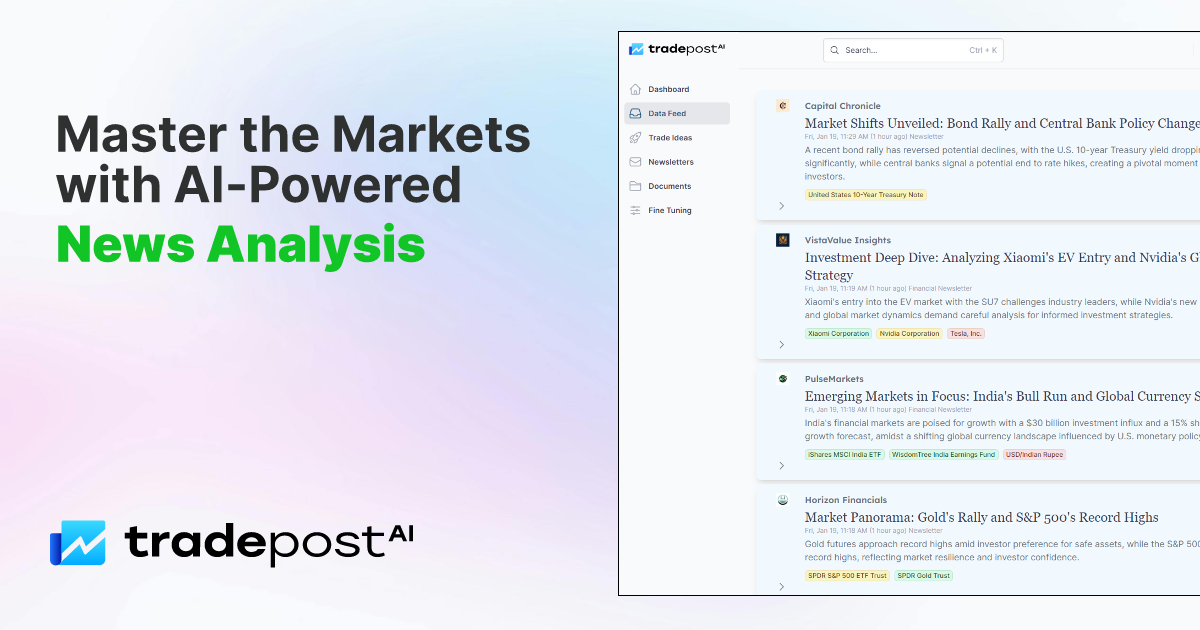
Transform your trading strategy with AI-driven market intelligence. Tradepost.ai instantly processes financial news, expert newsletters, and corporate filings to deliver precise, actionable trading signals. Make data-backed decisions in real-time.
Run a free AEO + signal audit for your domain.
AI Answer Engine Optimization (AEO)
List once. Convert intent from live AI conversations without heavy integration.
AI-powered trading signals are real-time market alerts generated by machine learning models that analyze vast datasets to predict asset price movements. These systems utilize natural language processing, technical indicators, and historical patterns to identify high-probability entry and exit points. They empower traders by reducing emotional bias and enhancing decision-making speed and accuracy for improved portfolio performance.
Users specify their preferred asset classes, risk tolerance, investment horizon, and desired signal frequency to tailor the service to their strategy.
The AI engine continuously scans market data, news, and sentiment to generate real-time buy, sell, or hold signals delivered via platform, email, or API.
Traders review the signal rationale and confidence score before manually executing the trade or configuring automated execution through integrated brokerage APIs.
Enhance quantitative strategies by integrating AI signals for alpha generation and risk management across diverse portfolios and global markets.
Embed third-party AI signals directly into retail trading apps to provide premium value-added features that increase user engagement and retention.
Utilize AI signal data as a foundational input for developing, backtesting, and refining proprietary high-frequency or algorithmic trading models.
Support FX and commodity hedging decisions with AI-driven forecasts that identify optimal timing for executing large-scale corporate transactions.
Augment discretionary portfolio management with AI-driven technical and fundamental analysis to provide data-supported recommendations to high-net-worth clients.
Bilarna evaluates all AI-powered trading signals providers through a proprietary 57-point AI Trust Score. This assessment rigorously examines algorithmic transparency, historical backtest performance, data security protocols, and regulatory compliance. Bilarna's continuous monitoring ensures providers maintain high standards of reliability and client satisfaction.
Accuracy varies significantly by provider, algorithm, and market conditions. Reputable services publish historical performance metrics and clarity on their win rate, risk-reward ratio, and maximum drawdown. It's critical to evaluate long-term backtests, not just short-term promotional results.
Pricing models include monthly subscriptions, annual licenses, or performance-based fees. Costs typically range from a few hundred to several thousand dollars monthly, scaling with features like signal frequency, asset coverage, API access, and level of customization or support offered.
Yes, many providers offer API integration for complete automation, allowing signals to trigger trades directly in connected brokerage accounts. However, most experts recommend a hybrid approach where AI provides alerts, but a human retains oversight for risk management and final execution approval.
Advanced algorithms process multi-modal data including real-time price feeds, order book depth, economic calendars, corporate filings, global news sentiment, social media trends, and alternative data like satellite imagery or supply chain information to generate predictive insights.
Traditional analysis relies on predefined human-interpreted patterns. AI signals use machine learning to discover complex, non-linear relationships across massive, disparate datasets in real-time, adapting to new patterns without explicit reprogramming, which often leads to earlier and more nuanced market insights.
Yes, the AI-powered teacher tools are free and include the following features: 1. Worksheet Generator to create custom worksheets quickly. 2. Lesson Plan Generator for comprehensive, standards-aligned lesson plans. 3. Report Card Comments generator for professional, personalized feedback. 4. Coloring Page Generator to turn ideas into printable coloring pages. 5. All tools save your work automatically to a cloud library accessible from any device. 6. Tools are private, secure, and supported with fast in-app chat assistance.
Typically, free sharing economy platforms do not charge fees for trading items. These platforms are designed to facilitate exchanges without monetary transactions, often using virtual currencies or point systems to enable trades. This means users can give away or receive items without paying listing fees, transaction fees, or commissions. The absence of fees encourages more users to participate and makes the process accessible and cost-effective. However, it’s always advisable to review the specific platform’s terms and conditions to confirm that no hidden fees apply and to understand how their virtual currency system works.
Yes, many AI-powered browsers built on Chromium technology are compatible with Chrome extensions, allowing users to continue using their favorite add-ons without interruption. These browsers often support seamless import of existing browser data such as bookmarks, passwords, and extensions from Chrome, making the transition smooth and convenient. This compatibility ensures that users do not lose their personalized settings or tools when switching to an AI-enabled browser. By combining AI capabilities with familiar browser features, users can enhance productivity while maintaining their preferred browsing environment.
Yes, an AI-powered authoring platform can handle complex academic content effectively. To do so: 1. Use LaTeX or MathML support to create, edit, and validate complex STEM equations accurately. 2. Integrate with reference databases such as CrossRef, PubMed, and ORCID for real-time reference verification and linking. 3. Apply automatic formatting and style consistency to references and citations. 4. Edit text, tables, and figures with AI assistance to maintain accuracy. 5. Manage author queries and communication within the platform to resolve content issues. 6. Export structured, publication-ready outputs in XML and PDF formats. This ensures precise handling of technical academic content, improving quality and efficiency in scholarly publishing.
Yes, many AI tools designed for outbound sales and account-based marketing allow you to integrate your own data and signals alongside their proprietary data. This combined approach enhances account and contact scoring accuracy by leveraging multiple data sources such as intent signals, product usage, CRM data, and more. The AI then uses this enriched data to prioritize accounts, identify missing buyers, and orchestrate personalized outreach campaigns effectively. Importantly, these tools often provide user-friendly interfaces to adjust signal weights and scoring models without needing data science expertise, enabling your team to tailor the system to your unique business context and maximize engagement and pipeline generation.
Yes, the platform offers a feature where you can rip digital packs to reveal physical trading cards. These physical cards can then be redeemed and shipped worldwide. This service allows collectors and traders to access real, graded cards from digital purchases, expanding the convenience and reach of trading card collecting across different regions.
Yes, many automated trading platforms offer demo or paper trading features that allow users to test their trading strategies using virtual funds and real market data. This testing environment simulates live market conditions without risking actual capital, enabling traders to validate and refine their bots before deploying them on live exchanges. Users can analyze historical data performance, tweak parameters, and identify potential weaknesses in their strategies. Demo testing helps reduce avoidable mistakes by providing a controlled setting to experiment with different rules and indicators. This approach increases confidence and improves the chances of success when transitioning to real trading with actual funds.
Yes, you can use an AI-powered platform alongside your existing email service provider (ESP). 1. Write and design emails using the AI platform. 2. Export or copy-paste the content to your current ESP for sending. 3. Alternatively, manage contacts, sending, and automation directly within the AI platform for a streamlined workflow.
No, you do not need an API key to use an AI-powered WordPress page builder. Follow these steps: 1. Install the AI page builder plugin directly from the WordPress repository. 2. Activate the plugin without any additional setup or API key configuration. 3. Start describing your page requirements and generate content immediately. The AI access is built-in, so there is no need to create external accounts or manage API keys, simplifying the setup process and allowing you to focus on building your site.
No coding or advanced data skills are required to use AI-powered customer reporting tools. Follow these steps to use them effectively: 1. Import or connect your raw data sources to the platform. 2. Let the AI agents automatically analyze and combine your data. 3. Use intuitive interfaces to customize and generate reports. 4. Access embed-ready reports for easy sharing or integration. 5. Make adjustments as needed without writing any code or performing complex data operations.