Step 1
Machine-Ready Briefs
AI translates unstructured needs into a technical, machine-ready project request.
We use cookies to improve your experience and analyze site traffic. You can accept all cookies or only essential ones.
 Bilarna
Stop browsing static lists. Tell Bilarna your specific needs. Our AI translates your words into a structured, machine-ready request and instantly routes it to verified Energy Data Platform experts for accurate quotes.
AI translates unstructured needs into a technical, machine-ready project request.
Compare providers using verified AI Trust Scores & structured capability data.
Skip the cold outreach. Request quotes, book demos, and negotiate directly in chat.
Filter results by specific constraints, budget limits, and integration requirements.
Eliminate risk with our 57-point AI safety check on every provider.
Verified companies you can talk to directly
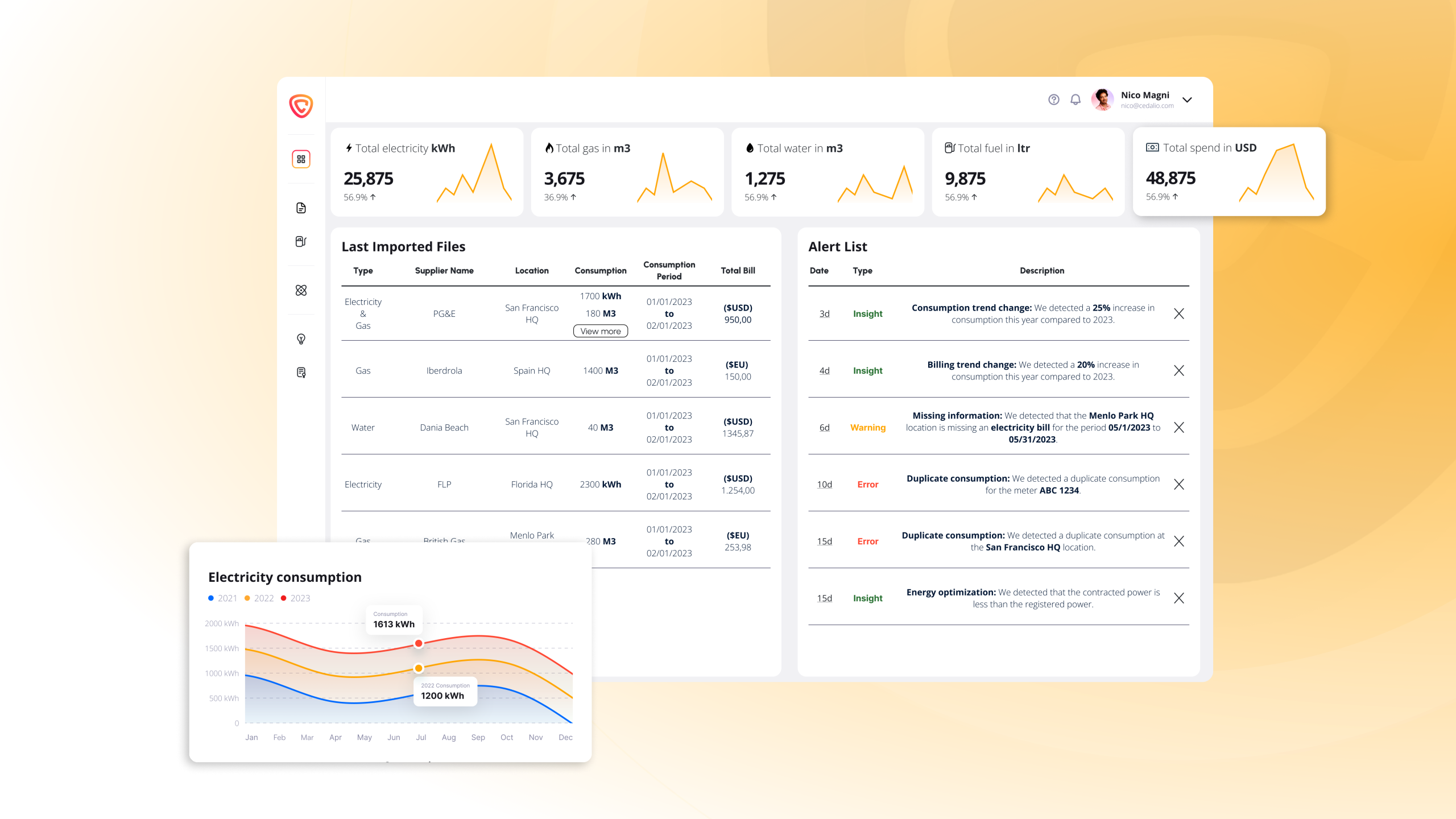
Upload your utility or gas bills, and we’ll handle the rest. Cedalio captures, organizes, and analyzes your energy consumption data with AI, giving sustainability leaders real-time insights, automated anomaly alerts, and GRI-compliant reports—instantly.
Run a free AEO + signal audit for your domain.
AI Answer Engine Optimization (AEO)
List once. Convert intent from live AI conversations without heavy integration.
An Energy Data Platform is a centralized software solution that enables the collection, management, and analysis of energy data from diverse sources. It integrates technologies like IoT sensors, cloud storage, and analytics tools to process data in real-time. This allows businesses to gain transparency, optimize consumption, and sustainably reduce operational costs.
Identify the data sources to integrate, such as smart meters, building management systems, or ERP software, to establish a comprehensive data foundation.
The platform consolidates data streams and applies analytical models to automatically identify consumption patterns and savings potentials.
Based on the insights gained, businesses can automate processes, forecast demand, and continuously improve energy efficiency.
Provides real-time insights into grid loads and consumption data to enhance grid stability and develop flexible tariff models.
Monitors energy consumption of machinery and plants, identifies inefficiencies, and reduces production costs per unit.
Enables portfolio-wide monitoring of multi-building assets, optimizes HVAC systems, and lowers operational overheads.
Manages distributed generation assets, forecasts energy output, and improves integration into the power grid.
Analyzes energy demand across stores and distribution centers to avoid peak loads and achieve sustainability targets.
Bilarna evaluates Energy Data Platform providers using a proprietary 57-point AI Trust Score. This score continuously assesses technical expertise, project portfolios, data security certifications, and client satisfaction metrics. Only vetted providers with a high trust score are listed on our marketplace, ensuring your selection process is both secure and efficient.
Costs vary significantly based on scope, required integrations, and user scale. Basic solutions start in the low five-figure range, while comprehensive enterprise platforms can require six-figure investments. The final price depends on your specific data and analytical requirements.
Implementation typically takes between 3 and 9 months. Cloud-based SaaS solutions deploy faster, while complex on-premise integrations with legacy systems require more time. The duration is largely dictated by data migration complexity.
Modern platforms integrate diverse sources including smart meters, building automation systems (BACnet, Modbus), SCADA, IoT sensors, and enterprise software like ERP. Standardized APIs and protocols ensure seamless data connectivity across these systems.
A dedicated Energy Data Platform provides a more extensive data foundation and analytical capabilities than a basic EMS. It acts as a central data hub enabling cross-site analytics, forecasting, and automation, rather than just metering consumption.
Payback is typically achieved within 2-4 years through significant energy savings, reduced manual workload, and avoided grid charges. Concrete savings of 10-25% of the energy budget are realistically achievable through data-driven optimizations.
Many multi-supplier purchasing platforms designed for veterinary clinics offer free access to veterinary hospitals and nonprofit organizations. These platforms aim to reduce ordering time and simplify the procurement process without charging clinics for usage. By aggregating multiple suppliers into one interface, clinics can efficiently manage orders and save on supplies without incurring additional fees. However, it is important for clinics to verify the specific terms and conditions of each platform, as some may have optional paid features or services.
To understand data upload limits and payment requirements on analytics platforms, follow these steps: 1. Review the platform's account types, such as free and paid plans. 2. Check the data upload limits for each plan; free accounts often have row limits per upload. 3. Determine if a credit card is required for free or paid accounts. 4. Understand the cancellation policy for paid subscriptions, which usually allows cancellation at any time.
Typically, free sharing economy platforms do not charge fees for trading items. These platforms are designed to facilitate exchanges without monetary transactions, often using virtual currencies or point systems to enable trades. This means users can give away or receive items without paying listing fees, transaction fees, or commissions. The absence of fees encourages more users to participate and makes the process accessible and cost-effective. However, it’s always advisable to review the specific platform’s terms and conditions to confirm that no hidden fees apply and to understand how their virtual currency system works.
Generally, there are no specific national subsidies for installing dormers alone, as they are considered home extensions. However, if the dormer installation includes energy-saving measures such as enhanced insulation, you may qualify for certain subsidies or sustainable energy loans. Additionally, some municipalities offer local grants or loans for home improvements and energy efficiency upgrades. It is advisable to check with your local government to see if any regional programs apply to your project.
Yes, AI RFP software typically integrates with a wide range of existing business tools such as CRM platforms, collaboration software, cloud storage services, and knowledge management systems. This seamless integration allows users to leverage their current data sources and workflows without disruption. Regarding security, reputable AI RFP solutions prioritize data protection through measures like end-to-end encryption, compliance with standards such as SOC 2, GDPR, and CCPA, and role-based access controls. Data is never shared with third parties, ensuring confidentiality and compliance with privacy regulations.
Yes, many AI-powered browsers built on Chromium technology are compatible with Chrome extensions, allowing users to continue using their favorite add-ons without interruption. These browsers often support seamless import of existing browser data such as bookmarks, passwords, and extensions from Chrome, making the transition smooth and convenient. This compatibility ensures that users do not lose their personalized settings or tools when switching to an AI-enabled browser. By combining AI capabilities with familiar browser features, users can enhance productivity while maintaining their preferred browsing environment.
Yes, an AI-powered authoring platform can handle complex academic content effectively. To do so: 1. Use LaTeX or MathML support to create, edit, and validate complex STEM equations accurately. 2. Integrate with reference databases such as CrossRef, PubMed, and ORCID for real-time reference verification and linking. 3. Apply automatic formatting and style consistency to references and citations. 4. Edit text, tables, and figures with AI assistance to maintain accuracy. 5. Manage author queries and communication within the platform to resolve content issues. 6. Export structured, publication-ready outputs in XML and PDF formats. This ensures precise handling of technical academic content, improving quality and efficiency in scholarly publishing.
Anonymous statistical data cannot usually be used to identify individual users without legal authorization. To ensure this: 1. Collect data without personal identifiers or tracking information. 2. Avoid combining datasets that could reveal user identities. 3. Use data solely for aggregated statistical analysis. 4. Obtain a subpoena or legal order if identification is necessary. 5. Maintain strict data governance policies to protect user anonymity.
Yes, beginners can learn dance using an online platform with AI feedback. 1. Sign up on the platform designed specifically for beginners. 2. Access expert video dance tutorials created by experienced tutors. 3. Record your dance performance using the platform's tools. 4. Receive instant AI feedback that analyzes your dance and suggests corrections. 5. Practice regularly using the feedback to improve your skills.
Many modern data analytics platforms are designed to integrate seamlessly with your existing technology infrastructure. This means you do not need to replace your current systems to start using the platform. These solutions are built with flexibility in mind, allowing them to sit on top of your existing ecosystem without requiring extensive integration work on your part. This approach helps organizations adopt new analytics capabilities quickly while preserving their current investments in technology. It is advisable to check with the platform provider about specific integration options and compatibility with your current setup.