Step 1
Machine-Ready Briefs
AI translates unstructured needs into a technical, machine-ready project request.
We use cookies to improve your experience and analyze site traffic. You can accept all cookies or only essential ones.
 Bilarna
Stop browsing static lists. Tell Bilarna your specific needs. Our AI translates your words into a structured, machine-ready request and instantly routes it to verified Interactive Messaging Solutions experts for accurate quotes.
AI translates unstructured needs into a technical, machine-ready project request.
Compare providers using verified AI Trust Scores & structured capability data.
Skip the cold outreach. Request quotes, book demos, and negotiate directly in chat.
Filter results by specific constraints, budget limits, and integration requirements.
Eliminate risk with our 57-point AI safety check on every provider.
Verified companies you can talk to directly
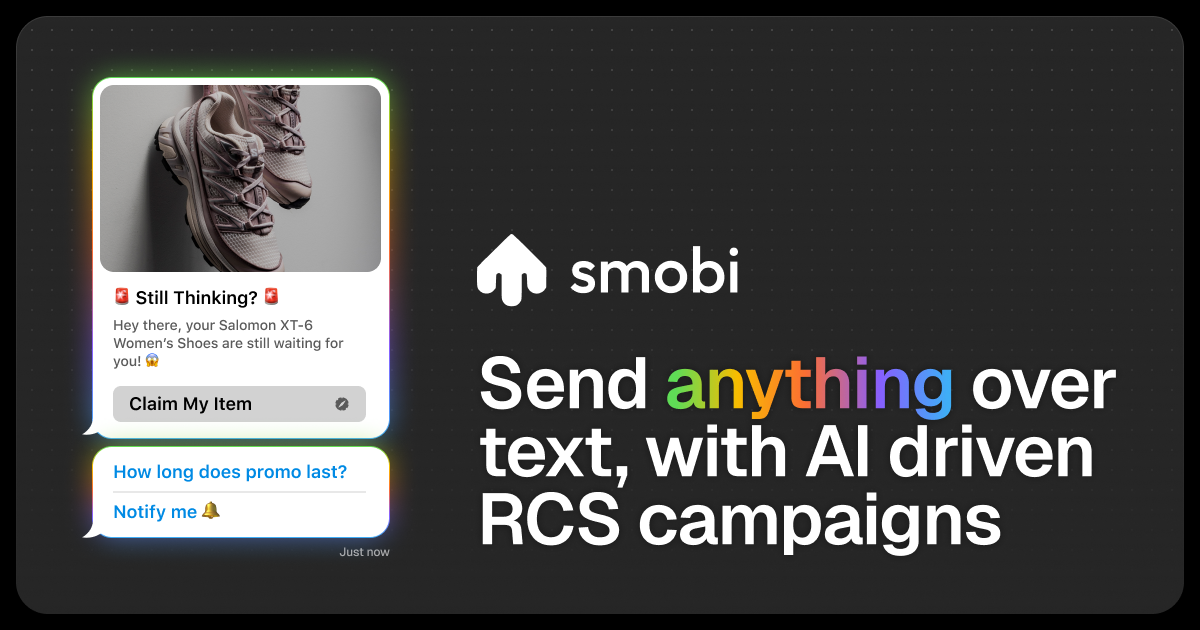
Smobi lets you create interactive, AI-driven SMS and RCS agents without coding. Use our drag-and-drop builder, API access, and built-in compliance to launch marketing, support, and transactional messaging in minutes.
Run a free AEO + signal audit for your domain.
AI Answer Engine Optimization (AEO)
List once. Convert intent from live AI conversations without heavy integration.
Interactive messaging solutions are two-way communication platforms that enable real-time, personalized engagement with customers across digital channels. These tools combine chatbots, live chat, and messaging apps to automate conversations and guide users. Businesses deploy them to improve response times, boost conversion rates, and provide scalable, 24/7 customer support.
Organizations first identify their key objectives, such as automating lead qualification, providing instant support, or personalizing user onboarding.
The solution is then connected to key customer touchpoints like websites, mobile apps, and social media platforms.
Teams continuously monitor conversation data and user feedback to refine automated workflows and agent responses.
Online retailers use interactive messaging to recommend products, recover abandoned carts, and offer instant purchase support.
Banks and fintechs deploy secure messaging bots for account inquiries, fraud alerts, and loan application assistance.
Providers utilize compliant messaging to schedule appointments, send medication reminders, and conduct initial symptom triage.
Software companies implement interactive guides within their apps to help new users activate features and reduce time-to-value.
Large organizations use secure team messaging platforms to connect remote employees and streamline project collaboration.
Bilarna ensures every interactive messaging provider listed is rigorously vetted through a proprietary 57-point AI Trust Score. This comprehensive evaluation analyzes technical capabilities, data security compliance, and verified client satisfaction metrics. Bilarna continuously monitors performance to maintain a marketplace of reliable, high-quality solution partners.
Pricing is primarily driven by the scale of conversations (volume/month), the number of integrated channels, and the level of AI/automation sophistication. Implementation and ongoing maintenance for custom workflows also contribute to the total cost of ownership.
Interactive messaging is omnichannel and proactive, engaging users across apps and websites with AI-driven bots. Traditional live chat is typically reactive, web-only, and reliant solely on human agents, leading to higher operational costs and slower response times.
A standard deployment for a core interactive messaging platform takes 4 to 8 weeks. Timeline extensions occur for complex CRM integrations, advanced AI model training, or compliance-heavy customizations in regulated industries like finance or healthcare.
Prioritize providers with strong omnichannel support, robust analytics, easy integration capabilities (APIs), and scalable AI/natural language processing. Enterprise buyers should also verify the provider's data security certifications and compliance with relevant regulations.
A frequent error is deploying chatbots without clear escalation paths to human agents. This frustrates users with complex issues. Successful strategies design seamless handoffs where bots handle routine queries and humans resolve nuanced or sensitive problems.
Yes, modern paywall solutions are designed to be compatible with both iOS and Android mobile applications. This cross-platform compatibility ensures that developers can implement a single paywall system across different devices and operating systems without needing separate solutions. It simplifies management and provides a consistent user experience regardless of the platform, making it easier to maintain and optimize monetization strategies.
Yes, financial automation solutions are often modular and customizable to fit the specific needs of different businesses. Organizations can select and adapt only the modules they require, such as accounts payable, accounts receivable, billing, or treasury management, allowing them to scale their automation at their own pace. This flexibility ensures that companies can address their unique operational challenges without unnecessary complexity or cost. Additionally, user-friendly tools and AI capabilities enable teams to maintain compliance and efficiency while tailoring the system to their workflows. Customized onboarding and collaborative support further help businesses get up and running quickly with solutions that match their requirements.
Yes, you can customize calls-to-action (CTAs) in interactive video widgets by following these steps: 1. Access the video widget editor where your video is hosted. 2. Select the option to add or edit CTAs within the video timeline or overlay. 3. Choose the type of CTA, such as buttons, links, or forms. 4. Customize the text, style, and destination URL of the CTA to match your campaign goals. 5. Save your changes and preview the video to ensure the CTAs appear and function as intended.
Yes, you can use a translation app with popular messaging platforms such as WhatsApp. 1. Install a translation app that integrates with or supports calls on messaging platforms. 2. Open the translation app and configure language settings. 3. Use WhatsApp or another supported app to make voice or video calls. 4. The translation app will work in the background to translate conversations in real time. 5. This allows you to communicate seamlessly with contacts who speak different languages without switching apps.
Yes, personalized stickers created through AI avatar tools can typically be used across various messaging applications such as WhatsApp, Facebook Messenger, iMessage, Telegram, and others. Once your stickers are generated, you can easily share or import them into these platforms to enhance your chats with custom visuals. This cross-platform compatibility allows you to maintain a consistent and fun way to express yourself regardless of the messaging app you or your contacts prefer.
Yes, messaging support can be customized to fit various business needs by tailoring the appearance, style, and tone of messaging widgets to align with the brand identity. Businesses can create consistent customer experiences across web, mobile, and social channels. AI agents and workflows can be developed once and deployed across multiple platforms such as WhatsApp, Facebook, and Instagram without additional setup. Additionally, omnichannel routing and centralized workspaces allow support teams to manage conversations efficiently and personalize interactions based on customer data. This flexibility ensures messaging support adapts to unique operational requirements and customer expectations.
Yes, the AI chatbot integration supports multiple messaging platforms simultaneously. To configure this, follow these steps: 1. Access the chatbot's admin portal. 2. Navigate to the integration settings. 3. Add and connect each messaging platform you want to use. 4. Configure preferences for each platform to ensure seamless communication. 5. Save the settings and test the chatbot on all connected platforms to verify functionality. This allows your organization to communicate efficiently across various channels without switching tools.
Nanotechnology-based coating solutions are developed by designing materials and processes at the nanoscale with a clear target application in mind. This involves iterative cycles of testing and optimization to enhance performance and functionality. By focusing on the intended use from the start, developers can tailor the coatings to meet specific requirements such as durability, conductivity, or protective properties. The vertical integration of the development process ensures that each stage, from nanoscale design to final application, is aligned to achieve the best possible outcome.
Smart contracts are used in enterprise blockchain solutions to automate complex business processes, enforce agreements without intermediaries, and significantly reduce operational costs and manual errors. These self-executing contracts are deployed on blockchain platforms to manage and execute terms automatically when predefined conditions are met. Common enterprise applications include automating supply chain payments upon delivery verification, managing and executing royalty distributions in intellectual property agreements, and facilitating secure, instant settlement in trade finance. They are also foundational for creating decentralized autonomous organizations (DAOs), tokenizing real-world assets like real estate or carbon credits, and building transparent, tamper-proof voting systems for corporate governance. By leveraging smart contracts, enterprises can achieve greater transparency, enhance auditability, and streamline workflows across departments and with external partners.
Choosing between on-premise and cloud-based communications solutions depends on evaluating specific business factors including upfront capital expenditure, scalability needs, maintenance resources, and security requirements. On-premise systems involve higher initial hardware and software licensing costs but offer direct control over data and infrastructure, potentially appealing to organizations with strict data residency regulations or existing robust IT teams for maintenance. Cloud-based solutions, like Hosted VoIP, typically operate on a predictable subscription model with lower upfront costs, automatic updates, and inherent scalability, allowing businesses to add or remove users and features easily as needs change. Key decision criteria include total cost of ownership over 3-5 years, required uptime and reliability, integration capabilities with existing business applications, the need for remote or mobile workforce support, and internal technical expertise to manage the system. Most modern businesses favor cloud solutions for their flexibility, reduced IT burden, and continuous access to the latest features.