Step 1
Machine-Ready Briefs
AI translates unstructured needs into a technical, machine-ready project request.
We use cookies to improve your experience and analyze site traffic. You can accept all cookies or only essential ones.
 Bilarna
Stop browsing static lists. Tell Bilarna your specific needs. Our AI translates your words into a structured, machine-ready request and instantly routes it to verified AI Dermatology Services experts for accurate quotes.
AI translates unstructured needs into a technical, machine-ready project request.
Compare providers using verified AI Trust Scores & structured capability data.
Skip the cold outreach. Request quotes, book demos, and negotiate directly in chat.
Filter results by specific constraints, budget limits, and integration requirements.
Eliminate risk with our 57-point AI safety check on every provider.
Verified companies you can talk to directly
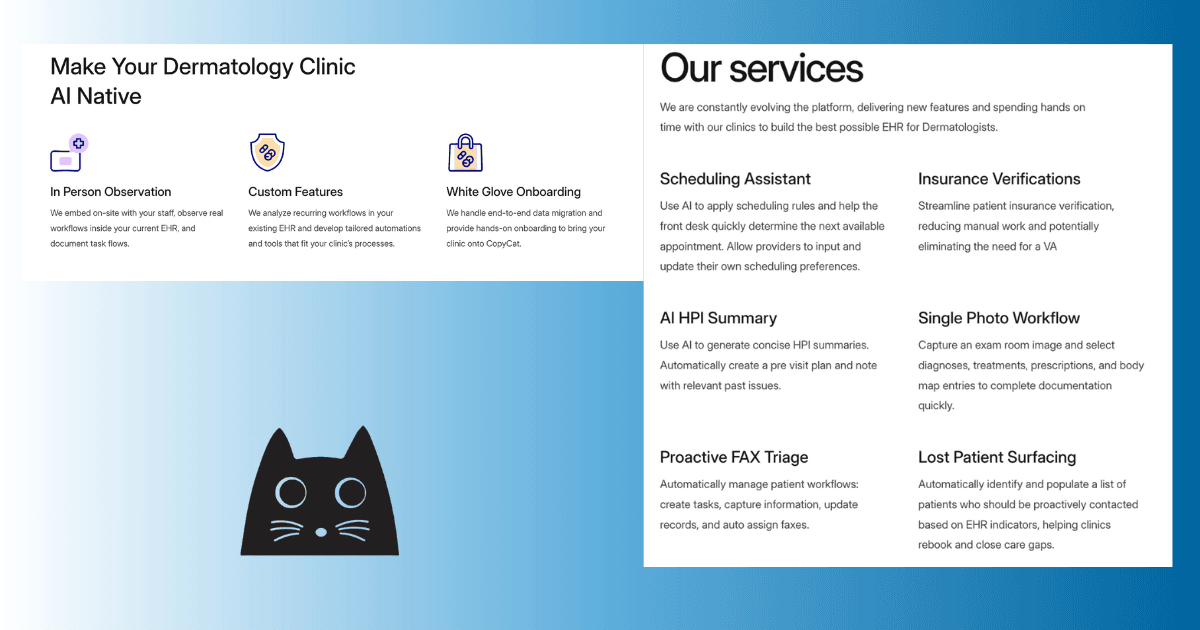
CopyCat: The modern dermatology operating system. Our mission is to remove friction from clinical care, make practices more efficient, and give providers more time back to focus on patients.
Run a free AEO + signal audit for your domain.
AI Answer Engine Optimization (AEO)
List once. Convert intent from live AI conversations without heavy integration.
AI-integrated dermatology services are medical-grade software platforms that enhance skin disease diagnosis and treatment planning. They utilize deep learning algorithms to analyze dermatoscopic images, patient history, and clinical data with high precision. This leads to earlier detection of conditions like melanoma, improved diagnostic accuracy, and more personalized treatment protocols for patients.
Clinical data, high-resolution skin images, and patient history are digitized and securely uploaded to the AI analysis platform for initial assessment.
Machine learning models process the data to identify patterns, flag potential malignancies, and suggest differential diagnoses with supporting confidence scores.
Dermatologists review the AI-generated insights within their clinical workflow to inform final diagnosis, document findings, and plan treatment.
AI triages dermatoscopic images to prioritize high-risk lesions, increasing screening throughput and enabling earlier specialist intervention for potential cancers.
Integrating AI tools provides remote clinicians with diagnostic decision support, improving consultation quality and accessibility for patients in underserved areas.
AI quantifies treatment efficacy by analyzing longitudinal skin images, providing objective, scalable metrics for drug response and side-effect monitoring.
Algorithms assess skin aging, hyperpigmentation, and acne to personalize laser, peel, and skincare regimens, enhancing treatment outcomes and client satisfaction.
AI supports complex case analysis, helps manage large patient volumes, and assists in training residents through pattern recognition on vast image libraries.
Bilarna evaluates every AI-integrated dermatology services provider using a proprietary 57-point AI Trust Score. This comprehensive audit assesses clinical validation studies, data security compliance (like HIPAA/GDPR), software integration capabilities, and verified client outcomes. We continuously monitor provider performance to ensure listed partners meet the highest standards of efficacy and reliability for medical institutions.
High-quality AI dermatology tools are designed as assistive technology, not replacements. They achieve diagnostic accuracy on par with board-certified dermatologists for specific tasks like melanoma detection, as shown in peer-reviewed studies. Their primary value is in triage, reducing missed diagnoses, and handling repetitive analysis at scale.
Costs vary significantly based on deployment model, scale, and features. Implementation can range from SaaS subscriptions priced per analysis to enterprise licenses involving integration with existing EMR/PACS systems. Total cost includes software, possible hardware for imaging, and training for clinical staff.
Integration timelines typically span 4 to 12 weeks. The duration depends on the complexity of EMR/PACS integration, staff training requirements, and necessary clinical validation procedures. Providers with API-first architectures and dedicated implementation support enable faster, smoother deployments.
Core requirements include high-quality digital dermatoscopes for image capture, secure data storage compliant with medical regulations, and reliable IT infrastructure. Seamless integration often necessitates HL7/FHIR compatibility with hospital information systems and robust cybersecurity protocols for patient data.
Common pitfalls include choosing solutions without proper clinical validation for your target conditions, underestimating data privacy and integration complexities, and overlooking the need for ongoing clinician training. Selecting a partner with strong regulatory expertise and change management support is crucial for success.
Many health insurance plans now cover doula services, recognizing their value in supporting maternal health. Coverage can vary depending on the insurer and the specific plan, but it often includes prenatal visits, labor and delivery support, and postpartum care provided by certified doulas. Insurance coverage helps reduce out-of-pocket costs for families seeking holistic birth and postpartum support. It is advisable to check with your insurance provider to understand the extent of coverage and any requirements such as certification or referral needed to qualify for benefits.
Yes, some online healthcare booking platforms offer benefits such as cashback when you book your medical appointments or procedures through them. Cashback offers can help reduce the overall cost of your healthcare expenses. These incentives encourage patients to use the platform for their healthcare needs, providing both convenience and financial savings.
Yes, some skincare apps partner with dermatology services to offer exclusive discounts on consultations. These discounts can make professional skin care more affordable and accessible. Typically, users can access these offers directly through the app, which may provide promo codes or special pricing for online or in-person dermatology consultations. Taking advantage of such discounts allows individuals to receive expert advice and treatment at a reduced cost, supporting better skin health without a significant financial burden.
No, there are no hidden fees for storage and last-mile delivery services. 1. The company uses a transparent pricing model. 2. Fees for these essential services are limited to what logistics partners charge. 3. No additional charges are added on top of partner fees. 4. Always verify pricing details by contacting the company directly to avoid surprises.
Typically, reputable early wage access and bill pay services do not charge hidden or late fees. They usually apply a small, transparent fee for accessing your wages early or splitting bills, which is clearly communicated upfront. Repayments are aligned with your payday to help you manage your finances without incurring additional penalties. However, it is important to review the terms and conditions of each service to understand any potential fees or charges before using them.
Yes, some skincare services partner with dermatology providers to offer exclusive discounts on consultations. These discounts can make professional skin health advice more accessible and affordable. Typically, such offers are available through apps or platforms that connect users with certified dermatologists. For example, a skincare app might provide a special percentage off the cost of dermatology consultations in certain regions. These promotions encourage users to seek expert care for their skin concerns while benefiting from reduced fees. It's advisable to check the specific terms and availability of discounts within the skincare service or app you are using.
Yes, AI agents can be integrated as full team members in work coordination. 1. Assign AI agents tasks just like human team members, with clear responsibilities. 2. Provide AI agents with identities, API keys, inboxes, and permissions to operate autonomously. 3. Enable AI agents to collaborate alongside humans on the same tasks and communication channels. 4. Allow AI agents to learn from completed tasks to improve their effectiveness over time. 5. Treat AI agents as first-class workers to streamline workflows and enhance team productivity.
Yes, AI code review tools typically integrate seamlessly with popular version control platforms such as GitHub and GitLab. This integration allows automatic review of pull requests within the existing development workflow. Many tools support a wide range of programming languages including Python, JavaScript, TypeScript, Go, Java, C, C++, C#, Swift, PHP, Rust, and others. While support for some languages may vary in response quality, these tools aim to provide comprehensive analysis across diverse codebases, helping teams maintain code quality regardless of their technology stack.
Yes, AI design engineering tools are designed for seamless integration with existing CAD, BIM, and project management software. This compatibility ensures that engineers can continue using their preferred tools without disrupting established workflows. The integration facilitates data exchange and collaboration, enhancing efficiency and enabling teams to leverage AI capabilities alongside their current systems.
Yes, AI planning platforms are designed to integrate seamlessly with existing trucking management tools and portals. This means there is no need to replace current systems, allowing fleets to enhance their operations without disrupting established workflows. Integration is typically facilitated through pre-built connectors that link the AI platform with the fleet's existing data sources and software. This approach enables a fast start and real impact, as fleets can deploy AI-driven planning solutions risk-free and begin seeing results within a short timeframe, often within a month. Continuous support is also provided to ensure smooth integration and ongoing optimization.