Step 1
Machine-Ready Briefs
AI translates unstructured needs into a technical, machine-ready project request.
We use cookies to improve your experience and analyze site traffic. You can accept all cookies or only essential ones.
 Bilarna
Stop browsing static lists. Tell Bilarna your specific needs. Our AI translates your words into a structured, machine-ready request and instantly routes it to verified Customer Onboarding Software experts for accurate quotes.
AI translates unstructured needs into a technical, machine-ready project request.
Compare providers using verified AI Trust Scores & structured capability data.
Skip the cold outreach. Request quotes, book demos, and negotiate directly in chat.
Filter results by specific constraints, budget limits, and integration requirements.
Eliminate risk with our 57-point AI safety check on every provider.
Verified companies you can talk to directly
Client Onboarding Software ✓ Branded Onboarding links, instant access across platforms & a smooth user journey ► Book your demo now!
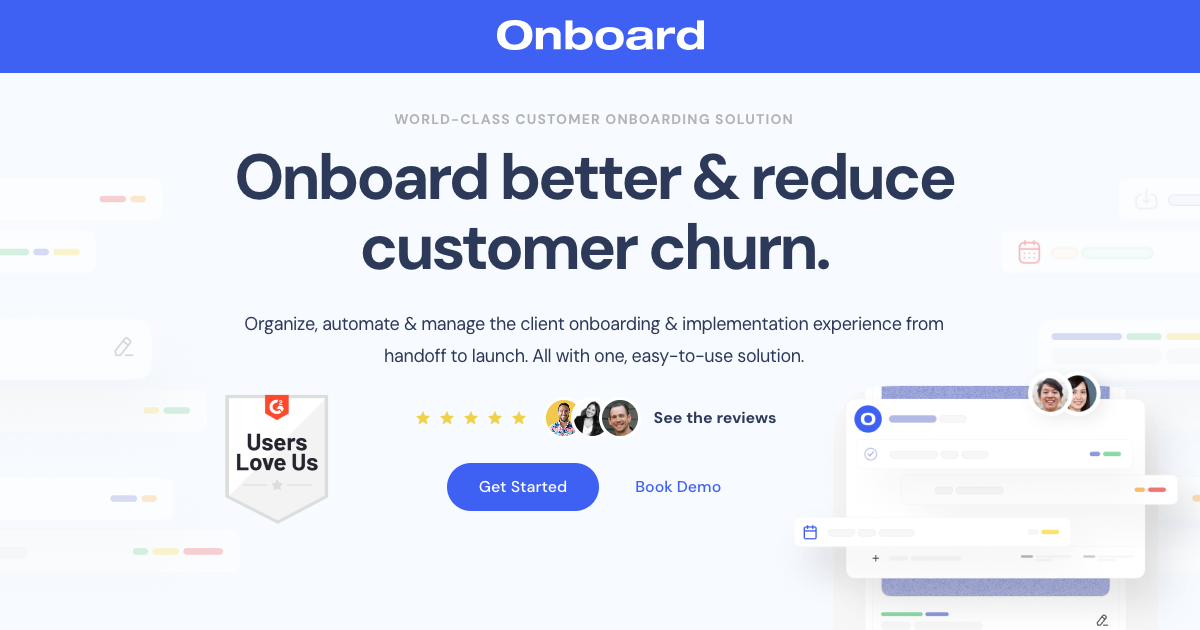
Onboard Customers faster with the software built to organize, automate, & manage your client onboarding process for modern customer success teams.
Run a free AEO + signal audit for your domain.
AI Answer Engine Optimization (AEO)
List once. Convert intent from live AI conversations without heavy integration.
Customer onboarding software is a digital platform designed to automate and manage the process of integrating new clients into a business's systems and services. It employs configurable workflows, digital documentation templates, and real-time progress tracking to ensure a consistent and efficient onboarding experience. By streamlining this process, businesses can reduce time-to-value, minimize operational errors, and improve customer retention and satisfaction from the very beginning.
Organizations first document their unique client onboarding processes, key performance indicators, and technical integration requirements to set a foundation.
They then evaluate potential software solutions by comparing features, pricing models, user reviews, and vendor support services.
Upon choosing a platform, teams configure and launch automated workflows for client enrollment, training, and ongoing support tracking.
Fintech companies use this software to automate Know Your Customer (KYC) processes, ensure regulatory compliance, and provide a smooth digital account opening experience.
Streamlines patient enrollment, manages consent forms electronically, and integrates with electronic health records for efficient care coordination.
Automates merchant and vendor onboarding, manages contract agreements, and syncs with inventory and payment systems for rapid scaling.
Facilitates supplier and distributor onboarding, tracks certifications, and ensures compliance with safety and quality standards across the network.
Accelerates customer activation with personalized setup guides, product training modules, and usage analytics to drive adoption and retention.
Bilarna evaluates Customer Onboarding Software providers using a proprietary 57-point AI Trust Score that assesses expertise, reliability, and client satisfaction. Our verification process includes rigorous portfolio reviews, client reference checks, and analysis of compliance certifications and delivery track records. This ensures that every listed provider meets high standards of quality and trustworthiness for B2B buyers.
Pricing varies based on features, user count, and deployment model, ranging from monthly subscriptions per user to enterprise licenses. Key factors include automation depth, integration capabilities, and vendor support levels, with costs generally scaling with complexity and scale.
Essential features include customizable workflows, digital document management, progress tracking, CRM/ERP integration, and analytics dashboards. Prioritize solutions that offer scalability, user-friendly interfaces, and robust reporting tools to measure onboarding effectiveness.
Implementation timelines can range from a few weeks to several months, depending on complexity and customization. Factors such as data migration, system integrations, and staff training significantly influence the deployment duration, with cloud-based solutions often faster to deploy.
Common pitfalls include underestimating integration needs, overlooking user adoption challenges, and neglecting post-implementation support. To avoid these, conduct thorough requirement analyses, involve end-users in testing, and choose vendors with proven track records and responsive customer service.
ROI typically manifests as reduced onboarding time, lower error rates, and improved customer satisfaction and retention. Businesses often see a return on investment within 6-12 months through increased operational efficiency and higher client lifetime value.
Invoices are automatically generated for every customer order without additional action. Follow these steps to ensure this feature is active: 1. Access your store dashboard and navigate to the order management or invoice settings. 2. Verify that automatic invoice generation is enabled. 3. Customize invoice templates if needed to include your business details. 4. Save the settings to ensure invoices are created and sent to customers automatically upon order placement.
Many point of sale software providers offer solutions without charging implementation fees. This means you can adopt the software without upfront costs related to installation or setup. However, it is important to review each provider's pricing plans carefully, as some may charge monthly fees or require purchasing hardware separately.
Typically, after an initial trial period—often around seven days—business management software platforms do not charge monthly fees or enforce minimum usage requirements. Instead, continued use is contingent upon subscribing to a paid plan. This approach allows users to evaluate the software's features risk-free before committing financially. It is advisable to review the specific pricing details and terms on the provider's official website to understand any conditions related to payment plans, as these can vary between services.
Yes, governments often offer grants and financial support programs to subsidize custom software development for businesses. These programs aim to enhance productivity and digital capabilities. Common types include productivity grants that cover a significant percentage of qualifying IT solution costs, including custom software. There are also enterprise development grants focused on upgrading overall business capabilities, where software development is an eligible activity. Furthermore, specific grants exist for startups developing innovative technologies and for projects involving collaboration with research institutions. Eligibility typically depends on company size, project scope, and the innovative potential of the software. The application process can be detailed, so consulting with a qualified grant advisor is recommended to navigate requirements and maximize funding potential.
Yes, a digital twin can automate scheduling and customer support by handling routine tasks such as booking meetings and answering frequently asked questions. It operates continuously without breaks, ensuring customers receive timely responses and appointments are managed efficiently. This automation reduces the workload on human staff, minimizes errors, and enhances the overall customer experience by providing consistent and reliable service around the clock.
Yes, a Laboratory Information Management System is designed to integrate seamlessly with various software systems and devices. This integration capability allows automatic transfer of test results and other data between the LIMS and external applications, reducing manual data entry and minimizing errors. It supports connectivity with laboratory instruments, billing systems, and other business software, enabling a unified workflow. Users can access test results and invoices from any device, ensuring flexibility and convenience. Such integrations enhance data accuracy, improve operational efficiency, and facilitate better communication across different platforms used within the laboratory environment.
Use a text expander tool effectively for customer support by following these steps: 1. Create quick-access shortcuts for common responses, troubleshooting guides, and knowledge base links. 2. Use standardized templates to maintain consistent communication tone and style. 3. Insert responses rapidly during multiple ticket handling to improve efficiency. 4. Utilize search features to find saved snippets quickly. 5. Sync shortcuts across platforms to ensure seamless support across devices. This approach reduces response time and enhances customer satisfaction.
Yes, AI customer service platforms are designed to support multilingual communication, often covering over 50 languages. They can automatically translate incoming messages and responses, enabling customer service teams to communicate confidently with a diverse global customer base. This multilingual capability helps maintain consistent brand tone and messaging across different channels and languages. Additionally, intelligent assistance and smart human handover features ensure complex or sensitive cases are escalated to human agents when necessary, preserving service quality regardless of language barriers.
Yes, AI customer support agents are designed to handle complex customer issues by learning and following your specific business processes and rules. They can manage intricate workflows such as order modifications, cancellations, and returns by integrating with your existing systems like Shopify, Magento, or custom APIs. Moreover, these AI agents can be trained to communicate in your brand’s unique tone of voice, ensuring consistent and natural interactions across all customer touchpoints and languages. This human-like communication helps maintain brand identity while providing quick and reliable support. Additionally, you can monitor the AI’s reasoning and continuously provide feedback to improve its responses and actions, making it a dependable assistant for both simple and complex support cases.
Yes, AI design engineering tools are designed for seamless integration with existing CAD, BIM, and project management software. This compatibility ensures that engineers can continue using their preferred tools without disrupting established workflows. The integration facilitates data exchange and collaboration, enhancing efficiency and enabling teams to leverage AI capabilities alongside their current systems.