Step 1
Machine-Ready Briefs
AI translates unstructured needs into a technical, machine-ready project request.
We use cookies to improve your experience and analyze site traffic. You can accept all cookies or only essential ones.
 Bilarna
Stop browsing static lists. Tell Bilarna your specific needs. Our AI translates your words into a structured, machine-ready request and instantly routes it to verified Dynamics 365 Implementation experts for accurate quotes.
AI translates unstructured needs into a technical, machine-ready project request.
Compare providers using verified AI Trust Scores & structured capability data.
Skip the cold outreach. Request quotes, book demos, and negotiate directly in chat.
Filter results by specific constraints, budget limits, and integration requirements.
Eliminate risk with our 57-point AI safety check on every provider.
Verified companies you can talk to directly
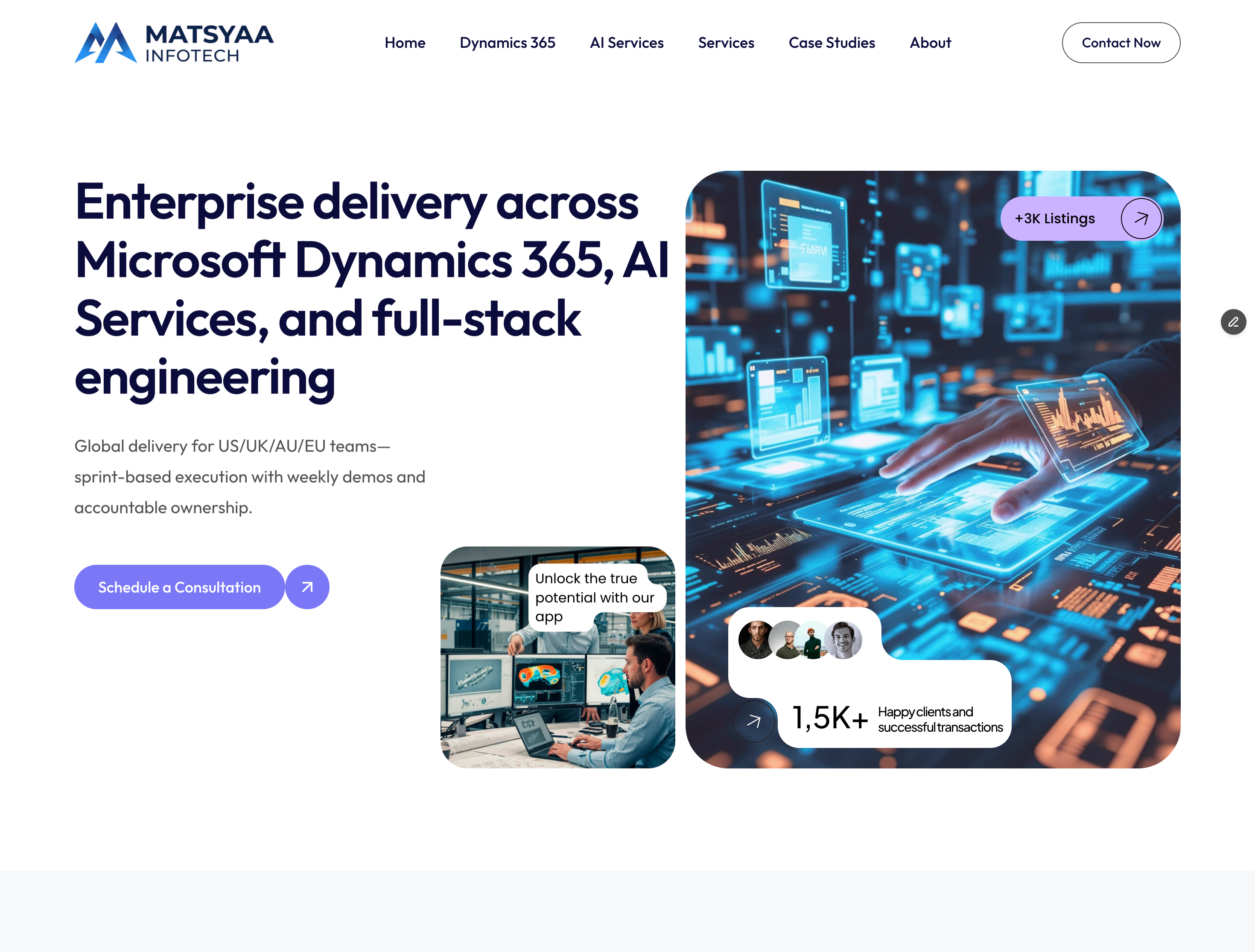
Matsyaa Infotech – Enterprise delivery across Microsoft Dynamics 365, AI services, and full-stack engineering. Transform business operations and accelerate growth with tailored technology solutions and expert engineering teams delivering scalable results.
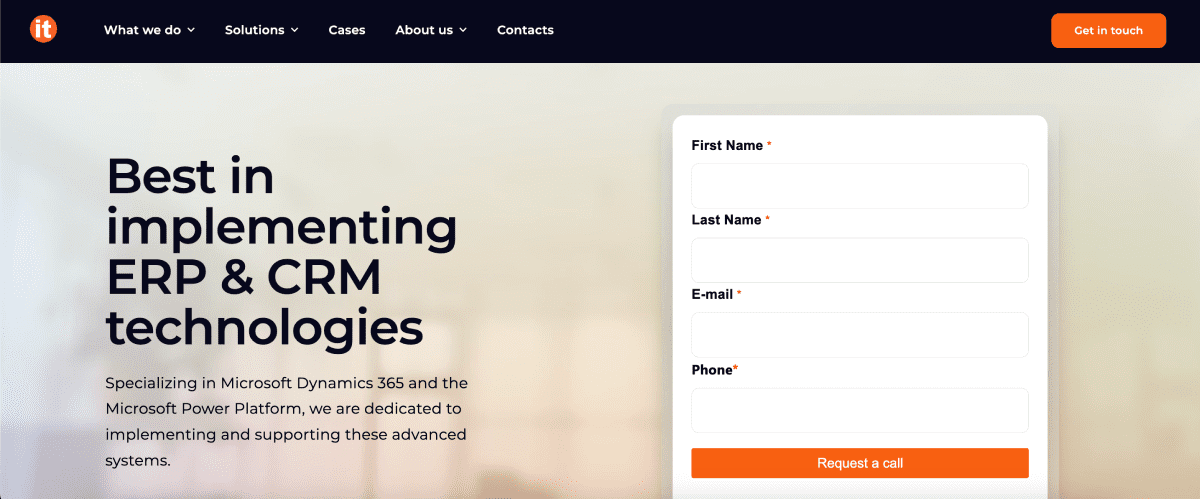
Unify CRM and ERP capabilities and disparate data with Microsoft Dynamics 365, a suite of modern, intelligent cloud applications.

AXSource is a leading Microsoft Dynamics 365 Partner and a trusted provider of Pharmaceutical and Regulatory consulting services. Contact us today!

Corporate Renaissance Group is a leading provider of Microsoft technology, corporate consulting, and business software & systems. Headquartered in Ottawa.

Software Solutions & consulting company with over 25 years of experience and one of the oldest Microsoft partners in India

Transform your organization with expert solutions from a dedicated Microsoft partner focused on your success and technology needs.



Trusted Microsoft Dynamics Partner delivering AI-powered business solutions backed by hands-on expertise and long-term partnership.

Calsoft Systems offers Microsoft Dynamics 365 ERP services that optimize operations, centralize data, & increase efficiency. Learn more to increase your ROI!

At Turnkey Technologies, we specialize in Microsoft Dynamics 365 solutions, providing licensing, seamless implementation, and comprehensive support to optimize operations, boost efficiency, and drive business growth.

A full service digital agency. Our creative thinkers, designers & technologists build innovative solutions that have a tangible impact.

AI platform for litigation lawyers and disputes teams
Run a free AEO + signal audit for your domain.
AI Answer Engine Optimization (AEO)
List once. Convert intent from live AI conversations without heavy integration.
Microsoft Dynamics 365 implementation is the strategic process of deploying and customizing Microsoft's cloud-based suite of intelligent business applications. It involves configuring modules for sales, customer service, finance, supply chain, and operations to align with specific organizational workflows. This project results in a unified data model, automated processes, and actionable insights that drive operational efficiency and growth.
Consultants conduct a discovery workshop to analyze current business processes, define clear objectives, and map out a detailed project roadmap for the implementation.
The core system is configured, custom entities and fields are built, and integrations are developed to connect Dynamics 365 with existing business systems.
The solution undergoes rigorous testing before a phased go-live, followed by comprehensive end-user training and the establishment of ongoing support protocols.
Integrate sales pipelines with customer service history to give agents a 360-degree customer view, enabling personalized engagement and faster issue resolution.
Automate core accounting, procurement, and financial reporting processes within Dynamics 365 Finance to improve accuracy, compliance, and real-time financial visibility.
Leverage Dynamics 365 Supply Chain Management to gain end-to-end visibility, optimize inventory levels, and improve demand forecasting and warehouse management.
Equip mobile technicians with schedules, asset histories, and remote assist tools to complete jobs efficiently on the first visit and improve customer satisfaction.
Consolidate data from all business functions into a single model and use built-in Power BI analytics to uncover trends and support strategic decision-making.
Bilarna evaluates every Microsoft Dynamics 365 implementation partner through a proprietary 57-point AI Trust Score. This rigorous assessment audits their certified expertise, project delivery reliability, security compliance, and verified client satisfaction. By using Bilarna, you confidently shortlist only the most thoroughly vetted and capable service providers for your critical business transformation.
A typical implementation project ranges from 3 to 12 months, depending on the scope, number of modules deployed, and level of customization required. A phased rollout for core CRM or ERP functions can be faster, while a full-scale, organization-wide transformation with complex integrations takes longer. The project timeline is defined during the initial discovery and planning phase.
Costs vary widely from $50,000 to over $500,000, based on partner rates, project complexity, user count, and required customizations. Key cost components include licensing, consulting services, data migration, custom development, and training. Obtaining detailed quotes from several verified partners is essential for accurate budgeting.
Success hinges on clear business objectives, strong executive sponsorship, and choosing an experienced implementation partner. Other critical factors include thorough process mapping, proactive change management, comprehensive user training, and a phased deployment approach. A well-defined project plan with measurable milestones is fundamental.
While Microsoft provides setup guides, most mid-to-large businesses require a certified implementation partner. Partners bring crucial expertise in best practices, complex configuration, data migration, integration, and change management to ensure the platform delivers its full ROI. Self-deployment often leads to underutilization and integration challenges.
Yes, there are integration tools designed to enable cross-platform messaging and file sharing among Google Workspace, Microsoft Teams, and Slack. These tools are not separate chat applications but work by integrating with your existing chat platforms. By installing the integration app on each platform, users can send messages and share files seamlessly across different services without switching apps. This approach helps organizations maintain their current chat environments while enhancing interoperability between platforms.
A business can assess its readiness for an AI implementation project by first conducting a structured AI maturity diagnostic. This diagnostic typically involves evaluating three foundational pillars: organizational AI maturity, data structure and quality, and geographical or market visibility. The process starts with a free assessment tool that benchmarks the company's current AI knowledge, infrastructure, and strategic alignment against industry standards. Secondly, it requires auditing existing data assets to ensure they are clean, organized, and sufficient to train AI models. Finally, it involves analyzing the competitive landscape and geo-specific opportunities to ensure the AI project has a clear market fit. This pre-project analysis helps identify gaps, set realistic goals, and create a data-driven roadmap, thereby reducing risk and increasing the likelihood of a successful, impactful AI deployment.
A consultant helps with HubSpot implementation by providing a structured approach to overcome setup complexity and drive user adoption. They begin with strategic planning to define clear objectives for using Sales, Marketing, Service, or Operations Hubs. The consultant then manages the technical configuration, ensuring data migration, system integration, and workflow automation are correctly established. A core focus is on training employees through personalized sessions that transform them into competent users, which is critical for overcoming internal resistance and ensuring a strong return on investment. Finally, they offer ongoing support to troubleshoot issues, refine processes, and adapt the system as business needs evolve, ensuring the platform becomes an integral growth tool rather than an underutilized expense.
A management knowledge base supports project implementation by providing practical insights, case studies, and checklists that highlight common challenges and effective solutions. It helps managers and directors identify bottlenecks and pitfalls encountered in real-world projects, enabling them to plan and organize more efficiently. By offering expert advice tailored to specific organizational needs, the knowledge base facilitates clearer decision-making and strategy development. This resource reduces the complexity of managing projects by consolidating proven business practices and lessons learned, ultimately improving the success rate of project execution and implementation.
Use AI agents to accelerate Salesforce implementation by automating and optimizing key project phases. 1. Employ Pre-Sales agents to analyze needs, create proposals, and design solutions. 2. Use Design agents to transform proposals into detailed user stories and acceptance criteria. 3. Apply Build agents to generate custom code and configure solutions. 4. Utilize Code agents to convert user stories into production-ready code efficiently. 5. Implement Testing agents to create test plans and manage defects. 6. Deploy Support agents for post-go-live change management and enhancements. This approach can save up to 80% effort in proposal creation and significantly reduce time in other phases.
Use AI agents to enhance legal document review by following these steps: 1. Integrate AI agents within Microsoft Office applications like Word and Outlook. 2. Utilize AI to detect errors, inconsistencies, and enforce firm style guides in emails and documents. 3. Leverage AI-powered tracked changes for precise redlining and suggestions. 4. Allow AI to analyze multiple documents in a project to verify alignment and catch inconsistencies across agreements and term sheets. 5. Ensure all processing is secure with end-to-end encryption and zero data retention policies.
AI implementation can significantly enhance custom software development by introducing predictive intelligence, automation, and personalized user experiences that drive measurable business outcomes. Integrating AI, such as Generative AI or machine learning models, allows software to turn raw data into actionable insights, automate complex processes, and interact with users in more natural and efficient ways. Specific benefits include reducing customer churn by over 20% through predictive analytics, boosting employee engagement with intelligent performance tools, improving chatbot performance by 1900% for superior customer service, and identifying new internal growth opportunities through data pattern recognition. AI features can personalize fitness app experiences to reach over 20,000 new users or transform customer interactions into strategic intelligence. By building AI-powered products since 2017, development teams leverage years of specialized experience to embed these capabilities directly into the software's core, ensuring the solution is not just functional but also intelligent, adaptive, and a key driver of competitive advantage.
AI implementation creates leverage for leadership teams by shifting the focus from isolated experiments to organization-wide changes that improve how work is actually done, leading to measurable operational and strategic advantages. This leverage is achieved by embedding AI into real workflows where capital is allocated, decisions are made, and core work is delivered, thereby redesigning the operating model itself. For leadership, this means moving beyond pilots to proven, contained implementations that demonstrate clear value in a live business area, such as improved software delivery speed or sustained operational gains. It establishes clear ownership, governance, and accountability frameworks, turning AI from a technical tool into a strategic lever. This approach provides a concrete decision point for wider rollout, allowing leaders to scale based on evidence of genuine impact rather than hypothetical benefits.
AI can significantly enhance productivity in Microsoft 365 workspaces by automating routine tasks, generating professional presentations, and providing advanced data analysis. It enables one-click slide generation from outlines or documents, applies consistent branding automatically, and updates content dynamically to reflect the latest data. In Excel, AI assists with automated model building, intelligent data analysis, and error detection, reducing manual effort and improving accuracy. Additionally, AI supports drafting and refining complex documents with style and tone adjustments, semantic search, and citation features. By integrating seamlessly with existing tools and workflows, AI enhances efficiency without disrupting current processes, making work faster and more accurate.
AI integration with Microsoft technologies drives business transformation by automating operations, enhancing decision-making, and enabling scalable innovation. Microsoft Copilot agents streamline customer engagement and efficiency in areas like sales, service, and finance through personalized automation. Dynamics 365 provides CRM and ERP capabilities for actionable insights, while Power Platform allows low-code development of custom apps and workflows. Cloud-native tools such as GitHub Copilot accelerate software development, and Azure services support infrastructure modernization with AI-driven monitoring. Security is strengthened by AI-powered threat detection using Copilot for Security. Together, these technologies reduce manual efforts, improve productivity, foster continuous innovation, and help businesses adapt to market changes for sustained growth.