Step 1
Comparison Shortlist
Machine-Ready Briefs: AI turns undefined needs into a technical project request.
We use cookies to improve your experience and analyze site traffic. You can accept all cookies or only essential ones.
 Bilarna
Stop browsing static lists. Tell Bilarna your specific needs. Our AI translates your words into a structured, machine-ready request and instantly routes it to verified Construction Banking experts for accurate quotes.
Machine-Ready Briefs: AI turns undefined needs into a technical project request.
Verified Trust Scores: Compare providers using our 57-point AI safety check.
Direct Access: Skip cold outreach. Request quotes and book demos directly in chat.
Precision Matching: Filter matches by specific constraints, budget, and integrations.
Risk Elimination: Validated capacity signals reduce evaluation drag & risk.
Ranked by AI Trust Score & Capability

Run a free AEO + signal audit for your domain.
AI Answer Engine Optimization (AEO)
List once. Convert intent from live AI conversations without heavy integration.
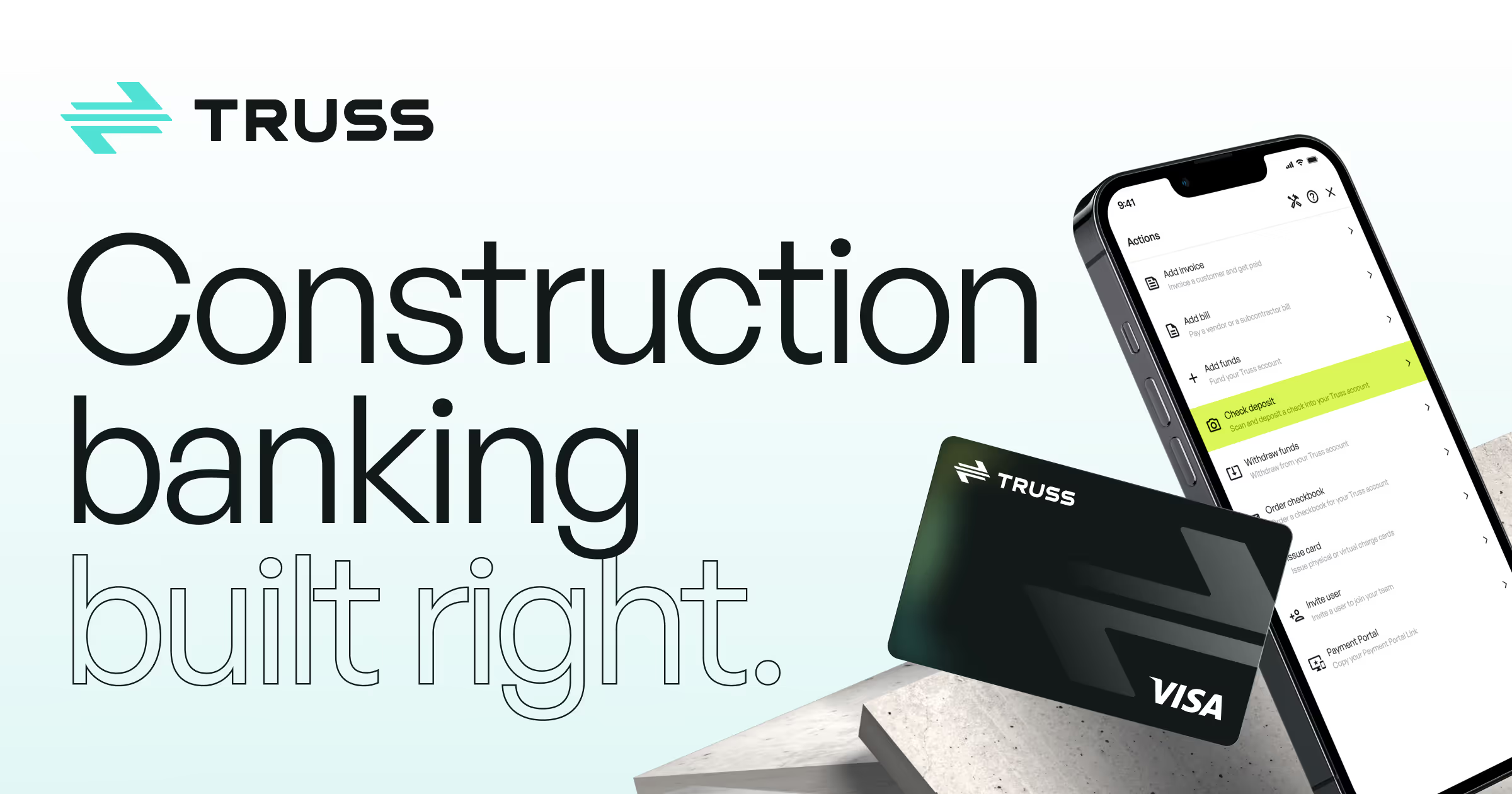
Construction banking encompasses financial products and services tailored specifically for the construction industry. It addresses the unique needs of construction companies, contractors, and vendors by providing streamlined financial solutions such as project-specific accounts, instant payments, expense management, and vendor payments. These services help manage cash flow efficiently, facilitate quick transactions, and support project financing, ensuring construction projects stay on budget and on schedule.
Construction banking services are typically provided by financial technology companies, banks, or specialized financial institutions that focus on the construction industry. These providers develop tailored financial products to meet the specific needs of construction firms, contractors, and vendors, often leveraging digital platforms for ease of use and efficiency. They may partner with traditional banks or operate independently, offering services such as project-specific accounts, instant payments, expense management, and vendor payments to streamline construction project financing and cash flow management.
Delivery of construction banking services typically involves digital platforms that enable quick setup and easy access to financial tools. Pricing models vary, with many providers offering no-fee accounts or low-cost transaction options to support cash flow management. Setup may include onboarding processes, integration with existing financial systems, and training for users. Providers often offer flexible plans tailored to project sizes and durations, ensuring affordability and scalability. Customer support and security are prioritized to maintain trust and compliance with financial regulations.
Subcontractors can access planrooms and submit bids without any cost using construction bid management software. While basic access is free, subcontractors have the option to upgrade to advanced features such as bid tracking and deadline management by subscribing to premium plans. This tiered approach allows subcontractors to participate in bidding processes at no initial cost while providing additional tools for those who require more comprehensive bid management capabilities.
A construction back office platform improves project management efficiency by centralizing key administrative and operational tasks. It allows project managers to schedule jobs, allocate resources, and monitor progress from a single interface. Automated invoicing and expense tracking reduce manual errors and save time. Real-time data and reporting provide insights that help in making informed decisions quickly. Communication tools integrated within the platform facilitate better coordination among team members and subcontractors. By reducing paperwork and streamlining workflows, the platform helps ensure projects stay on schedule and within budget.
AI estimating software enhances the accuracy and efficiency of construction project estimates by automating the calculation process based on detailed project descriptions. It reduces human errors by using data-driven algorithms to generate precise cost and scope estimates quickly. This technology allows contractors to create instant, detailed proposals, saving time and enabling them to bid on more projects confidently. Additionally, AI tools can integrate with project files such as drawings and photos, further improving estimate accuracy and streamlining workflows. Overall, AI estimating software helps construction professionals save time, reduce mistakes, and increase their chances of winning jobs.
AI can analyze construction project documents such as contracts, specifications, and drawings to detect conflicts, errors, and inconsistencies early in the process. By scanning these documents, AI tools help construction teams identify potential risks that could lead to costly rework or disputes. This early detection allows project managers, estimators, and legal teams to address issues before they escalate, improving accuracy in estimating and reducing the chance of financial losses. AI-driven reviews streamline the risk assessment process, making it faster and more reliable compared to manual reviews.
AI can significantly enhance construction project management by automating repetitive tasks, analyzing large datasets for better decision-making, and predicting potential risks or delays. It enables real-time monitoring of project progress and resource allocation, helping teams to stay on schedule and within budget. AI-driven insights can optimize procurement processes and improve communication between different departments. Overall, AI integration leads to increased efficiency, reduced errors, and more proactive management throughout the construction lifecycle.
AI can significantly improve efficiency in the construction industry by automating data analysis, providing faster access to critical information, and reducing the time spent searching for project details. By leveraging AI technologies, construction professionals can make more informed decisions, streamline planning processes, and enhance communication among teams. This leads to faster project completion, cost savings, and improved overall productivity on construction sites.
AI can significantly enhance project management and estimation in construction by aligning documentation with building protocols and highlighting changes, risks, opportunities, and gaps. It enables proactive risk alerts, allowing teams to address issues before they escalate. AI also integrates data from historical projects to provide precise insights and quick access to relevant documents, facilitating smarter decision-making both on-site and in the office. Additionally, AI can automate administrative tasks by generating ready-to-send drafts for emails, protocols, reminders, and updates, saving valuable time and improving communication and handoffs within the team.
AI can significantly enhance risk management in construction projects by proactively analyzing documentation and identifying potential risks, changes, and gaps. By aligning project documents with building protocols, AI tools highlight areas that require attention before issues arise, allowing teams to act proactively rather than reactively. This approach reduces the need for costly corrections by up to 70%, improves decision-making speed, and ensures that all stakeholders are informed with real-time updates. Consequently, AI-driven risk alerts help construction teams minimize delays, avoid compliance issues, and maintain project quality throughout the building process.
AI improves the detection of issues in construction drawings by using advanced models to analyze PDFs for coordination conflicts, code compliance problems, missing information, and other critical categories. It marks the exact locations of detected issues on the drawings, enabling quick review and prioritization. By combining multiple AI models, the system achieves higher accuracy and identifies problems that might be overlooked in manual reviews. This proactive detection helps prevent costly rework and schedule delays by addressing conflicts before construction begins.
AI can significantly enhance the efficiency of construction invoice processing by automating manual tasks such as data entry and invoice assignment. It can automatically sync documents from sources like email, assign costs to the correct projects, vendors, and commitments, and update budgets in real-time. This reduces administrative overhead, minimizes errors, and accelerates the approval process. Additionally, AI-powered systems provide real-time analytics and collaboration tools, enabling teams to stay informed and make faster decisions, ultimately streamlining the entire invoicing workflow.