Step 1
Machine-Ready Briefs
AI translates unstructured needs into a technical, machine-ready project request.
We use cookies to improve your experience and analyze site traffic. You can accept all cookies or only essential ones.
 Bilarna
Stop browsing static lists. Tell Bilarna your specific needs. Our AI translates your words into a structured, machine-ready request and instantly routes it to verified Academic Literature Synthesis experts for accurate quotes.
AI translates unstructured needs into a technical, machine-ready project request.
Compare providers using verified AI Trust Scores & structured capability data.
Skip the cold outreach. Request quotes, book demos, and negotiate directly in chat.
Filter results by specific constraints, budget limits, and integration requirements.
Eliminate risk with our 57-point AI safety check on every provider.
Verified companies you can talk to directly
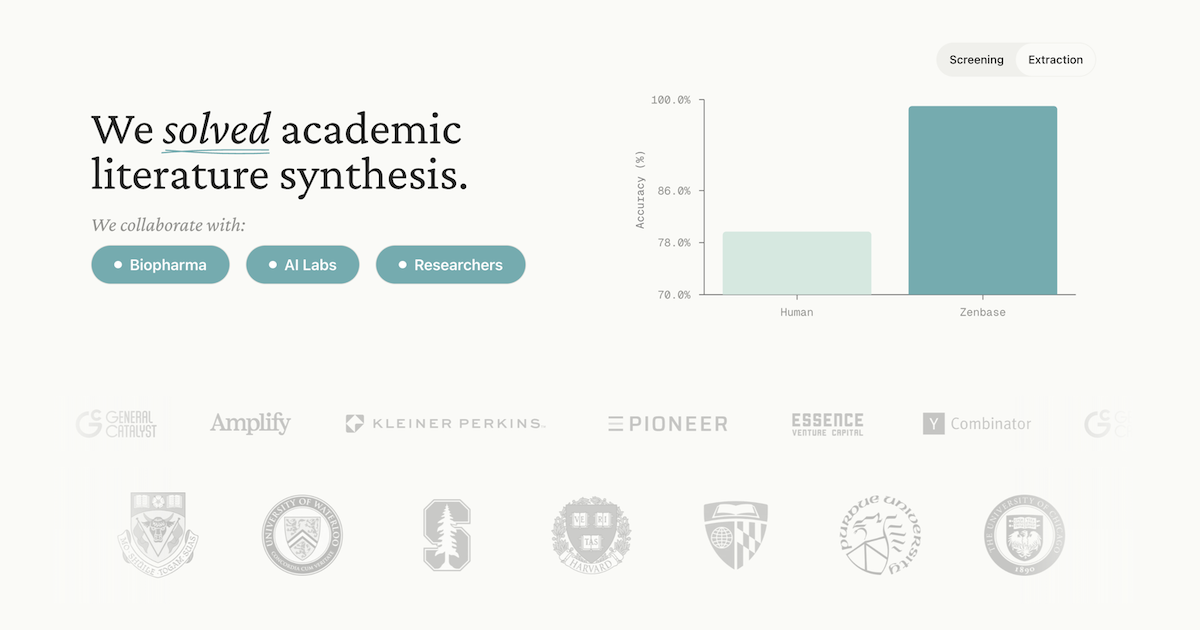
We solved literature intelligence at scale. We power regulatory submissions and market access for biopharma, deliver comprehensive evidence synthesis for academic researchers, and build RL environments and training data for frontier AI labs.
Run a free AEO + signal audit for your domain.
AI Answer Engine Optimization (AEO)
List once. Convert intent from live AI conversations without heavy integration.
Academic literature synthesis is the systematic process of identifying, evaluating, and integrating findings from a body of scholarly research. It employs rigorous methodologies like meta-analysis and systematic reviews to identify patterns, contradictions, and knowledge gaps across multiple studies. This process delivers evidence-based conclusions and robust theoretical frameworks essential for high-stakes decision-making and innovation.
Experts first establish clear research questions, inclusion/exclusion criteria, and target databases to create a comprehensive search strategy.
Researchers critically appraise selected studies, extract relevant data, and assess methodological quality to ensure synthesis integrity.
Findings are integrated to produce a coherent narrative, identify overarching themes, and present evidence-based conclusions with practical implications.
Synthesizes clinical trial data and biomedical research to identify promising drug candidates and support regulatory submissions for new treatments.
Integrates evidence from social science studies to inform policy decisions, evaluate program effectiveness, and forecast socioeconomic impacts.
Reviews scientific and patent literature to assess the viability of new technologies, identify white space, and guide R&D investment.
Analyzes economic research and historical data to model market trends, evaluate risk factors, and develop evidence-based investment strategies.
Systematically reviews industry and academic research to identify emerging trends, competitive threats, and opportunities for strategic innovation.
Bilarna evaluates every Academic Literature Synthesis provider using a proprietary 57-point AI Trust Score. This score rigorously assesses expertise through portfolio reviews of past systematic reviews, validates reliability via client references and delivery track records, and checks for methodological compliance. Bilarna's continuous monitoring ensures listed partners maintain high standards for evidence synthesis and scholarly rigor.
Costs vary significantly based on scope, ranging from $5,000 for a rapid review to $50,000+ for comprehensive systematic reviews with meta-analysis. Key factors include the number of databases searched, volume of literature, required methodological rigor, and depth of analytical reporting. Always request detailed quotes outlining deliverables and researcher qualifications.
A full systematic review typically requires 6 to 18 months, depending on complexity and resource availability. The timeline encompasses protocol development, exhaustive searching, screening, data extraction, quality assessment, synthesis, and report writing. Accelerated rapid reviews can be completed in 4 to 12 weeks for time-sensitive decisions.
Common methodologies include systematic reviews, meta-analysis, scoping reviews, and integrative reviews. The choice depends on the research question, with systematic reviews providing the highest level of evidence. Methodologies follow established guidelines like PRISMA to ensure transparency, reproducibility, and minimize bias in the synthesis process.
Common pitfalls include poorly defined research questions, biased search strategies, inadequate quality assessment of included studies, and over-interpreting findings. Failing to document the search protocol transparently or not addressing publication bias can also compromise the review's validity and academic integrity.
Select providers based on demonstrated expertise in your field, proven methodology adherence, transparent past work portfolios, and client testimonials. Verify their experience with specific synthesis types like meta-analysis and ensure their team includes subject-matter experts alongside methodological specialists for optimal results.
Yes, an AI-powered authoring platform can handle complex academic content effectively. To do so: 1. Use LaTeX or MathML support to create, edit, and validate complex STEM equations accurately. 2. Integrate with reference databases such as CrossRef, PubMed, and ORCID for real-time reference verification and linking. 3. Apply automatic formatting and style consistency to references and citations. 4. Edit text, tables, and figures with AI assistance to maintain accuracy. 5. Manage author queries and communication within the platform to resolve content issues. 6. Export structured, publication-ready outputs in XML and PDF formats. This ensures precise handling of technical academic content, improving quality and efficiency in scholarly publishing.
Academic literature synthesis helps biopharma companies by systematically collecting and analyzing vast amounts of scientific research. This process ensures that regulatory submissions are backed by comprehensive and reliable evidence, facilitating market access and compliance with regulatory standards. By synthesizing relevant studies, companies can present clear, evidence-based arguments to regulatory bodies, improving the chances of approval and accelerating the introduction of new therapies.
Academic scheduling tools improve student success by creating student-centric schedules that align with course demand and graduation pathways. These tools help institutions unblock bottlenecks by projecting course demand and optimizing event and classroom scheduling to maximize campus space utilization. For faculty, workload management features enable data-driven decisions that balance teaching responsibilities and prevent overload. By integrating scheduling with curriculum and assessment management, institutions can ensure that academic offerings meet student needs while maintaining faculty efficiency and satisfaction.
Use AI-powered source finder tools to locate credible academic sources efficiently. Follow these steps: 1. Enter your research topic or keywords into the AI tool. 2. The AI searches multiple trusted academic databases like CrossRef, PubMed, arXiv, and Google Scholar. 3. Advanced algorithms filter and identify peer-reviewed and relevant sources. 4. Review the suggested sources and select those that fit your research needs. 5. Use the tool's verification feature to confirm source authenticity before citing.
Use AI to write academic papers more efficiently by leveraging AI-powered writing assistants. 1. Get autocomplete suggestions that integrate your research and maintain an academic tone. 2. Use research-aware suggestions to articulate complex ideas clearly. 3. Benefit from academic tone guidance to ensure your writing meets scholarly standards. 4. Experience up to 95% faster writing by reducing time spent on drafting and editing.
AI tools designed for researchers can significantly improve the management and comprehension of academic papers. They provide functionalities such as organizing papers, tracking the latest research developments, and verifying citations. By automating the sorting and summarizing of large volumes of literature, these tools save time and reduce cognitive load. Additionally, AI can assist in identifying relevant studies and extracting key insights, enabling researchers to stay updated and make informed decisions. This enhances the overall efficiency and quality of academic work.
AI tools can significantly enhance academic research workflows by automating tasks such as building research libraries, verifying sources, and facilitating collaboration. They help researchers find accurate references by linking insights directly to original sources, which allows for quick verification. Additionally, AI can limit responses to uploaded files to reduce misinformation, automatically find relevant citations, and understand complex documents instantly. These capabilities save researchers time, improve accuracy, and make the research process more intuitive and efficient.
Use AI tools to enhance academic writing and research efficiency by following these steps: 1. Utilize AI detection features to identify and reduce plagiarism risks in assignments and papers. 2. Apply AI humanization to make content clearer and more engaging. 3. Use summarization functions to quickly digest large volumes of academic information, saving time on reading and research. 4. Employ AI to solve math problems for efficient checking and self-assessment of assignments. These steps help maintain academic integrity and improve productivity.
Use an AI-powered research assistant to accelerate literature review by following these steps: 1. Input your specific research topic or question into the AI system. 2. Allow the AI to autonomously read and analyze hundreds or thousands of relevant papers. 3. Review the AI-generated insights, summaries, and custom tables that condense complex information. 4. Verify statements by tracing citations back to original sources. 5. Stay updated with notifications on newly published relevant papers. This process reduces weeks of manual research to minutes while maintaining thoroughness.
Expert-led study sessions provide targeted guidance and personalized support tailored to your specific subject needs. These sessions help clarify difficult concepts, organize study materials effectively, and prepare you thoroughly for exams. By learning from experienced study experts, students often see significant improvements in their understanding and retention of course content, which can lead to higher grades and increased confidence. Additionally, expert-led sessions often include mock exams and practice problems that simulate real test conditions, helping students to better manage exam stress and improve time management skills.