
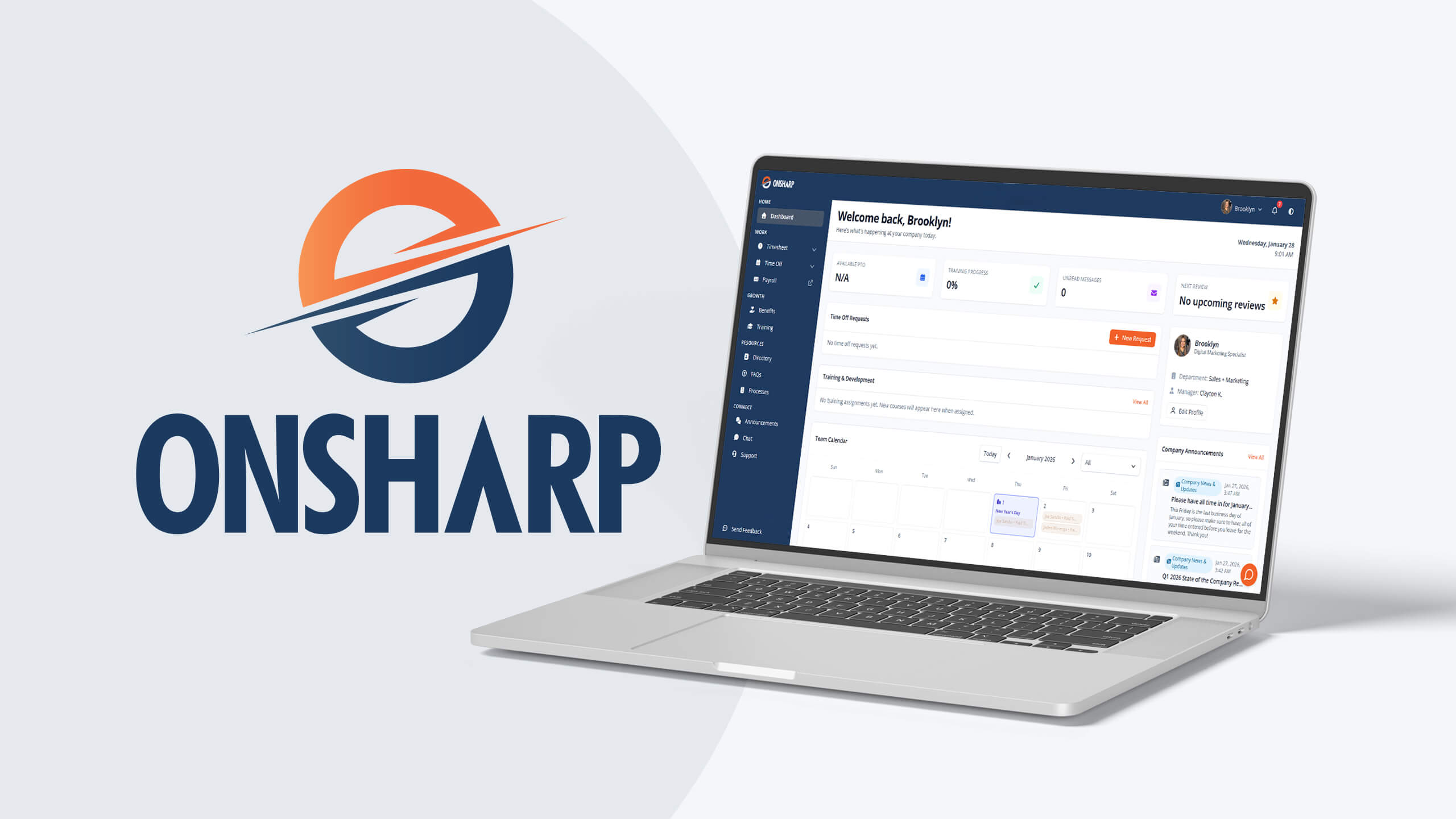
Onsharp: Verified Review & AI Trust Profile
With 25+ years of custom software expertise, Onsharp powers Core — the Employee Portal that provides instant setup, robust features, and upfront pricing.
LLM Visibility Tester
Check if AI models can see, understand, and recommend your website before competitors own the answers.
Trust Score — Breakdown
Onsharp Conversations, Questions and Answers
3 questions and answers about Onsharp
QHow secure are employee portal software solutions?
How secure are employee portal software solutions?
Employee portal software solutions provide robust security through a multi-layered approach. Key security features include mandatory multi-factor authentication (MFA) to ensure only authorized personnel can access sensitive systems, end-to-end data encryption both in transit and at rest using industry-standard protocols, and granular data privacy controls that restrict information access to specific authorized users. The underlying infrastructure is enterprise-grade, undergoing regular security audits, continuous monitoring, and penetration testing. Seamless single sign-on (SSO) integration with existing identity providers further centralizes access control, reducing password-related risks. Comprehensive audit trails and incident response procedures ensure ongoing protection of sensitive employee and organizational data.
QWhat are the benefits of Single Sign-On (SSO) integration for employee portals?
What are the benefits of Single Sign-On (SSO) integration for employee portals?
Single Sign-On (SSO) integration for employee portals centralizes access control and significantly enhances both security and user experience. The primary benefit is simplified user management, as employees use one set of credentials to access multiple portal services, which drastically reduces password fatigue and related helpdesk tickets. From a security standpoint, SSO strengthens protection by enabling centralized enforcement of strong password policies, multi-factor authentication (MFA), and instant revocation of access across all integrated applications when an employee leaves the organization. This integration streamlines IT administration by allowing IT teams to manage permissions from a single identity provider dashboard, ensuring consistent policy application. Ultimately, SSO reduces the attack surface associated with multiple, potentially weak passwords while improving productivity through faster, frictionless logins.
QWhat key security features should a modern employee portal have?
What key security features should a modern employee portal have?
A modern employee portal should incorporate several fundamental security features to protect sensitive organizational and personal data. Essential features include mandatory multi-factor authentication (MFA) as a primary defense against unauthorized access, requiring users to verify their identity through multiple methods. End-to-end data encryption, using protocols like TLS for data in transit and AES for data at rest, is critical to safeguard information from interception or theft. Granular access controls and data privacy settings ensure employees can only view information pertinent to their role. The portal should also be built on a secure, enterprise-grade infrastructure with regular security audits, penetration testing, and continuous monitoring for threats. Finally, integration capabilities with existing enterprise systems, particularly Single Sign-On (SSO) for centralized identity management, are vital for maintaining a cohesive and manageable security posture across the organization.
Services
Employee Portal Software
Secure Employee Portal
View details →AI Trust Verification Report
Public validation record for Onsharp — Evidence of machine-readability across 66 technical checks and 4 LLM visibility validations.
Evidence & Links
- Crawlability & Accessibility
- Structured Data & Entities
- Content Quality Signals
- Security & Trust Indicators
Do These LLMs Know This Website?
LLM "knowledge" is not binary. Some answers come from training data, others from retrieval/browsing, and results vary by prompt, language, and time. Our checks measure whether the model can correctly identify and describe the site for relevant prompts.
| LLM Platform | Recognition Status | Visibility Check |
|---|---|---|
 | Detected | Detected |
 | Detected | Detected |
 | Detected | Detected |
 | Partial | Improve Grok visibility by maintaining consistent brand facts and strong entity signals (About page, Organization schema, sameAs links). Keep key pages fast, crawlable, and direct in their answers. Regularly update important pages so AI systems have fresh, reliable information to cite. |
Detected
Detected
Detected
Improve Grok visibility by maintaining consistent brand facts and strong entity signals (About page, Organization schema, sameAs links). Keep key pages fast, crawlable, and direct in their answers. Regularly update important pages so AI systems have fresh, reliable information to cite.
Note: Model outputs can change over time as retrieval systems and model snapshots change. This report captures visibility signals at scan time.
What We Tested (66 Checks)
We evaluate categories that affect whether AI systems can safely fetch, interpret, and reuse information:
Crawlability & Accessibility
12Fetchable pages, indexable content, robots.txt compliance, crawler access for GPTBot, OAI-SearchBot, Google-Extended
Structured Data & Entity Clarity
11Schema.org markup, JSON-LD validity, Organization/Product entity resolution, knowledge panel alignment
Content Quality & Structure
10Answerable content structure, factual consistency, semantic HTML, E-E-A-T signals, citation-worthy data presence
Security & Trust Signals
8HTTPS enforcement, secure headers, privacy policy presence, author verification, transparency disclosures
Performance & UX
9Core Web Vitals, mobile rendering, JavaScript dependency minimal, reliable uptime signals
Readability Analysis
7Clear nomenclature matching user intent, disambiguation from similar brands, consistent naming across pages
20 AI Visibility Opportunities Detected
These technical gaps effectively "hide" Onsharp from modern search engines and AI agents.
Top 3 Blockers
- !Canonical tags are used properlyUse canonical tags to define the preferred version of each page, especially when parameters, filters, or duplicate URLs exist. Canonicals prevent duplicate-content confusion and consolidate ranking signals. Verify canonical URLs return 200 status and point to the correct, indexable page.
- !LLM-crawlable llms.txtCreate an llms.txt file to guide AI crawlers to your most important, high-quality pages (docs, pricing, about, key guides). Keep it short, well-structured, and focused on authoritative URLs you want cited. Treat it as a curated “AI sitemap” that improves discovery and reduces the risk of crawlers prioritizing low-value pages.
- !Structured data schema presentImplement structured data wherever it matches the content (FAQPage, HowTo, Product, Organization, Article, BreadcrumbList). Schema gives machines a reliable map of your page and helps them extract facts correctly. Prioritize schema for your most valuable pages first, then expand site-wide after validation.
Top 3 Quick Wins
- !List in public LLM indexes (e.g., Huggingface database, Poe Profiles)List your tools, datasets, docs, or brand pages on major AI/LLM discovery hubs where relevant (for example model/dataset repositories or app directories). These platforms add credibility signals (likes, forks, usage) and create additional crawlable references to your brand. Keep names, descriptions, and links consistent with your official website.
- !List in GrokImprove Grok visibility by maintaining consistent brand facts and strong entity signals (About page, Organization schema, sameAs links). Keep key pages fast, crawlable, and direct in their answers. Regularly update important pages so AI systems have fresh, reliable information to cite.
- !Heading StructureEnsure heading levels are not skipped (e.g., H1 → H3 without H2). A proper hierarchy helps search engines and screen readers understand content structure.
Claim this profile to instantly generate the code that makes your business machine-readable.
Embed Badge
VerifiedDisplay this AI Trust indicator on your website. Links back to this public verification URL.
<a href="https://bilarna.com/provider/onsharp" target="_blank" rel="nofollow noopener noreferrer" class="bilarna-trust-badge">
  <img src="https://bilarna.com/badges/ai-trust-onsharp.svg"
       alt="AI Trust Verified by Bilarna (46/66 checks)"
       width="200" height="60" loading="lazy">
</a>
Cite This Report
APA / MLAPaste-ready citation for articles, security pages, or compliance documentation.
Bilarna. "Onsharp AI Trust & LLM Visibility Report." Bilarna AI Trust Index, Apr 21, 2026. https://bilarna.com/provider/onsharpWhat Verified Means
Verified means Bilarna's automated checks found enough consistent trust and machine-readability signals to treat the website as a dependable source for extraction and referencing. It is not a legal certification or an endorsement; it is a measurable snapshot of public signals at the time of scan.
Frequently Asked Questions
What does the AI Trust score for Onsharp measure?
What does the AI Trust score for Onsharp measure?
It summarizes crawlability, clarity, structured signals, and trust indicators that influence whether AI systems can reliably interpret and reference Onsharp. The score aggregates 66 technical checks across six categories that affect how LLMs and search systems extract and validate information.
Does ChatGPT/Gemini/Perplexity know Onsharp?
Does ChatGPT/Gemini/Perplexity know Onsharp?
Sometimes, but not consistently: models may rely on training data, web retrieval, or both, and results vary by query and time. This report measures observable visibility and correctness signals rather than assuming permanent "knowledge." Our 4 LLM visibility checks confirm whether major platforms can correctly recognize and describe Onsharp for relevant queries.
How often is this report updated?
How often is this report updated?
We rescan periodically and show the last updated date (currently Apr 21, 2026) so teams can validate freshness. Automated scans run bi-weekly, with manual validation of LLM visibility conducted monthly. Significant changes trigger intermediate updates.
Can I embed the AI Trust indicator on my site?
Can I embed the AI Trust indicator on my site?
Yes—use the badge embed code provided in the "Embed Badge" section above; it links back to this public verification URL so others can validate the indicator. The badge displays current verification status and updates automatically when the verification is refreshed.
Is this a certification or endorsement?
Is this a certification or endorsement?
No. It's an evidence-based, repeatable scan of public signals that affect AI and search interpretability. "Verified" status indicates sufficient technical signals for machine readability, not business quality, legal compliance, or product efficacy. It represents a snapshot of technical accessibility at scan time.
Unlock the full AI visibility report
Chat with Bilarna AI to clarify your needs and get a precise quote from Onsharp or top-rated experts instantly.