
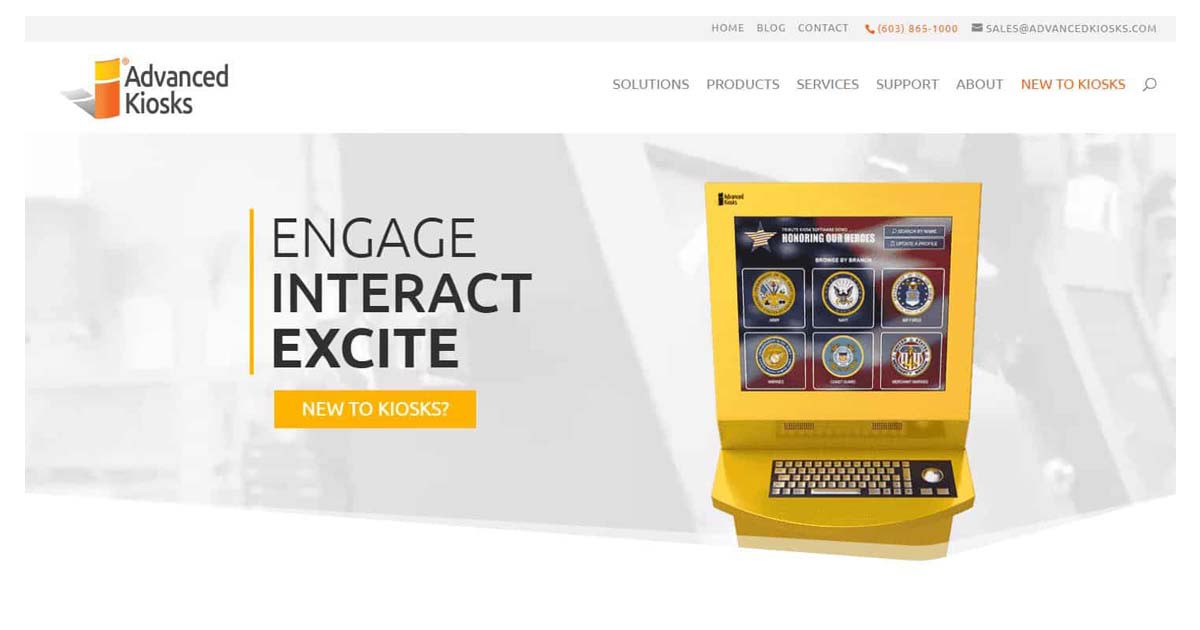
Advanced Kiosks: Verified Review & AI Trust Profile
Advanced Kiosks: Trusted self-service kiosk manufacturer and supplier. Offering hardware & management software for self-service projects.
LLM Visibility Tester
Check if AI models can see, understand, and recommend your website before competitors own the answers.
Trust Score — Breakdown
Advanced Kiosks Conversations, Questions and Answers
3 questions and answers about Advanced Kiosks
QWhat are the main uses of self-service kiosks in government and public sector?
What are the main uses of self-service kiosks in government and public sector?
Self-service kiosks in the public sector are primarily used to automate citizen-facing transactions such as permit applications, payments, document submissions, and check-ins. Government agencies deploy kiosks to reduce paperwork, improve data accuracy, and streamline in-person services. Common applications include digital courthouse access, housing authority resident services (applications, rent payments), law enforcement support (firearm registration, incident reports), and general government lobby check-ins. Kiosks also enable multilingual access to public information, event calendars, and service directories. By handling routine tasks independently, kiosks free up staff for complex case work and shorten wait times for citizens. Many systems support ADA compliance and secure data handling, ensuring accessibility and privacy. Remote management software allows agencies to monitor, update, and maintain their entire kiosk fleet from a central location.
QHow do self-service kiosks improve efficiency for public agencies?
How do self-service kiosks improve efficiency for public agencies?
Self-service kiosks improve efficiency for public agencies by reducing manual processing, cutting wait times, and automating routine citizen transactions. When citizens can independently submit forms, make payments, or check in for appointments via kiosks, staff workload decreases and errors from manual data entry are minimized. Kiosks also enable 24/7 access to services, extending service hours without additional personnel. Integrated software allows real-time data synchronization with agency databases, eliminating duplicate data entry and improving reporting accuracy. Remote management capabilities further boost efficiency by allowing IT teams to update software, troubleshoot issues, and monitor usage across multiple locations from a single dashboard. In practice, agencies have reported wait time reductions of up to 75% and significant improvements in compliance and data accuracy after deploying kiosk solutions.
QWhat features should you look for when choosing a self-service kiosk for a government facility?
What features should you look for when choosing a self-service kiosk for a government facility?
When choosing a self-service kiosk for a government facility, prioritize features that ensure accessibility, security, and durability. First, the kiosk must be ADA-compliant, with screen heights, tactile interfaces, and audio options for users with disabilities. Second, data security is critical: look for encrypted payment processing, secure document handling, and compliance with government data protection standards. Third, consider the operating environment—industrial-grade components are essential for both indoor public lobbies and outdoor installations. Fourth, integrated software capabilities such as remote fleet management, real-time monitoring, and easy content updates reduce long-term maintenance costs. Fifth, built-in visitor management, appointment check-in, and multilingual support expand the kiosk’s utility for diverse citizen needs. Finally, choose a provider that offers turnkey deployment, including hardware, software, installation, and ongoing technical support, to ensure the system works reliably from day one.
Services
Kiosk Software
Self-Service Kiosk Software
View details →AI Trust Verification Report
Public validation record for Advanced Kiosks — Evidence of machine-readability across 66 technical checks and 4 LLM visibility validations.
Evidence & Links
- Crawlability & Accessibility
- Structured Data & Entities
- Content Quality Signals
- Security & Trust Indicators
Do These LLMs Know This Website?
LLM "knowledge" is not binary. Some answers come from training data, others from retrieval/browsing, and results vary by prompt, language, and time. Our checks measure whether the model can correctly identify and describe the site for relevant prompts.
| LLM Platform | Recognition Status | Visibility Check |
|---|---|---|
 | Detected | Detected |
 | Detected | Detected |
 | Detected | Detected |
 | Detected | Detected |
Detected
Detected
Detected
Detected
Note: Model outputs can change over time as retrieval systems and model snapshots change. This report captures visibility signals at scan time.
What We Tested (66 Checks)
We evaluate categories that affect whether AI systems can safely fetch, interpret, and reuse information:
Crawlability & Accessibility
12Fetchable pages, indexable content, robots.txt compliance, crawler access for GPTBot, OAI-SearchBot, Google-Extended
Structured Data & Entity Clarity
11Schema.org markup, JSON-LD validity, Organization/Product entity resolution, knowledge panel alignment
Content Quality & Structure
10Answerable content structure, factual consistency, semantic HTML, E-E-A-T signals, citation-worthy data presence
Security & Trust Signals
8HTTPS enforcement, secure headers, privacy policy presence, author verification, transparency disclosures
Performance & UX
9Core Web Vitals, mobile rendering, JavaScript dependency minimal, reliable uptime signals
Readability Analysis
7Clear nomenclature matching user intent, disambiguation from similar brands, consistent naming across pages
12 AI Visibility Opportunities Detected
These technical gaps effectively "hide" Advanced Kiosks from modern search engines and AI agents.
Top 3 Blockers
- !Listicle FormattingUse listicle formatting with numbered headings, "Top N" patterns, ordered lists, or comparison tables. AI models prefer structured, scannable content for citations.
- !GEO Schema StackingInclude all three GEO schema types: Article (or BlogPosting/NewsArticle), ItemList, and FAQPage. Schema stacking increases the chance of AI citation with rich context.
- !Flesch Reading EaseUse Flesch Reading Ease (0–100) to measure clarity; higher scores are easier to read (often 60–80 is a practical goal for web content). Improve the score by using shorter sentences and more common words. Clearer writing helps both search snippets and AI answer extraction.
Top 3 Quick Wins
- !List in public LLM indexes (e.g., Huggingface database, Poe Profiles)List your tools, datasets, docs, or brand pages on major AI/LLM discovery hubs where relevant (for example model/dataset repositories or app directories). These platforms add credibility signals (likes, forks, usage) and create additional crawlable references to your brand. Keep names, descriptions, and links consistent with your official website.
- !JSON-LD Schema: Organization, Product, FAQ, WebsiteAdd schema.org JSON-LD to describe your key entities (Organization, Product/Service, FAQPage, WebSite, Article when relevant). Structured data makes your meaning explicit and improves the chance of rich results and accurate AI citations. Validate markup with schema testing tools and keep the data consistent with the visible page content.
- !Author/Publisher detection (AI authority & citation signal)Show who wrote or owns the content (author and publisher) using visible bylines and structured data (Person/Organization). Link to author bios with credentials to strengthen expertise signals. Consistent attribution increases trust and improves the chance your content is treated as a reliable source.
Claim this profile to instantly generate the code that makes your business machine-readable.
Embed Badge
VerifiedDisplay this AI Trust indicator on your website. Links back to this public verification URL.
<a href="https://bilarna.com/provider/advancedkiosks" target="_blank" rel="nofollow noopener noreferrer" class="bilarna-trust-badge">
  <img src="https://bilarna.com/badges/ai-trust-advancedkiosks.svg"
       alt="AI Trust Verified by Bilarna (54/66 checks)"
       width="200" height="60" loading="lazy">
</a>
Cite This Report
APA / MLAPaste-ready citation for articles, security pages, or compliance documentation.
Bilarna. "Advanced Kiosks AI Trust & LLM Visibility Report." Bilarna AI Trust Index, Apr 23, 2026. https://bilarna.com/provider/advancedkiosksWhat Verified Means
Verified means Bilarna's automated checks found enough consistent trust and machine-readability signals to treat the website as a dependable source for extraction and referencing. It is not a legal certification or an endorsement; it is a measurable snapshot of public signals at the time of scan.
Frequently Asked Questions
What does the AI Trust score for Advanced Kiosks measure?
What does the AI Trust score for Advanced Kiosks measure?
It summarizes crawlability, clarity, structured signals, and trust indicators that influence whether AI systems can reliably interpret and reference Advanced Kiosks. The score aggregates 66 technical checks across six categories that affect how LLMs and search systems extract and validate information.
Does ChatGPT/Gemini/Perplexity know Advanced Kiosks?
Does ChatGPT/Gemini/Perplexity know Advanced Kiosks?
Sometimes, but not consistently: models may rely on training data, web retrieval, or both, and results vary by query and time. This report measures observable visibility and correctness signals rather than assuming permanent "knowledge." Our 4 LLM visibility checks confirm whether major platforms can correctly recognize and describe Advanced Kiosks for relevant queries.
How often is this report updated?
How often is this report updated?
We rescan periodically and show the last updated date (currently Apr 23, 2026) so teams can validate freshness. Automated scans run bi-weekly, with manual validation of LLM visibility conducted monthly. Significant changes trigger intermediate updates.
Can I embed the AI Trust indicator on my site?
Can I embed the AI Trust indicator on my site?
Yes—use the badge embed code provided in the "Embed Badge" section above; it links back to this public verification URL so others can validate the indicator. The badge displays current verification status and updates automatically when the verification is refreshed.
Is this a certification or endorsement?
Is this a certification or endorsement?
No. It's an evidence-based, repeatable scan of public signals that affect AI and search interpretability. "Verified" status indicates sufficient technical signals for machine readability, not business quality, legal compliance, or product efficacy. It represents a snapshot of technical accessibility at scan time.
Unlock the full AI visibility report
Chat with Bilarna AI to clarify your needs and get a precise quote from Advanced Kiosks or top-rated experts instantly.