Step 1
Machine-Ready Briefs
AI translates unstructured needs into a technical, machine-ready project request.
We use cookies to improve your experience and analyze site traffic. You can accept all cookies or only essential ones.
 Bilarna
Stop browsing static lists. Tell Bilarna your specific needs. Our AI translates your words into a structured, machine-ready request and instantly routes it to verified Data Analytics & Business Intelligence experts for accurate quotes.
AI translates unstructured needs into a technical, machine-ready project request.
Compare providers using verified AI Trust Scores & structured capability data.
Skip the cold outreach. Request quotes, book demos, and negotiate directly in chat.
Filter results by specific constraints, budget limits, and integration requirements.
Eliminate risk with our 57-point AI safety check on every provider.
Verified companies you can talk to directly
This AI Data Analyst chatbot generates SQL code using AI, like ChatGPT for SQL Databases. Connect and chat with database in ChatGPT.

Quills.ai is your AI assistant to analyze, visualize data from databases & CSVs by chatting in plain english supplemented with AI-generated SQL queries.

Depth automates your analytics, providing actionable feedback, automated reports, and new feature ideas. No more manual product analytics, user sessions, and feedback analysis.

Sourcetable is the AI spreadsheet for analysts, operators, and finance teams—automate workflows, build models, and create dashboards without code.
Looking for data analyst jobs? FindADataJob.com connects you with the best data analysis roles! Find entry-level, remote, and high-paying data jobs! Looking for

Petals provides automated data agent solutions that transform business analytics with self-learning widgets and AI-powered insights without technical complexity.

Let us find the answers related to your search, quantify the trends, its growth and risk impacts, and recommend a list of winners and losers. You focus on what you’re good at.

Ask your SQL anything. Built on your context, directly on your editor.
MindsDB enables humans, AI agents, and applications to get highly accurate answers across disparate data sources and types.
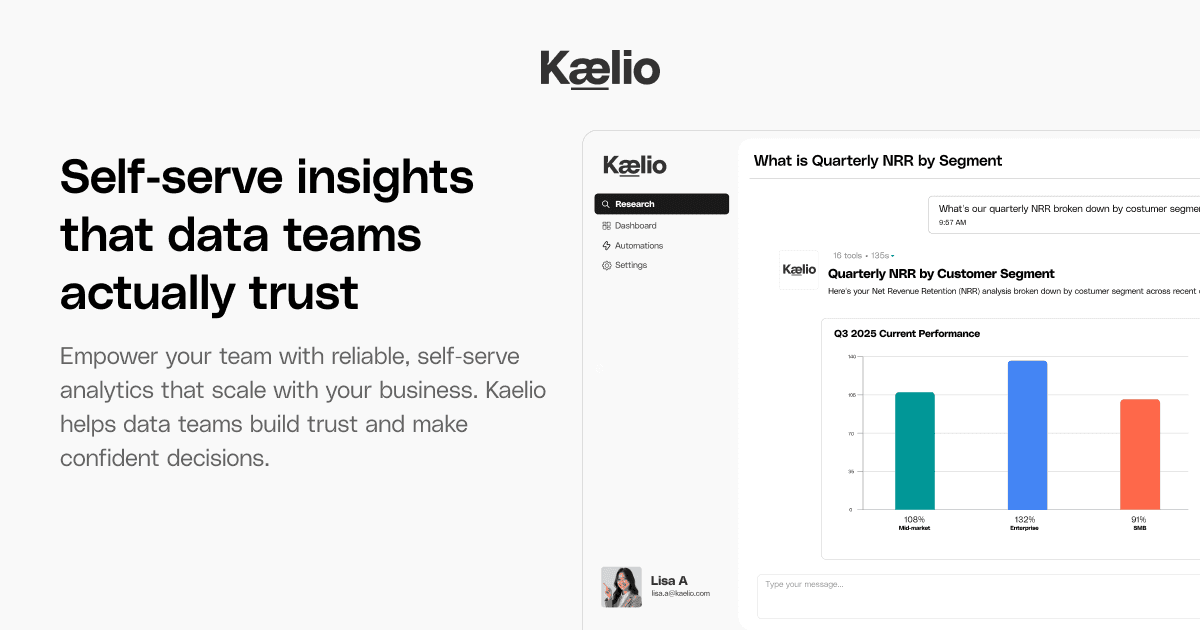
Kaelio is the AI data analyst built on your semantic layer, business context, and governance to deliver trusted, governed insights directly from your data stack.

MixRank curates the world’s most updated feed of people, companies, and technographic datasets. Receive data updates at hourly rates.

Effortlessly centralize all the data you need so your team can deliver better insights, faster. Start for free.
Run a free AEO + signal audit for your domain.
AI Answer Engine Optimization (AEO)
List once. Convert intent from live AI conversations without heavy integration.
Data analytics and business intelligence are systematic processes for evaluating data to extract insights that drive better business decisions. They encompass technologies like data mining, predictive analytics, and dashboards to synthesize information from structured and unstructured sources. Organizations leverage them to enhance operational efficiency, identify new market opportunities, and improve customer experience.
Relevant internal and external data sources are collected, cleansed, and integrated into a central data warehouse or lake.
Using statistical models and machine learning, patterns are uncovered and communicated through interactive dashboards and reports.
The derived analytical insights inform strategic planning and decision-making processes to optimize business operations.
Banks employ predictive analytics for credit scoring, fraud detection, and developing personalized financial products to mitigate risks.
Online retailers analyze customer behavior to optimize dynamic pricing, targeted product recommendations, and marketing campaigns.
Manufacturers use sensor data to predict equipment failures, schedule maintenance, and enhance production quality.
Hospitals analyze patient and treatment data to optimize care pathways, plan resources, and improve clinical outcomes.
Software companies utilize usage analytics to measure feature adoption, predict churn, and guide data-driven product roadmaps.
Bilarna evaluates every data analytics and business intelligence provider using a proprietary 57-point AI Trust Score. This continuously assesses expertise, client references, compliance certifications, and delivery track record. Only verified providers with a proven success history are listed on the platform.
Costs vary widely based on scope, technologies used, and service level. They range from monthly SaaS subscriptions for standard tools to six-figure investments for customized enterprise solutions including consultancy.
Business Intelligence (BI) focuses on descriptive analysis of historical data for standardized reporting and dashboards. Data analytics encompasses a broader spectrum, including predictive and prescriptive analytics to forecast trends and recommend actions.
Implementation can range from 3 months for pre-configured cloud solutions to over a year for complex, enterprise-wide on-premise systems. The timeline depends on data integration, customization, and training needs.
A competent consultant holds certifications in technologies like Tableau or Power BI, has deep SQL and data warehousing knowledge, and demonstrates proven experience in your industry. Strong communication skills for liaising with business units are essential.
Successful BI initiatives improve data freshness, reduce manual reporting time, increase decision speed, and enhance ROI transparency. Concrete KPIs often include revenue growth, cost reduction, or improved customer satisfaction scores.
Data analytics and machine learning tools enhance business intelligence by transforming raw data into actionable insights through advanced processing and predictive modeling. Key tools include Python libraries like Pandas and Scikit-learn for data manipulation and algorithm implementation, visualization platforms such as Tableau and Looker for interactive dashboards, and big data frameworks like Spark and Databricks for handling large datasets. Machine learning applications leverage TensorFlow and NLP models including BERT for tasks like sentiment analysis and trend forecasting. These technologies enable automated reporting, real-time analytics, and data-driven decision-making, helping organizations optimize operations, identify market opportunities, and improve customer experiences through precise, scalable analytical capabilities.
An AI-first business intelligence and analytics platform uses artificial intelligence to enhance data analysis and decision-making. 1. Collect data from various sources. 2. Use AI algorithms to process and analyze the data. 3. Generate insights and visualizations automatically. 4. Provide predictive analytics to forecast trends. 5. Enable users to make data-driven decisions efficiently.
Artificial intelligence enhances business intelligence and financial analysis platforms by enabling natural language querying, providing predictive insights, and automating complex data analysis tasks. AI allows users to ask questions in plain language to retrieve instant insights from their data, making the software accessible even to non-technical users. It can identify patterns, anomalies, and trends that might be missed manually, offering recommendations for action. For instance, AI can forecast sales demand, optimize inventory levels, or highlight rebates opportunities. By integrating AI, these platforms accelerate decision-making, reduce the reliance on IT support, and empower teams to leverage data more effectively for strategic planning. This leads to improved operational efficiency and competitive advantage.
Using SAPPER intelligence in business analytics offers several benefits. First, it enhances data accuracy by automating data processing and reducing human error. Second, it provides predictive insights that help anticipate market trends and customer behavior. Third, it improves decision-making speed by delivering real-time analysis. Fourth, it enables customization to fit unique business needs and scenarios. Fifth, it supports scalability, allowing businesses to handle growing data volumes efficiently. Lastly, it fosters competitive advantage by leveraging advanced analytics to optimize strategies and operations.
Automating data extraction streamlines the process of gathering information from various complex documents, reducing the need for manual data entry. This leads to faster and more reliable reporting since data is validated and structured consistently. Automated extraction minimizes human errors and ensures that analytics are based on accurate and up-to-date information. Consequently, businesses can generate insights more efficiently, enabling timely decision-making and better performance tracking across departments or projects.
Data analytics plays a crucial role in enhancing food safety and business performance by transforming raw data into actionable insights. Using advanced technologies such as artificial intelligence and machine learning, businesses can predict potential risks, optimize operational processes, and make informed strategic decisions. This approach helps identify trends in foodborne illnesses, monitor compliance, and improve customer satisfaction by addressing safety concerns effectively. Ultimately, data analytics supports continuous improvement and risk mitigation in the food industry.
Automating data extraction eliminates the need for manual data entry, reducing errors and saving valuable time. This leads to faster and more reliable data availability, which enhances the quality of business reporting and analytics. With structured and validated data, companies can perform accurate benchmarking and generate insightful reports, enabling better decision-making and strategic planning.
An automated AI data team simplifies business analytics by using AI to handle data collection, processing, and analysis without requiring technical expertise. To utilize such a team: 1. Integrate your data sources into the platform, supporting multiple tools and formats. 2. Allow the AI to automatically learn about your organization and connect data points. 3. Access real-time insights through intuitive, self-learning widgets that adapt to your business needs. This approach democratizes data access across the organization, enabling data-driven decisions without complex technical involvement.
Video analytics supports retail analytics and loss prevention by providing detailed insights into customer behavior, store traffic, and potential security threats. It can track movement patterns, identify suspicious activities, and monitor high-risk areas in real time. This data helps retailers optimize store layouts, improve customer experience, and reduce theft or fraud. Additionally, video analytics can filter alarms to focus on genuine incidents, minimizing false alerts and enabling security teams to act efficiently. Overall, it empowers retailers to make informed, data-driven decisions to enhance operational efficiency and protect assets.
Business Intelligence (BI) systems improve decision-making by aggregating and analyzing data from multiple sources to provide actionable insights and a unified view of business performance. They transform raw data into interactive dashboards and reports, enabling users to identify trends, monitor KPIs, and forecast outcomes with greater accuracy. For business growth, BI tools enhance competitiveness by speeding up decision cycles and allowing companies to respond swiftly to market changes. They help optimize sales strategies by revealing top-performing products and markets, improve operational efficiency by pinpointing bottlenecks, and increase revenue by identifying new business opportunities. By basing strategic decisions on consolidated, real-time data rather than assumptions, organizations can allocate resources more effectively, improve customer satisfaction through deeper insights, and achieve sustainable growth through data-driven agility.