Step 1
Machine-Ready Briefs
AI translates unstructured needs into a technical, machine-ready project request.
We use cookies to improve your experience and analyze site traffic. You can accept all cookies or only essential ones.
 Bilarna
Stop browsing static lists. Tell Bilarna your specific needs. Our AI translates your words into a structured, machine-ready request and instantly routes it to verified Chinese Reading Courses experts for accurate quotes.
AI translates unstructured needs into a technical, machine-ready project request.
Compare providers using verified AI Trust Scores & structured capability data.
Skip the cold outreach. Request quotes, book demos, and negotiate directly in chat.
Filter results by specific constraints, budget limits, and integration requirements.
Eliminate risk with our 57-point AI safety check on every provider.
Verified companies you can talk to directly
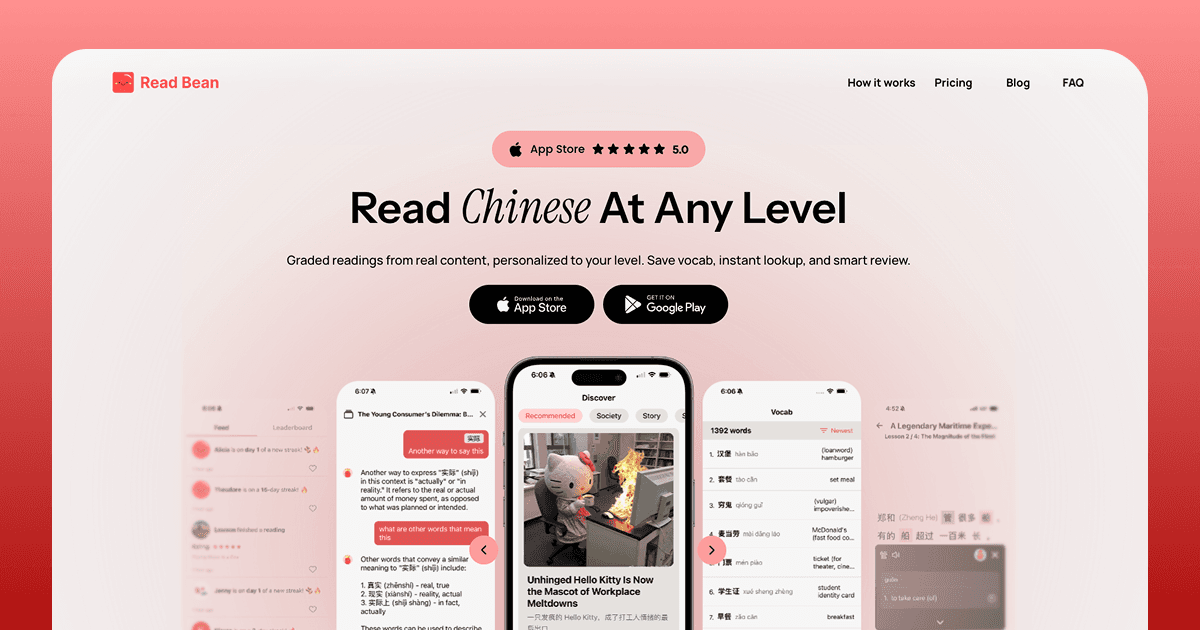
Master Chinese reading from HSK 1–6 through real stories and culture. Read Bean personalizes each lesson with smart review and context to help you improve effortlessly.
Run a free AEO + signal audit for your domain.
AI Answer Engine Optimization (AEO)
List once. Convert intent from live AI conversations without heavy integration.
Chinese reading courses are specialized training programs designed to equip professionals with the skills to comprehend, analyze, and interpret business documents written in Chinese. They focus on building domain-specific vocabulary, understanding complex sentence structures, and developing strategies for efficient information extraction from contracts, reports, and technical manuals. This enables executives, analysts, and researchers to make data-driven decisions based on primary sources without relying on translation services.
The process begins with an assessment of current proficiency and the establishment of clear business objectives for reading Chinese materials.
Learners then participate in structured lessons that systematically build technical vocabulary, document format familiarity, and context-specific reading strategies.
Finally, acquired skills are reinforced and applied through practical exercises and the analysis of authentic, real-world business documents.
Enabling professionals to read contracts, regulatory documents, and product specifications to mitigate risks and enhance negotiation capabilities.
Empowering analysts to interpret Chinese financial statements, market news, and economic reports for accurate valuations and investment insights.
Allowing engineers and product managers to decipher technical documentation, patent filings, and research papers for development and competitive analysis.
Equipping professionals to understand regulatory submissions, clinical trial data, and medical journals for compliance and market entry strategies.
Enabling scholars to access and analyze historical texts, scientific articles, and market studies published in Chinese for independent research.
Bilarna evaluates Chinese reading course providers using a proprietary 57-point AI Trust Score that assesses expertise, reliability, and client satisfaction. This comprehensive screening includes rigorous checks of instructor credentials, curriculum quality, and verified learner outcomes. We continuously monitor performance and update scores to ensure you connect with the most reputable and effective training partners on our platform.
Professional Chinese reading courses for business typically range from $800 to $5,000 per participant, depending on course length, customization level, and provider reputation. Costs are influenced by factors such as class size, inclusion of proprietary industry document libraries, and the depth of personalized coaching. Many providers offer tailored enterprise solutions with volume discounts.
A comprehensive business reading course usually requires 40 to 100 hours of instruction, typically delivered over 3 to 6 months. The timeline is determined by the learner's starting level, the complexity of the target materials, and the course format. Intensive programs or self-paced online modules can accommodate accelerated or more flexible schedules.
Prioritize providers with proven experience in your industry, a clear pedagogical focus on reading comprehension, and a curriculum that utilizes authentic business documents. Evaluate instructor qualifications, request case studies demonstrating past learner success, and assess the relevance of teaching materials to your specific needs. A trial session is highly recommended.
Yes, leading providers often develop industry-specific modules focusing on the vocabulary and document types prevalent in fields like law, finance, or engineering. This customization ensures participants acquire precisely the skills needed for their professional context, thereby maximizing the training's return on investment and immediate applicability.
General courses balance speaking, listening, reading, and writing, while specialized reading courses offer intensive training in decoding written business texts. They emphasize technical terminology, complex grammatical structures, and strategies for rapid comprehension of formal documents, making them ideal for professionals whose primary need is extracting information from written Chinese sources.
Yes, you can download the personalized storybook as a PDF for offline reading. Follow these steps: 1. Complete the storybook creation by uploading the photo and generating the story. 2. Once the story is ready, look for the download option on the platform. 3. Click the download button to save the PDF file to your device. 4. Open the PDF anytime without an internet connection.
Evaluate the accuracy of online palm reading by following these steps: 1. Understand that online palm reading combines traditional palmistry wisdom with advanced image analysis technology. 2. Upload clear palm photos to allow the system to identify lines, patterns, and features precisely. 3. Note that many platforms achieve up to 95% user satisfaction due to detailed and accurate readings. 4. Consider that instant digital analysis can provide consistent and objective insights, often matching or exceeding traditional methods in precision.
Increase pupil enthusiasm for reading by using a school library app that visualizes their reading progress and offers tailored advice. 1. Show pupils what they are currently reading. 2. Provide personalized book recommendations based on their interests. 3. Track and display reading achievements to motivate pupils. 4. Encourage exploration of new genres and authors. 5. Use data insights to support pupils who find reading difficult.
AI can improve reading growth and curriculum coherence by integrating real-time assessment, personalized instruction, and one-on-one tutoring. 1. Use AI to listen to students read aloud and analyze their reading skills quickly. 2. Employ AI-driven lesson plans that align with curriculum standards and adapt to individual student needs. 3. Provide personalized tutoring sessions where AI coaches students, reinforcing learning and addressing specific reading difficulties. This approach ensures faster reading growth and consistent curriculum delivery across all learners.
AI-powered summaries improve news reading by providing clear, concise overviews that highlight key facts and expose biases. 1. They reduce the time needed to understand complex articles. 2. They filter out emotional and persuasive language to focus on factual content. 3. They reveal hidden agendas by analyzing tone and framing. 4. They enable readers to make informed decisions based on unbiased information. 5. They deliver instant clarity regardless of the news source or platform. This enhances comprehension and trust in news consumption.
Use autonomous night scanning to detect diseases early on golf courses. 1. Schedule nightly scans to capture fungal symptoms at their first appearance. 2. Analyze the collected data to identify disease indicators such as Dollar Spot before they become visible during the day. 3. Receive alerts and stress maps each morning to prioritize treatment areas. 4. Implement targeted interventions promptly to prevent disease spread and reduce chemical use. 5. Monitor treatment effectiveness over time by comparing data from previous scans.
Beginners interested in starting a career in the electrical industry can benefit greatly from free online courses that provide basic electrical training and an overview of the industry. These courses typically cover essential topics such as industry career paths, jobsite and electrical safety, and fundamental electrical theory including current, voltage, and Ohm’s Law. Completing such a course not only equips learners with foundational knowledge but also often connects them with potential employers. Many platforms notify employers once candidates finish the training, significantly increasing the chances of being hired. This approach is ideal for those new to the field who want to gain skills and enter the workforce efficiently.
Bilingual reading tools help overcome language barriers on social media by translating posts instantly into your preferred languages. 1. Access social media platforms as usual. 2. Use the bilingual reading tool to translate posts and comments with one click. 3. View original and translated texts side by side for clear understanding. 4. Engage with global content effortlessly, enhancing communication and cultural exchange.
Developers can enhance their skills and stay current with industry standards by engaging with mobile development tutorials. Tutorials provide hands-on experience through step-by-step instructions, code snippets, and project-based learning. They help in understanding complex concepts such as state management in apps, integration of APIs, or implementing security features. By following tutorials, developers can quickly learn new tools and libraries, troubleshoot issues, and build a portfolio of projects. Additionally, tutorials often include explanations of why certain approaches are used, fostering deeper comprehension. This practical knowledge translates to more efficient coding, better app performance, and increased employability in the competitive tech job market.
Differentiated reading materials cater to the individual reading levels of students, allowing each learner to engage with content that matches their comprehension abilities. In science and history education, this approach helps students grasp core concepts more effectively by reading texts tailored to their skill level. It supports literacy development while simultaneously teaching subject matter, ensuring that all students, regardless of their reading proficiency, can participate and learn. This method also enables teachers to save time on lesson planning and focus on reteaching concepts where students struggle.