Step 1
Machine-Ready Briefs
AI translates unstructured needs into a technical, machine-ready project request.
We use cookies to improve your experience and analyze site traffic. You can accept all cookies or only essential ones.
 Bilarna
Stop browsing static lists. Tell Bilarna your specific needs. Our AI translates your words into a structured, machine-ready request and instantly routes it to verified Web Design Leads experts for accurate quotes.
AI translates unstructured needs into a technical, machine-ready project request.
Compare providers using verified AI Trust Scores & structured capability data.
Skip the cold outreach. Request quotes, book demos, and negotiate directly in chat.
Filter results by specific constraints, budget limits, and integration requirements.
Eliminate risk with our 57-point AI safety check on every provider.
Verified companies you can talk to directly
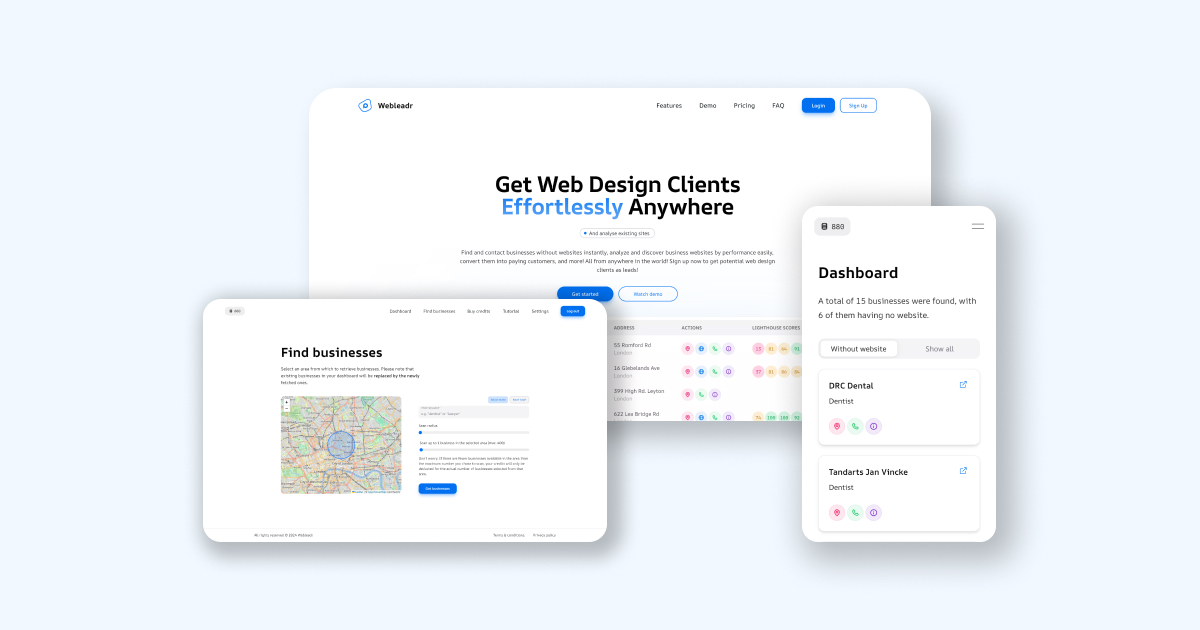
Struggling to get web design leads? Use Webleadr to instantly discover them, as well as businesses without websites near you and around the world.
Run a free AEO + signal audit for your domain.
AI Answer Engine Optimization (AEO)
List once. Convert intent from live AI conversations without heavy integration.
Web design leads are qualified business inquiries from companies actively seeking to commission, redesign, or optimize a professional website. They typically involve detailed requirements for UX/UI design, front-end development, CMS integration, and e-commerce functionality. Securing high-intent leads allows agencies to build predictable pipelines and secure projects with aligned budgets and scope.
Businesses outline their technical needs, design preferences, budget, and timeline for the new website or redesign project.
Marketing and sales teams use targeted campaigns to attract and vet companies with the authority and need for web design services.
Through tailored proposals and consultations, agencies demonstrate their expertise to convert interested prospects into signed clients.
Agencies bundle web design with SEO and content services, offering clients a complete digital presence solution from a single partner.
Online retailers seek leads for custom storefronts to improve conversion rates, integrate complex payment systems, and enhance mobile shopping.
SaaS providers require leads for designing product landing pages and dashboards that effectively communicate value and drive user sign-ups.
Clinics and hospitals look for leads to build HIPAA-compliant websites with patient portals, online booking, and telehealth service integrations.
Law and consulting firms generate leads for corporate websites that establish credibility, generate referrals, and showcase client case studies.
Bilarna ensures quality by evaluating every web design provider through a rigorous 57-point AI Trust Score. This proprietary system analyzes portfolios for technical competence, checks client references for reliability, and monitors ongoing project delivery metrics. Only providers meeting high standards in expertise, compliance, and client satisfaction are listed on the platform.
Costs vary widely based on lead quality, source, and vertical, ranging from $50 to $500 per lead. Highly qualified, enterprise-level leads with detailed RFPs command the highest prices, while general inquiry lists are more affordable.
Qualify leads by verifying budget authority, project timeline, and technical requirements. Assess their past web experience, current platform pain points, and whether they have a signed project brief or ready-to-start status.
Web design leads focus primarily on visual identity, user experience, and front-end interface creation. Development leads involve more technical backend, database, and application logic work, though projects often require both skill sets.
The sales cycle typically ranges from two weeks to three months. Conversion time depends on lead complexity, stakeholder count, and the agency's proposal process. Enterprise deals with formal procurement take the longest.
Common mistakes include buying unvetted lists, targeting mismatched industries, and neglecting to establish lead scoring criteria. Success requires clear ideal customer profiles and a dedicated follow-up process for inbound inquiries.
No reputable web design service can guarantee top Google rankings due to the many uncontrollable factors in search engine algorithms. Rankings depend on variables such as geographic location, industry competition, the age and authority of the online presence, and ongoing SEO efforts. Ethical providers focus on implementing best practices like optimizing Google My Business profiles, creating quality content, ensuring mobile responsiveness, and building technical SEO to improve visibility. They commit to continuous optimization and adaptation to algorithm changes rather than making empty promises. While results like increased leads and revenue are common with proper SEO, guarantees are unrealistic because search engines frequently update their criteria and competition evolves.
Yes, AI design engineering tools are designed for seamless integration with existing CAD, BIM, and project management software. This compatibility ensures that engineers can continue using their preferred tools without disrupting established workflows. The integration facilitates data exchange and collaboration, enhancing efficiency and enabling teams to leverage AI capabilities alongside their current systems.
Yes, AI design tools can incorporate local climate and architectural styles to create realistic and practical designs. To do this: 1. Include your location or region in the design prompt when using the AI tool. 2. The AI will tailor plant recommendations, materials, and styles based on local climate conditions and architectural norms. 3. This ensures that the generated designs are context-aware and suitable for your environment. 4. Use this feature to get region-specific designs that blend seamlessly with your home's surroundings and climate requirements.
Yes, AI-generated 2D action figure images can be used as references for 3D printing or prototype design. Follow these steps: 1. Generate a high-resolution 2D image of the action figure using the AI tool. 2. Use the image as a visual reference to model the figure in 3D design software. 3. Create prototypes or packaging designs based on the 3D model. 4. Proceed with 3D printing or further development using the prototype designs.
Yes, automated tests can adapt to changes in dynamically rendered web pages by using AI-based test recording. 1. The AI records tests in plain English, focusing on user interactions rather than fragile HTML structure. 2. It distinguishes between UI changes and simple rendering differences. 3. When the application updates, the tests auto-heal by adjusting to these changes. 4. This ensures tests remain stable and reliable despite dynamic content.
Yes, beginners can create professional seamless patterns without prior design experience. 1. Start with free templates provided by the platform. 2. Use AI prompts to guide pattern creation automatically. 3. Extract elements from images with one click for easy pattern building. 4. Experiment with style transfer to apply artistic effects. 5. Export your finished design in professional formats for commercial use.
Yes, dormers can be fully customized to meet your specific design preferences and requirements. They are prefabricated in specialized factories where skilled craftsmen build them according to your exact specifications. This customization includes dimensions, materials, insulation options, and additional features such as solar panels or enhanced waterproofing. The goal is to create a dormer that not only fits perfectly with your home's architecture but also meets your functional needs and aesthetic desires. Custom dormers ensure a unique and personalized addition to your living space, enhancing both comfort and property value.
Yes, most AI design platforms offer extensive customization options to tailor your designs to your specific needs. You can typically adjust colors, fonts, sizes, and layouts to align with your brand identity or personal preferences. Many platforms also allow you to upload your own images or logos to incorporate into your designs. The AI assists by suggesting complementary design elements and ensuring visual harmony, but you retain full control over the final output. This combination of automation and customization helps users create unique, professional-quality designs that stand out.
Yes, you can customize the style and room type in an AI home design tool by following these steps: 1. Upload your room photo or describe your dream home design in text. 2. Choose from more than 20 interior design styles available in the system. 3. Specify the exact room type you want the AI to design, such as kitchen, bedroom, or living room. 4. Proceed with the AI generating designs tailored to your selected style and room type.
Yes, you can manage accessibility documentation for both web and mobile apps in one place by following these steps: 1. Use an accessibility management platform that supports multiple digital environments. 2. Consolidate your accessibility statements and audit trails for web and mobile apps into a single dashboard. 3. Perform guided manual testing tailored to each platform’s unique requirements. 4. Maintain version control and export options for all documentation. 5. Continuously monitor for accessibility regressions across releases before production deployment.