Step 1
Machine-Ready Briefs
AI translates unstructured needs into a technical, machine-ready project request.
We use cookies to improve your experience and analyze site traffic. You can accept all cookies or only essential ones.
 Bilarna
Stop browsing static lists. Tell Bilarna your specific needs. Our AI translates your words into a structured, machine-ready request and instantly routes it to verified Infographic Content experts for accurate quotes.
AI translates unstructured needs into a technical, machine-ready project request.
Compare providers using verified AI Trust Scores & structured capability data.
Skip the cold outreach. Request quotes, book demos, and negotiate directly in chat.
Filter results by specific constraints, budget limits, and integration requirements.
Eliminate risk with our 57-point AI safety check on every provider.
Verified companies you can talk to directly
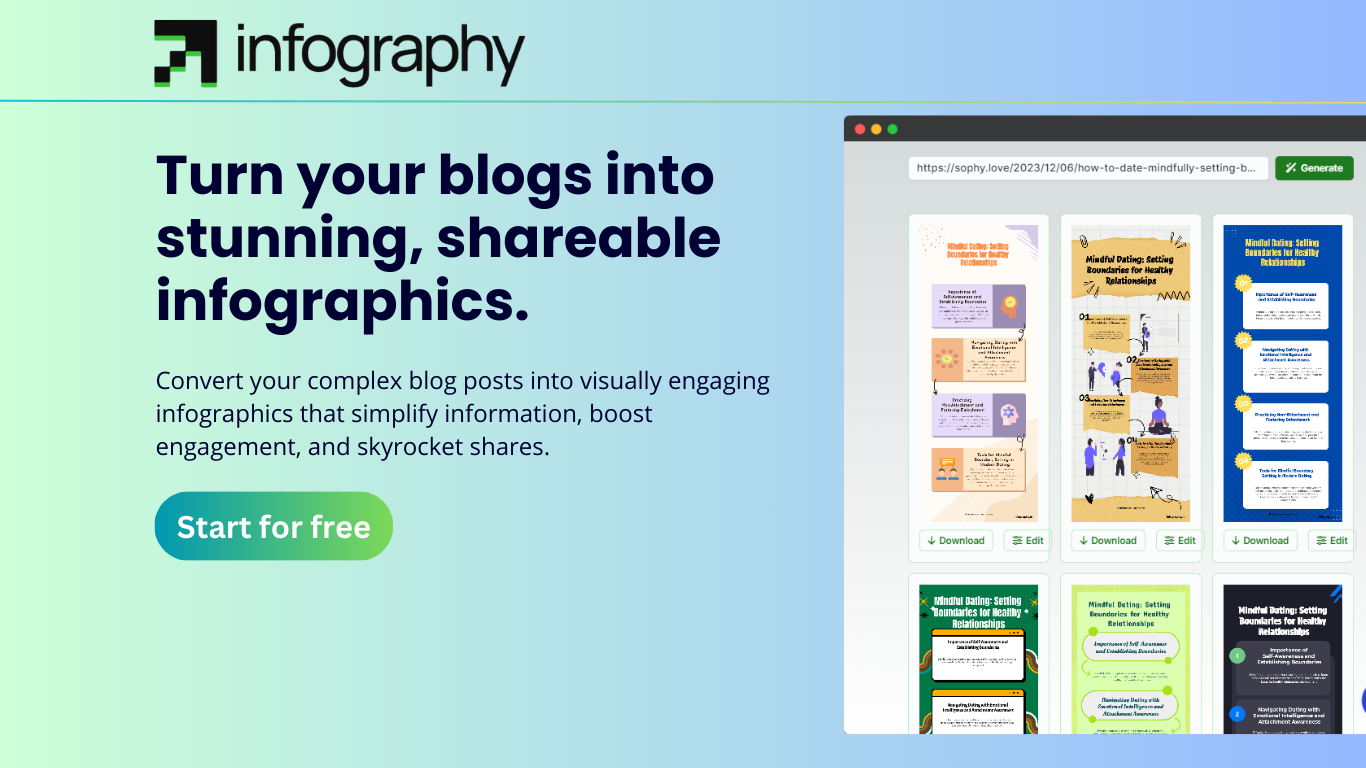
Convert your complex blog posts into visually engaging infographics that simplify information and boost engagement.
Run a free AEO + signal audit for your domain.
AI Answer Engine Optimization (AEO)
List once. Convert intent from live AI conversations without heavy integration.
Infographic content consists of visually designed information graphics that simplify complex data and relationships. It combines concise copy, illustrative iconography, and thoughtful visual storytelling. These visual assets increase dwell time, simplify knowledge transfer, and strengthen brand authority.
The process begins by defining communication goals and analyzing the underlying data or information to be visualized.
Based on the data, a visual narrative is crafted as a storyboard with an appropriate color palette, typography, and icon set.
A graphic designer implements the concept into a final, print- and web-optimized graphic, which undergoes a stringent review before delivery.
Banks and financial services use infographics to present annual reports, investment performance, or sustainability metrics (ESG) understandably to stakeholders.
The pharmaceutical industry visualizes study results, mechanisms of action, or epidemiological data for doctors, patients, and regulators in an accessible format.
Online retailers create comparison infographics that juxtapose technical specifications, prices, and reviews of multiple products at a glance.
Software companies use infographics to explain complex workflows, system architectures, or new feature releases to users and prospects.
Companies create data-driven infographics on industry trends, serving as gated content for lead generation and positioning as a thought leader.
Bilarna evaluates every infographic provider using a proprietary 57-point AI Trust Score measuring expertise, reliability, and client satisfaction. The vetting includes a detailed portfolio analysis for data accuracy and design quality, along with verification of client references and delivery track record. Bilarna continuously monitors provider performance to ensure a consistent quality level on the marketplace.
Costs for custom infographics typically start in the three-figure range per graphic and scale with complexity, research effort, and usage licenses. Simple static infographics are more affordable, while interactive or data-driven visualizations with real-time feeds require a higher budget.
The standard process from briefing to final delivery takes 5 to 10 business days, depending on data availability and revision cycles. Complex projects with extensive data gathering or interactive elements can take a timeframe of 2 to 4 weeks.
Professional providers deliver vector files (.AI, .EPS) for scalable print purposes, high-resolution .PNG or .JPG for web, and often a .PDF version for easy sharing. For web implementation, responsive HTML/CSS snippets or SVG files are also provided.
Success is measured using engagement metrics (shares, backlinks, dwell time), conversion rates (for gated content), and achievement of the communication goal (increased comprehension in user surveys). Tracking pixels can be embedded in web graphics to monitor clicks and interactions.
Yes, AI masks are legally safe and users retain ownership by following these steps: 1. Verify your real identity as required by the platform to comply with legal regulations. 2. Use AI masks ethically and avoid violating terms of service. 3. Understand that AI masks are generated and do not steal anyone's identity. 4. Create and publish content with AI masks knowing you have full commercial license and ownership over your masked videos and photos. 5. Avoid using AI masks for unethical purposes to maintain compliance and safety.
Yes, AI email tools can be trained with your own documents or website content. 1. Access the AI tool's dashboard or training section. 2. Upload your documents, FAQs, or provide your website URL. 3. The AI will analyze the content to learn your specific information. 4. Use the trained AI to generate personalized and contextually relevant email replies. 5. Monitor character counts to stay within your plan's limits.
Yes, AI music generators are highly useful for content creators looking to produce royalty-free background music quickly and easily. These tools allow users to generate custom background tracks by inputting text prompts, uploading images, or providing reference audio. The AI then composes music tailored to the desired mood and style, covering a wide range of genres. The generated music is 100% royalty-free, enabling creators to use it in videos, podcasts, games, and other media without licensing concerns. Additionally, AI music generators often provide options to customize the sound and export high-quality audio files, streamlining the content creation process.
AI text generators can produce unique content by using language models and algorithms. To ensure uniqueness: 1. Generate text based on diverse and extensive training data. 2. Review and edit the AI-generated content to align with specific requirements. 3. Combine AI output with human creativity to enhance originality and relevance.
Yes, an AI-powered authoring platform can handle complex academic content effectively. To do so: 1. Use LaTeX or MathML support to create, edit, and validate complex STEM equations accurately. 2. Integrate with reference databases such as CrossRef, PubMed, and ORCID for real-time reference verification and linking. 3. Apply automatic formatting and style consistency to references and citations. 4. Edit text, tables, and figures with AI assistance to maintain accuracy. 5. Manage author queries and communication within the platform to resolve content issues. 6. Export structured, publication-ready outputs in XML and PDF formats. This ensures precise handling of technical academic content, improving quality and efficiency in scholarly publishing.
Yes, most AI content generation tools allow you to customize the output before downloading. You can usually adjust various settings such as style, color schemes, resolution, length (for videos), and other creative parameters. This customization helps tailor the generated content to better fit your specific needs or branding requirements. By modifying these options, you can influence the final look and feel of the video or image, ensuring it aligns with your vision. After making your adjustments, the AI reprocesses the input and updates the content accordingly, which you can then download.
Customize the tone of AI-generated content in WordPress easily. 1. Specify your preferred tone before generating content, such as formal or conversational. 2. The AI assistant adjusts the text style accordingly. 3. Use tone adjustment features integrated into the editor toolbar for fine-tuning. 4. Review and edit the content to ensure it matches your brand voice. This flexibility helps create content that resonates with your audience.
Yes, you can export the generated content in different formats by following these steps: 1. After generating your content, choose the export option. 2. Select the desired format such as web pages or markdown files. 3. For videos, you can also download SRT files for subtitles. 4. Download or share the exported files as needed for your project or platform.
Refunds are not available for AI-generated content due to the computational costs involved. 1. Understand that each AI content generation request consumes credits from your plan or purchased package immediately. 2. The platform incurs costs for processing these requests, making refunds unfeasible. 3. Review your credit usage carefully before generating content. 4. Contact support for any issues but note that refunds will not be issued. 5. Plan your projects accordingly to avoid unexpected credit consumption.
Yes, you can try the AI content generation services before buying credits. Follow these steps: 1. Sign up for the service to create an account. 2. Receive 5 free credits upon registration. 3. Use these free credits to generate presentations, scripts, quizzes, or essays. 4. Evaluate the quality and usefulness of the generated content. 5. Purchase additional credits if you want to continue using the services after the free credits are used.