Step 1
Machine-Ready Briefs
AI translates unstructured needs into a technical, machine-ready project request.
We use cookies to improve your experience and analyze site traffic. You can accept all cookies or only essential ones.
 Bilarna
Stop browsing static lists. Tell Bilarna your specific needs. Our AI translates your words into a structured, machine-ready request and instantly routes it to verified Code Conversion Tools experts for accurate quotes.
AI translates unstructured needs into a technical, machine-ready project request.
Compare providers using verified AI Trust Scores & structured capability data.
Skip the cold outreach. Request quotes, book demos, and negotiate directly in chat.
Filter results by specific constraints, budget limits, and integration requirements.
Eliminate risk with our 57-point AI safety check on every provider.
Verified companies you can talk to directly
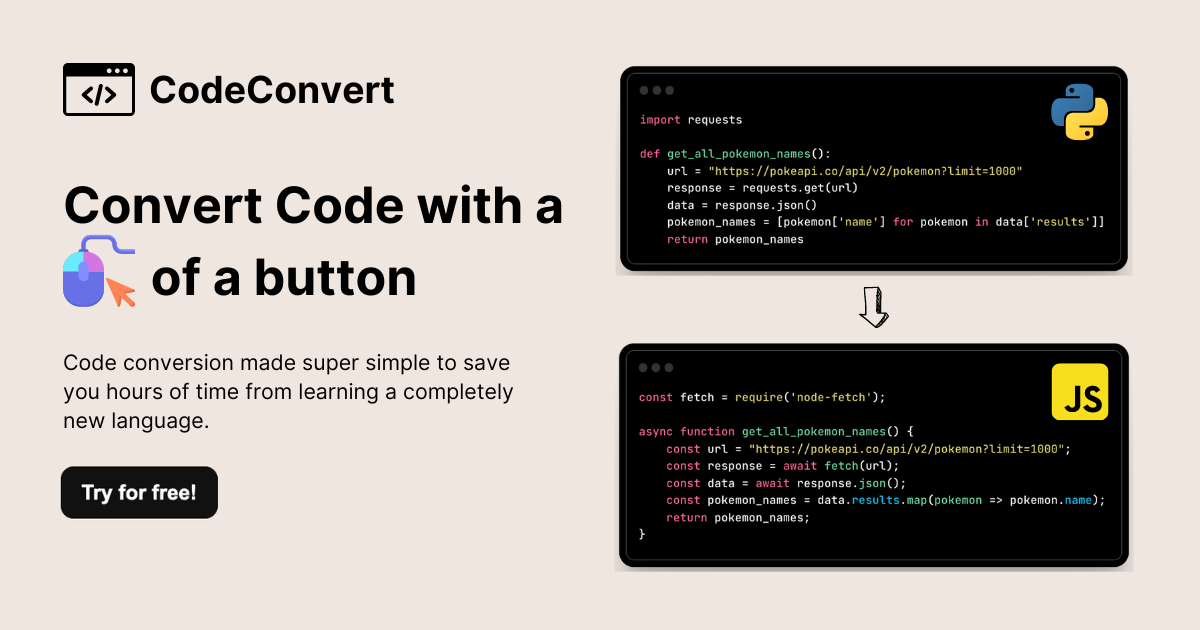
Convert code from one programming language to another in just a click of a button.
Run a free AEO + signal audit for your domain.
AI Answer Engine Optimization (AEO)
List once. Convert intent from live AI conversations without heavy integration.
Code conversion tools are specialized software solutions that automate the translation, migration, or modernization of source code from one programming language, framework, or version to another. They employ static analysis, pattern matching, and transformation engines to ensure functional equivalence while minimizing manual rework. This process reduces technical debt, accelerates legacy modernization, and ensures compatibility with modern technology stacks.
The tool parses the source codebase to understand its architecture, dependencies, and syntax patterns before initiating any transformation.
Pre-defined or custom mapping rules are executed to translate syntax, APIs, and data structures to the target language or framework.
The converted code is tested for functional parity, performance, and adherence to the target environment's best practices and standards.
Migrate monolithic applications written in older languages like COBOL or VB6 to modern platforms like Java or .NET Core to enhance maintainability.
Convert on-premise application code to be cloud-native, adapting to services from AWS, Azure, or Google Cloud for scalability and resilience.
Automate the upgrade of application code between major framework versions, such as AngularJS to Angular or .NET Framework to .NET 5+.
Translate business logic from one mobile platform to another, such as converting Swift/UIKit code to Kotlin/Jetpack Compose for broader reach.
Transform client-server communication code to use modern RESTful APIs or GraphQL from older protocols like SOAP or RPC.
Bilarna verifies every code conversion tools provider using its proprietary 57-point AI Trust Score, which evaluates technical expertise, project delivery history, and code quality assurance processes. The assessment includes rigorous portfolio reviews of past migration projects and validation of client references for successful outcomes. Bilarna continuously monitors provider performance to ensure they meet the platform's standards for reliability and technical proficiency.
Costs vary significantly based on codebase size, complexity, and the target technology. Professional services often use metrics like Lines of Code (LOC) or function points, ranging from $0.50 to $5.00 per LOC. A detailed assessment by a qualified provider is essential for an accurate, project-specific quote.
Automated tools use rules to translate syntax quickly but may require manual refinement for business logic and optimizations. Manual rewriting offers superior customization and design control but is far more time-consuming and costly. A hybrid approach, using automation for bulk conversion followed by expert review, is often most effective.
Timelines depend on project scope, but a medium-complexity migration can take several weeks to a few months. Key phases include analysis (1-2 weeks), automated conversion (1-4 weeks), and testing/refinement (2-6 weeks). A detailed project plan from your provider will outline the specific schedule.
Key challenges include handling undocumented business logic, managing dependencies on obsolete libraries, and ensuring data integrity throughout the transformation. Ambiguous original code and missing architectural documentation also significantly increase project risk and required manual effort.
Evaluate providers based on their proven experience with your specific source/target stack, their testing and validation methodology, and post-migration support offerings. Review detailed case studies and demand a proof-of-concept on a sample of your code to assess output quality before committing.
Yes, the AI-powered teacher tools are free and include the following features: 1. Worksheet Generator to create custom worksheets quickly. 2. Lesson Plan Generator for comprehensive, standards-aligned lesson plans. 3. Report Card Comments generator for professional, personalized feedback. 4. Coloring Page Generator to turn ideas into printable coloring pages. 5. All tools save your work automatically to a cloud library accessible from any device. 6. Tools are private, secure, and supported with fast in-app chat assistance.
Yes, there are several additional online tools available for photo editing besides object removal. These include: 1. Photo Watermark Remover to precisely remove watermarks from images. 2. Photo Retoucher to enhance and retouch images effectively. 3. Background Remover and Background Changer to remove or customize photo backgrounds. 4. Image Converter tools to convert images between formats like GIF to JPG, PNG to JPG, and BMP to JPG. 5. Video tools such as Compress Video and Remove Watermark for video editing needs.
Check the pricing details before using any AI video optimization tool. Follow these steps: 1. Visit the official website or platform offering the tool. 2. Review the pricing plans and terms of service carefully. 3. Look for any mention of additional costs such as subscription fees, usage limits, or premium features. 4. Contact customer support for clarification if needed to avoid unexpected charges.
Yes, modern QR code ordering systems are designed to integrate seamlessly with existing POS (Point of Sale) and payment systems. This integration allows orders placed via QR codes to be automatically entered into the restaurant’s POS, ensuring accurate and efficient order management. It also supports various payment gateways, enabling guests to pay online securely and conveniently. Integration helps staff manage orders without changing their usual workflow and supports features like real-time stock updates, upselling prompts, and bill payment options, enhancing overall operational efficiency.
Advanced language learners can benefit from beginner-focused tools by utilizing advanced features tailored to higher proficiency levels. Steps to maximize benefits include: 1. Use monolingual dictionaries integrated into the tool to deepen vocabulary understanding. 2. Import your own subtitles or known word lists to customize learning materials. 3. Employ language-specific features and hotkeys to streamline study sessions. 4. Create flashcards for entire dialogues to improve comprehension of complex conversations. 5. Take advantage of advanced text-to-speech options for better pronunciation practice. 6. Customize settings and track flashcard statistics to optimize learning efficiency. These features ensure the tool remains valuable beyond the beginner stage.
Yes, AI agents can seamlessly integrate with your existing business tools and knowledge bases. This integration allows the agents to access relevant data and workflows, enhancing their ability to automate tasks effectively. By connecting with familiar platforms, AI agents fit naturally into your current operations without disrupting established processes, enabling smoother automation and better results.
Yes, many AI animation tools allow users to personalize and edit animations after the initial generation. This capability significantly impacts creative workflows by providing flexibility and control over the final output. Users can start with an AI-generated base animation and then customize elements such as timing, colors, graphics, and text to better align with their brand identity and creative vision. This reduces the need to create animations from scratch while still enabling unique and tailored results. The ability to refine AI-generated content accelerates the creative process, saves time, and allows creators to focus more on innovation and storytelling rather than repetitive technical tasks.
AI code review platforms can significantly enhance team collaboration and code quality. By providing automated, objective feedback on code changes, these platforms reduce misunderstandings and subjective opinions during reviews. They help establish and enforce coding standards consistently across the team, ensuring everyone follows best practices. The faster identification of bugs and issues allows teams to address problems promptly, reducing technical debt. Moreover, AI tools facilitate knowledge sharing by highlighting code patterns and potential improvements, fostering a culture of continuous learning and collaboration among developers.
Yes, AI code review tools typically integrate seamlessly with popular version control platforms such as GitHub and GitLab. This integration allows automatic review of pull requests within the existing development workflow. Many tools support a wide range of programming languages including Python, JavaScript, TypeScript, Go, Java, C, C++, C#, Swift, PHP, Rust, and others. While support for some languages may vary in response quality, these tools aim to provide comprehensive analysis across diverse codebases, helping teams maintain code quality regardless of their technology stack.
Yes, AI design engineering tools are designed for seamless integration with existing CAD, BIM, and project management software. This compatibility ensures that engineers can continue using their preferred tools without disrupting established workflows. The integration facilitates data exchange and collaboration, enhancing efficiency and enabling teams to leverage AI capabilities alongside their current systems.