Step 1
Machine-Ready Briefs
AI translates unstructured needs into a technical, machine-ready project request.
We use cookies to improve your experience and analyze site traffic. You can accept all cookies or only essential ones.
 Bilarna
Stop browsing static lists. Tell Bilarna your specific needs. Our AI translates your words into a structured, machine-ready request and instantly routes it to verified AI Sales Co-Pilot experts for accurate quotes.
AI translates unstructured needs into a technical, machine-ready project request.
Compare providers using verified AI Trust Scores & structured capability data.
Skip the cold outreach. Request quotes, book demos, and negotiate directly in chat.
Filter results by specific constraints, budget limits, and integration requirements.
Eliminate risk with our 57-point AI safety check on every provider.
Verified companies you can talk to directly

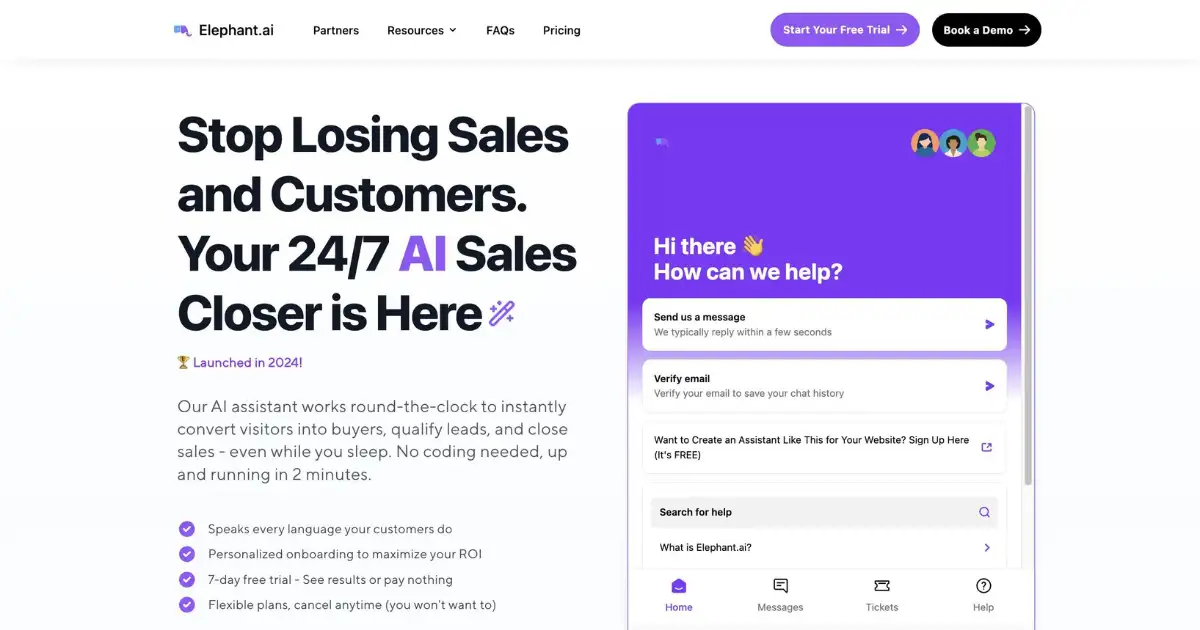
Boost your website conversions with Elephant.ai, the leading AI-powered sales assistant.
AI-powered sales assistant for non-salespeople. Skarbe captures every email and meeting, suggests what to do next, and keeps deals on track.
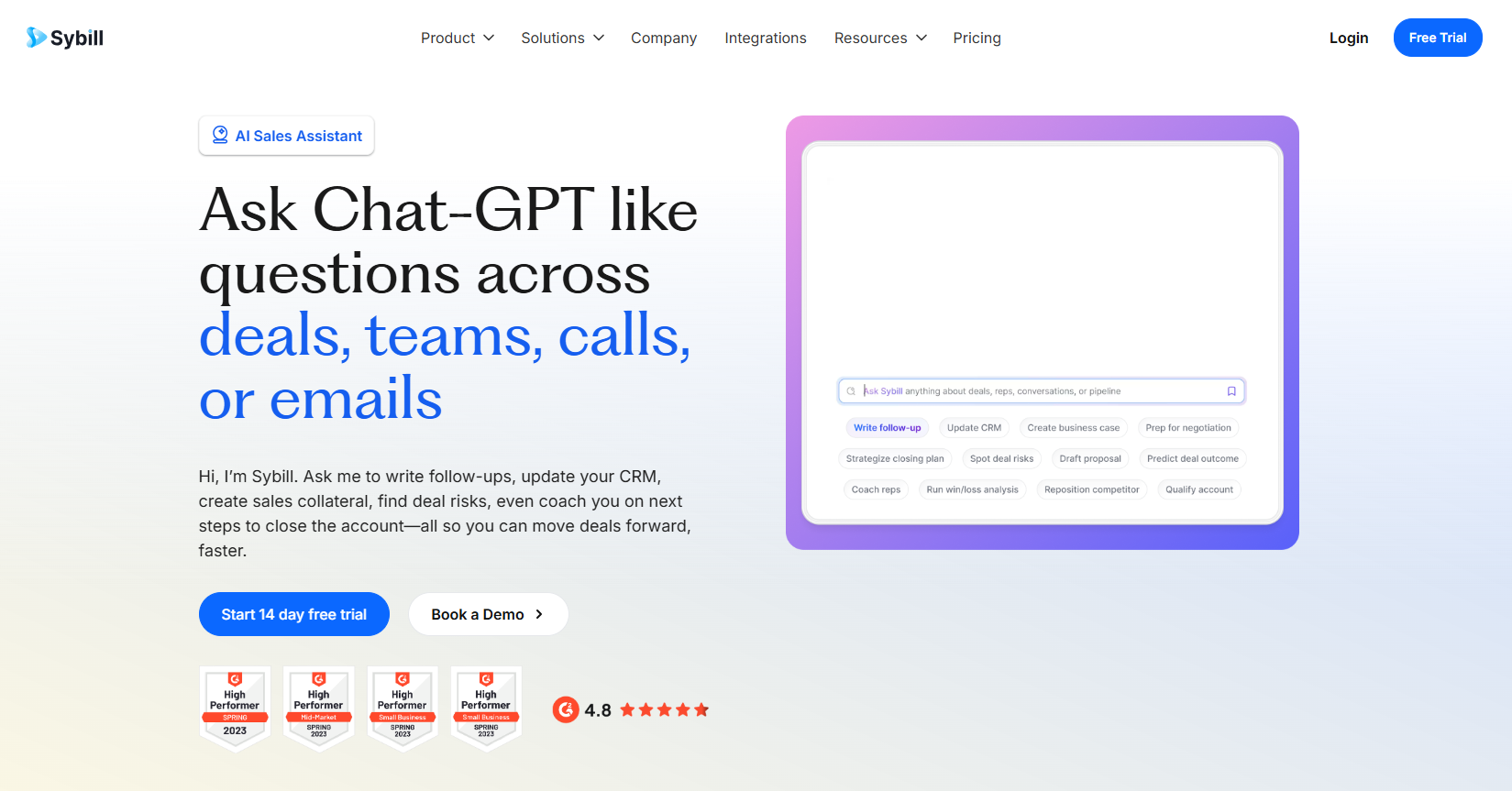
Sybill is your all-knowing AI sales assistant who can answer deal questions, create sales assets, and automate grunt work like meeting prep, email follow-ups, and CRM updates.

AI Sales Co-Pilot for Cold Outbound, Follow-Ups, and Replies. Leverage your previous conversations, CRM activity, and prospect intentions to craft a highly personalized email in one click. Acquired by FirstQuadrant in 2024.
Run a free AEO + signal audit for your domain.
AI Answer Engine Optimization (AEO)
List once. Convert intent from live AI conversations without heavy integration.
An AI Sales Co-Pilot is a software platform that uses artificial intelligence to augment and automate B2B sales processes. It typically leverages machine learning, natural language processing, and predictive analytics to handle tasks like lead scoring, email sequencing, and customer interaction analysis. This results in increased sales team productivity, higher conversion rates, and more accurate revenue forecasting for businesses.
Business leaders identify key goals, required features, and integration needs for their sales process automation.
Teams evaluate different AI sales assistant solutions based on functionality, scalability, customer reviews, and vendor reputation.
The selected platform is integrated with existing CRM and sales tools, followed by AI model training on historical data.
Qualifies inbound leads at scale and personalizes outreach sequences, shortening sales cycles for complex software solutions.
Analyzes customer purchase patterns and market signals to predict demand and prioritize high-potential account outreach.
Ensures compliant communication, automates follow-ups for financial product inquiries, and identifies cross-selling opportunities.
Manages and nurtures long sales cycles for medical devices or software by tracking stakeholder engagement and scheduling follow-ups.
Augments business development efforts by analyzing RFPs, drafting proposals, and managing client onboarding communications.
Bilarna ensures all listed AI Sales Co-Pilot providers are rigorously vetted through its proprietary 57-point AI Trust Score. This evaluation covers technical capabilities, client satisfaction via verified reviews, security compliance, and proven implementation track records. Continuous monitoring on the Bilarna platform guarantees providers maintain high standards of reliability and performance.
Pricing models vary significantly, often based on users, features, or usage volume. Common structures include monthly subscriptions per seat, enterprise licensing, or consumption-based pricing. Implementation and training services may incur additional one-time costs.
A CRM is a system of record for customer data and interactions, while an AI Sales Co-Pilot is an intelligence layer that automates tasks and provides insights. The co-pilot analyzes CRM data to recommend actions, automate outreach, and predict outcomes, enhancing the sales team's effectiveness.
Implementation timelines range from a few weeks for out-of-the-box solutions to several months for complex enterprise deployments. The duration depends on data integration complexity, required customizations, and the extent of AI model training needed on your historical sales data.
Essential features include predictive lead scoring, automated email and call logging, conversation intelligence, revenue forecasting, and seamless CRM integration. Also evaluate the AI's transparency, customization options, and the quality of the vendor's support and training resources.
No, its primary role is to augment, not replace, human sales teams. It automates repetitive tasks, provides data-driven insights, and manages administrative work, allowing sales professionals to focus on high-value activities like building relationships and closing complex deals.
Many food delivery services do not charge sales tax on orders, which can result in significant savings for customers, sometimes around 9%. This means that the total cost you pay for your food delivery might be lower compared to other services that include sales tax. However, this can vary depending on the service provider and local tax regulations. It's always a good idea to check the specific terms of the delivery service you are using to understand if sales tax applies to your order.
No, when using credit options designed for online sellers, there are typically no fixed fees or fixed monthly payments. Instead, repayments are tied to sales performance, meaning if your sales decrease, your payments decrease as well. This structure eliminates the burden of fixed financial obligations and helps sellers manage their cash flow more effectively, especially during periods of lower sales. It provides a flexible and risk-mitigated way to access capital for business growth.
Yes, AI sales tools are designed to integrate seamlessly with existing CRM and marketing platforms such as Salesforce, Hubspot, Outreach, and Salesloft. This integration allows sales teams to access all relevant buyer signals, account scores, and outreach tasks directly within their familiar tools, eliminating the need to switch between multiple applications. It streamlines workflows by automatically queuing tasks and personalized emails, improving efficiency and reducing manual research. Additionally, synchronized updates across advertising, sales outreach, and CRM ensure coordinated engagement with prospects. This unified approach enhances team adoption, accelerates pipeline development, and ultimately drives better sales outcomes.
Yes, ConnectAI can create a complete offer in Myfactory within 20 seconds from an incoming email or PDF. The AI agent reads the email or document, extracts relevant information, and generates a formatted offer directly in the ERP system. This feature is part of the sales automation suite, which also includes automatic creation of contacts and offers. It streamlines the sales process by eliminating manual data entry and speeding up response times.
Many AI plan checking services are designed to be user-friendly and efficient, often eliminating the need for sales calls or lengthy consultations before use. These services typically offer straightforward submission processes where users can upload construction drawings, specifications, and codes directly for automated review. This approach streamlines the workflow, allowing teams to quickly receive feedback and address issues without delays caused by scheduling meetings or sales discussions. The focus is on providing fast, accurate plan checking to support construction projects promptly.
No, you do not need technical skills or a GIS team to use AI sales territory mapping tools. 1. These tools are designed to be user-friendly with no coding required. 2. You simply input your sales and geographic data into the system. 3. The AI automatically processes the data to generate optimized territories. 4. This allows sales managers and teams without technical backgrounds to efficiently create fair and balanced sales territories quickly.
No, a professional web design agency does not take any commission on your e-commerce sales. The standard business model is a fixed service fee, typically a monthly subscription, which covers design, development, hosting, maintenance, and support. This means 100% of the revenue generated through the online store belongs directly to the business owner. This transparent pricing structure eliminates hidden costs and aligns the agency's success with providing reliable service, not with taking a percentage of the client's profits. It allows for clear financial planning and ensures the agency is incentivized to build a high-performing, sales-optimized site.
Sales and shopper data are translated into actionable business strategies through a structured process. 1. Collect sales data directly from shelves and checkout points. 2. Integrate qualitative and quantitative shopper data for comprehensive analysis. 3. Analyze the combined data to identify trends and opportunities. 4. Develop strategic business recommendations based on insights. 5. Present recommendations in a clear, actionable format to guide client decisions.
A B2B revenue data platform improves marketing and sales alignment by unifying data from multiple sources such as CRM, marketing automation platforms, ad platforms, and website activity. This unified data provides a comprehensive view of the buyer journey, enabling teams to identify high-intent accounts and optimize their outreach strategies. By integrating predictive AI insights and attribution models, the platform helps teams prioritize efforts, coordinate campaigns, and measure ROI effectively. This alignment ensures that marketing and sales work collaboratively towards shared revenue goals, improving pipeline visibility and accelerating business growth.
Businesses can increase online leads and sales by implementing a structured digital marketing strategy that optimizes the sales funnel and sets measurable goals. This involves using services like search engine optimization to attract targeted traffic, pay-per-click advertising for quick visibility, and social media marketing to build audience engagement. A proven process, often including discovery, strategy development, execution, and continuous optimization, aligns marketing efforts with business objectives. For B2B companies, focusing on lead generation through content marketing and targeted campaigns is key, while B2C companies benefit from product promotions and enhanced website user experience to drive conversions. Regularly analyzing metrics and adjusting tactics ensures sustained growth and maximizes ROI.