Step 1
Machine-Ready Briefs
AI translates unstructured needs into a technical, machine-ready project request.
We use cookies to improve your experience and analyze site traffic. You can accept all cookies or only essential ones.
 Bilarna
Stop browsing static lists. Tell Bilarna your specific needs. Our AI translates your words into a structured, machine-ready request and instantly routes it to verified Research Paper Generation experts for accurate quotes.
AI translates unstructured needs into a technical, machine-ready project request.
Compare providers using verified AI Trust Scores & structured capability data.
Skip the cold outreach. Request quotes, book demos, and negotiate directly in chat.
Filter results by specific constraints, budget limits, and integration requirements.
Eliminate risk with our 57-point AI safety check on every provider.
Verified companies you can talk to directly
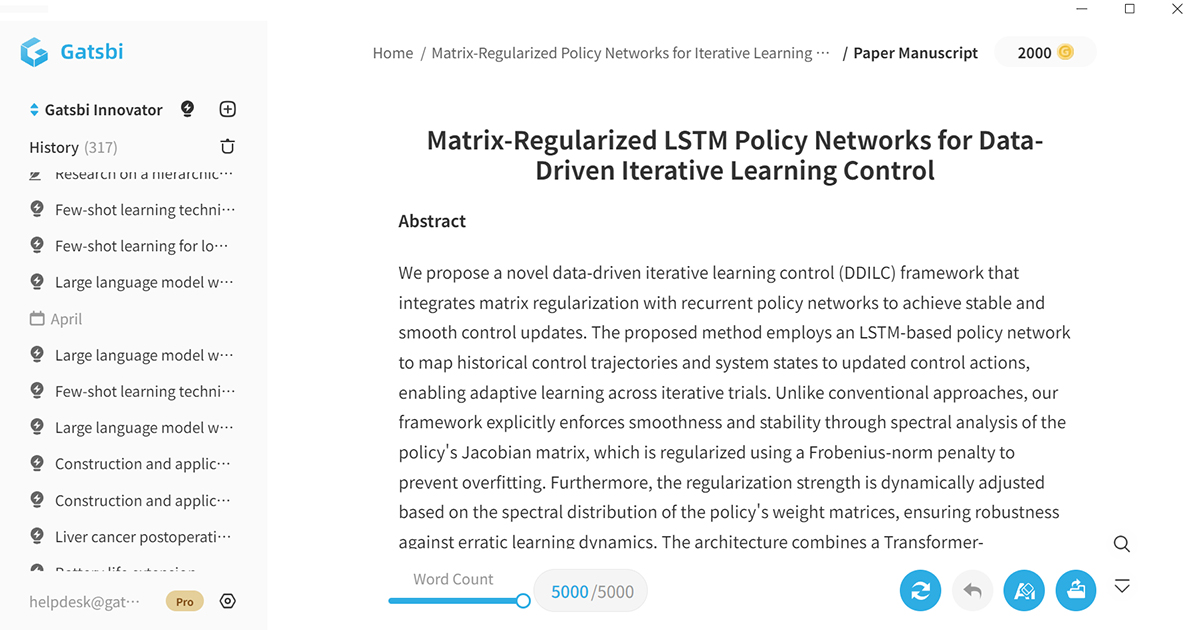
Gatsbi generates research ideas, drafts scientific papers, and performs systematic reviews and meta-analyses with accurate citations and clear visuals.
Run a free AEO + signal audit for your domain.
AI Answer Engine Optimization (AEO)
List once. Convert intent from live AI conversations without heavy integration.
No, there are no limits on the number of messages or bio generations you can create. To use this unlimited feature, follow these steps: 1. Register and log in to your account. 2. Access the message or bio generation tool within the application. 3. Generate as many messages or bios as needed without restrictions.
Yes, many AI animation tools allow users to personalize and edit animations after the initial generation. This capability significantly impacts creative workflows by providing flexibility and control over the final output. Users can start with an AI-generated base animation and then customize elements such as timing, colors, graphics, and text to better align with their brand identity and creative vision. This reduces the need to create animations from scratch while still enabling unique and tailored results. The ability to refine AI-generated content accelerates the creative process, saves time, and allows creators to focus more on innovation and storytelling rather than repetitive technical tasks.
Autonomous labs do not replace scientists in biotechnology research; rather, they empower them. These labs automate repetitive and manual tasks, allowing scientists to focus on higher-level activities such as data interpretation, experimental design, and creative problem-solving. By handling routine benchwork through robotics and software, autonomous labs free researchers from time-consuming manual labor. This shift enhances scientists' productivity and innovation capacity without diminishing their critical role in guiding research direction and making informed decisions.
Yes, you can edit Roblox UGC items after AI generation. Follow these steps: 1. Generate your Roblox UGC item using the AI tool. 2. Download the item in editable formats such as FBX or GLB. 3. Open the downloaded file in 3D editing software like Blender or Maya. 4. Make any desired adjustments to proportions, details, or design. 5. Save the edited file and upload it to the Roblox UGC Marketplace. Most users find AI-generated items ready to upload, but editing is available for customization.
Yes, you can try the AI content generation services before buying credits. Follow these steps: 1. Sign up for the service to create an account. 2. Receive 5 free credits upon registration. 3. Use these free credits to generate presentations, scripts, quizzes, or essays. 4. Evaluate the quality and usefulness of the generated content. 5. Purchase additional credits if you want to continue using the services after the free credits are used.
No, you do not need separate subscriptions. Follow these steps: 1. Create a single account on the platform. 2. Use the unified credit system that works across all available AI video generation models. 3. Purchase credit packages according to your needs; credits never expire. 4. Access and switch between multiple models like Sora 2, Veo 3.1, and Grok Imagine Video without additional subscriptions. 5. Generate videos using any model under one account seamlessly. This approach saves costs and simplifies access to diverse AI video generation technologies.
Social media video datasets are prepared for AI research through a process that involves cleaning, segmenting, and making the data semantically searchable. Cleaning ensures that the videos are free from noise, irrelevant content, or errors. Segmenting breaks down long videos into meaningful parts or clips that focus on specific actions or interactions. Semantic searchability allows researchers to find videos based on content, context, or specific features, which is crucial for training AI models effectively. This preparation enhances the usability and accuracy of datasets in AI labs.
A cloud-based platform can significantly enhance productivity in biotechnology research and development by digitizing laboratory processes and automating workflows. It allows researchers to plan, record, and share experiments in a collaborative environment accessible from anywhere. Automation reduces manual and repetitive tasks, freeing up scientists to focus on analysis and innovation. Additionally, integrated AI tools help optimize workflows and data analysis, leading to faster insights and decision-making. The platform also supports a unified data model that organizes complex scientific data, enabling better tracking and computational analysis. Overall, these features streamline research activities, improve collaboration, and accelerate the pace of scientific breakthroughs.
A cloud-based platform enhances productivity in biotechnology research by digitizing laboratory processes, automating repetitive workflows, and enabling seamless collaboration. Researchers can plan, record, and share experiments in real-time using a centralized, cloud-hosted notebook. Automation reduces manual data entry and repetitive tasks, allowing scientists to focus on analysis and innovation. Additionally, integrated AI tools help optimize workflows and data interpretation, accelerating research outcomes. The platform's flexibility supports diverse scientific data types and integrates with various instruments and software, creating a unified environment that adapts to evolving research needs.
Use a collaborative AI research platform to enhance translational research by enabling direct collaboration around live scientific evidence. Steps: 1. Integrate domain-grounded AI into workflows to improve traceability and iteration. 2. Collaborate on scientific artifacts such as data, analyses, figures, and literature instead of static reports. 3. Bridge communication gaps between AI, data scientists, and translational teams to accelerate alignment and decision-making. 4. Utilize curated datasets and biomarker discovery tools integrated into the workflow. 5. Turn research outputs into live, shareable, and actionable resources to advance science efficiently.