Step 1
Machine-Ready Briefs
AI translates unstructured needs into a technical, machine-ready project request.
We use cookies to improve your experience and analyze site traffic. You can accept all cookies or only essential ones.
 Bilarna
Stop browsing static lists. Tell Bilarna your specific needs. Our AI translates your words into a structured, machine-ready request and instantly routes it to verified Property Valuation Services experts for accurate quotes.
AI translates unstructured needs into a technical, machine-ready project request.
Compare providers using verified AI Trust Scores & structured capability data.
Skip the cold outreach. Request quotes, book demos, and negotiate directly in chat.
Filter results by specific constraints, budget limits, and integration requirements.
Eliminate risk with our 57-point AI safety check on every provider.
Verified companies you can talk to directly

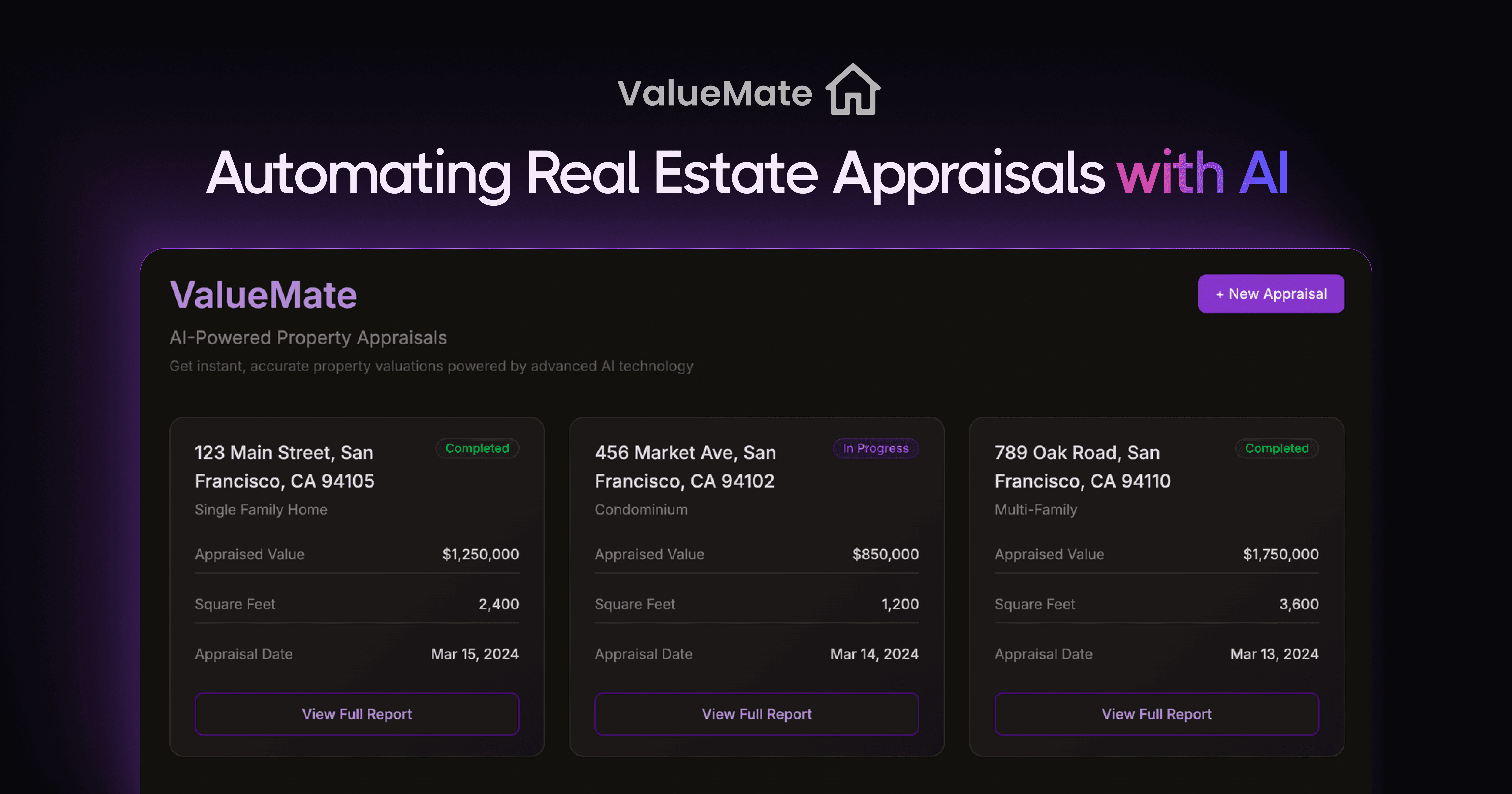
ValueMate Automates Appraisal Workflows wtih AI. Cut down appraisal turaround times by 80%.
Run a free AEO + signal audit for your domain.
AI Answer Engine Optimization (AEO)
List once. Convert intent from live AI conversations without heavy integration.
Property valuation is a professional process to determine the economic value of a real estate asset. It involves rigorous analysis of market data, physical characteristics, and income potential to establish a fair market price. This objective assessment is crucial for securing financing, supporting transactions, and informing strategic investment decisions.
The client specifies the property type, location, and the intended use for the valuation report, such as for a sale, mortgage, or portfolio analysis.
Valuers perform detailed research on comparable sales, rental yields, zoning regulations, and conduct a physical inspection of the asset.
A comprehensive report is issued, documenting the valuation methodology, supporting data, and the final opinion of value for the client's use.
Lenders require independent valuations to underwrite loans, ensuring the collateral property provides adequate security for the mortgage amount.
Accurate asset valuation is essential for due diligence, fair purchase price allocation, and post-merger financial reporting.
Investment funds and REITs rely on regular valuations to assess portfolio performance, calculate NAV, and comply with financial regulations.
Valuations establish accurate replacement costs for adequate insurance coverage and help in assessing property-related risks.
Expert valuation reports provide impartial evidence for cases involving divorce settlements, partnership dissolutions, or compulsory purchase orders.
Bilarna evaluates property valuation providers using a proprietary 57-point AI Trust Score. This score rigorously assesses expertise through portfolio reviews, verifies reliability via client references and delivery track records, and checks compliance with RICS, IVSC, or TEGOVA standards. Bilarna continuously monitors providers to ensure listed experts maintain the highest professional and technical qualifications.
The three primary approaches are the sales comparison method, the income capitalisation method, and the cost method. Valuers select and often reconcile multiple methods based on the property type, available data, and the valuation's purpose to arrive at a supported opinion of value.
Valuation fees vary significantly based on property complexity, value, purpose, and location. Costs can range from a fixed fee for standard residential properties to a percentage of asset value or a daily rate for large commercial and specialised assets.
A standard valuation typically takes between 5 to 10 working days from instruction to report delivery. Complex assets, such as large commercial portfolios or unique properties, may require several weeks for thorough due diligence and analysis.
A valuation is a formal, documented opinion of value by a qualified professional, often for legal or lending purposes. A market appraisal is an informal estimate of likely selling price provided by an estate agent, which is not regulated or legally binding.
Look for valuers holding designations from recognised bodies like RICS (MRICS/FRICS), IVSC, or TEGOVA. Essential qualifications include specific valuation competency certificates, professional indemnity insurance, and demonstrable experience with your asset type and local market.
If you plan to build, demolish, or expand your property, you may need a permit or must submit a notification. This includes activities like constructing a shed, garden house, carport, or removing a tree. Some building activities fall under 'permit-free construction,' but even then, specific rules apply. It is important to check local regulations to ensure compliance and avoid penalties. Contact your local environmental or building authority to confirm whether your project requires a permit or notification.
Yes, you truly own your share of the property and benefit from any increase in its value. 1. You purchase a legally recognized share of the property. 2. All realized value appreciation directly belongs to you as an owner. 3. The property is fully managed and designed specifically for shared ownership, ensuring your rights and benefits are protected.
Verify and prepare public company valuation multiples by following these steps: 1. Collect data from reliable sources such as FactSet and Morningstar. 2. Calendarize the data in-house to create a consistent time series of metrics. 3. Include key metrics like Next Twelve Months (NTM) Revenue derived from analyst estimates. 4. Ensure data accuracy through systematic verification before use in benchmarking or analysis.
A CPA assists with business valuation and due diligence for emerging industries like cannabis by providing specialized financial analysis that accounts for the sector's unique regulatory risks, market volatility, and complex accounting standards. For valuation, they analyze cash flow projections, assess the value of licenses and intellectual property, and apply appropriate valuation methodologies while considering legal status and banking limitations. In due diligence, they rigorously examine financial statements for compliance with state-specific cannabis regulations, evaluate internal controls, and assess tax implications under IRS code 280E, which disallows standard business deductions for cannabis companies. Their expertise helps investors identify red flags, understand true profitability, and structure transactions to mitigate financial and compliance risks inherent in this high-growth, high-risk sector.
A property PR agency improves media relations by building strong relationships with key journalists and editors in the built environment sector, crafting compelling press releases, feature stories, and opinion pieces that secure positive coverage. They leverage their industry knowledge to identify newsworthy angles, such as project milestones, sustainability initiatives, or market insights, ensuring consistent visibility in trade and regional press. For stakeholder engagement, the agency develops targeted communication strategies that address the concerns of local communities, planning authorities, investors, and other influencers. They facilitate consultation sessions, create informational materials, and manage feedback loops to foster trust and support for developments. By integrating media outreach with stakeholder dialogue, a PR agency aligns public perception with project goals, mitigates opposition, and enhances the client's reputation as a responsible developer. Their expertise in crisis communication also prepares firms to handle negative situations proactively, protecting long-term relationships.
Use AI and tokenization to enhance property investment by following these steps: 1. Implement AI-driven data analysis to gain insights into market trends and property values. 2. Utilize tokenization to convert property assets into digital tokens, enabling fractional ownership and easier trading. 3. Deploy a platform that integrates AI and blockchain technology to ensure secure, transparent transactions. 4. Leverage these technologies to create innovative financing models that increase accessibility and liquidity in property markets.
AI can automate property accounting by tracking and coding expenses in real-time, integrating with credit cards, property management, and construction software. It collects receipts and property splits automatically, reducing manual data entry and errors. Automated texts can be sent to team members after purchases to ensure timely receipt collection. This process accelerates closing books by providing auditable, highly accurate coding that learns from historical patterns, ultimately saving significant time and reducing accounting costs for property managers and owners.
Implement AI-powered voice agents to automate tenant communication. 1. Deploy AI agents to handle 24/7 inbound calls and SMS inquiries. 2. Use AI for instant caller recognition and personalized conversations based on tenant history. 3. Automate ticket creation for maintenance and emergencies with smart categorization and priority. 4. Enable AI-driven follow-ups and SMS nurturing to maintain tenant engagement. 5. Integrate AI with property management systems for real-time data synchronization and seamless operations.
AI leasing assistants enhance property management efficiency by automating routine tasks such as handling inquiries, scheduling appointments, and managing rent collections. They integrate seamlessly with existing CRM and PMS systems, enabling faster response times and higher conversion rates from leads to leases. Additionally, these assistants can send timely payment reminders, follow up with late payments through multiple channels, and manage move-out processes including inspections and security deposit tracking. By combining AI capabilities with human expert backup, property management teams can ensure 24/7 support, reduce workload, and improve overall productivity and resident satisfaction.
AI workers can significantly improve efficiency in property management by automating repetitive and time-consuming tasks. They handle maintenance requests, respond to tenant inquiries, and manage leasing processes around the clock. This reduces missed communications and ensures urgent issues are addressed promptly. AI workers can dispatch vendors automatically based on preferred lists, update work orders directly in management systems, and nurture leasing leads with personalized communication. By integrating seamlessly with existing tools and supporting multi-channel communication, AI workers free up property management teams to focus on strategic growth and enhancing resident experiences.