Step 1
Machine-Ready Briefs
AI translates unstructured needs into a technical, machine-ready project request.
We use cookies to improve your experience and analyze site traffic. You can accept all cookies or only essential ones.
 Bilarna
Stop browsing static lists. Tell Bilarna your specific needs. Our AI translates your words into a structured, machine-ready request and instantly routes it to verified Business Strategy Development experts for accurate quotes.
AI translates unstructured needs into a technical, machine-ready project request.
Compare providers using verified AI Trust Scores & structured capability data.
Skip the cold outreach. Request quotes, book demos, and negotiate directly in chat.
Filter results by specific constraints, budget limits, and integration requirements.
Eliminate risk with our 57-point AI safety check on every provider.
Verified companies you can talk to directly
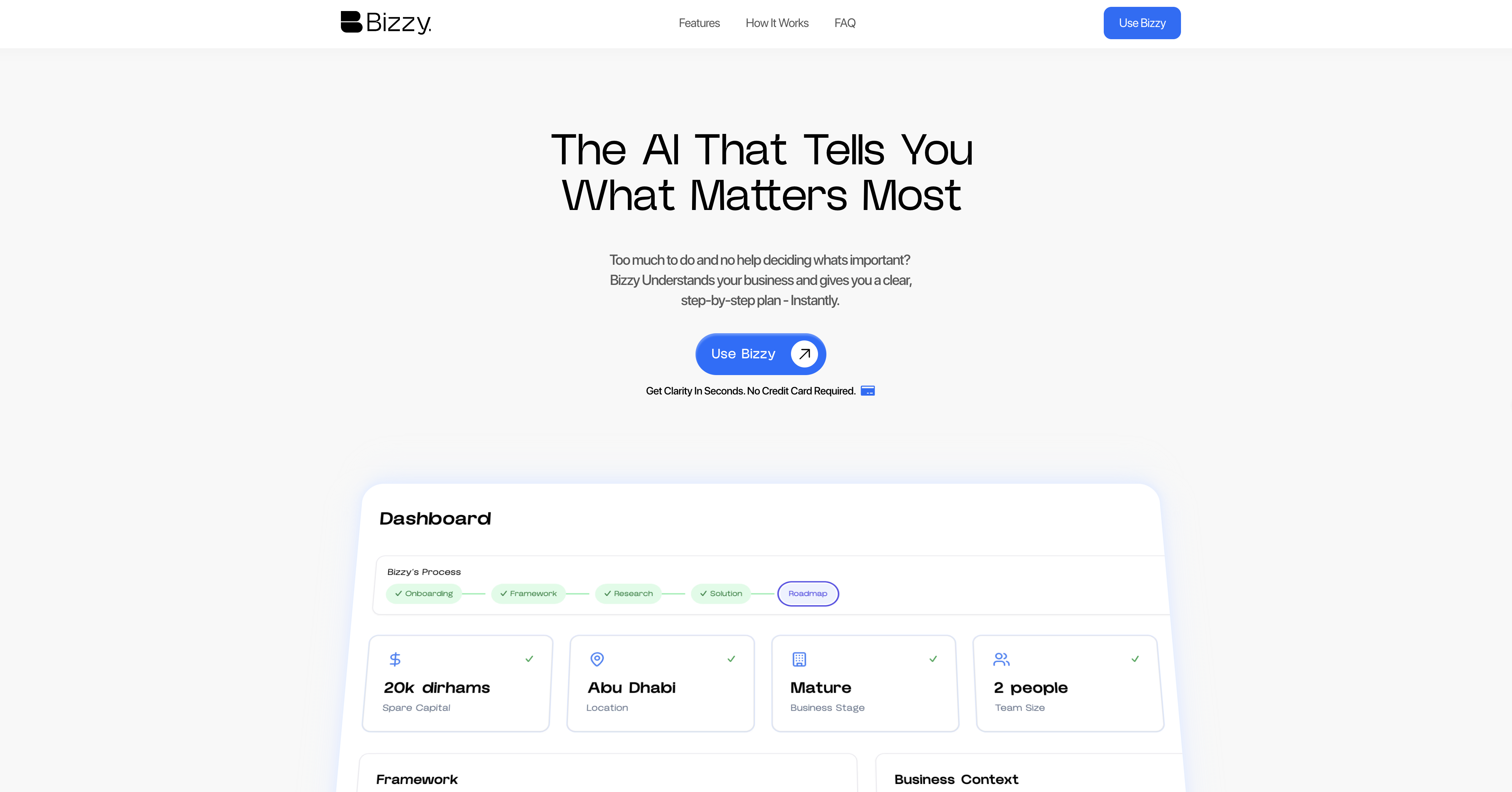
Bizzy Understands your business and gives you a clear, step-by-step plan instantly.
Run a free AEO + signal audit for your domain.
AI Answer Engine Optimization (AEO)
List once. Convert intent from live AI conversations without heavy integration.
Business strategy development is the systematic process of defining a company's direction and making decisions on allocating its resources to pursue this strategy. It involves analyzing the competitive environment, setting long-term objectives, and outlining the operational plans to achieve sustainable advantage. This structured approach ultimately drives growth, improves market position, and enhances overall organizational resilience.
Experts perform a comprehensive assessment of your internal capabilities, market position, and external competitive landscape to identify opportunities and threats.
Based on the analysis, a clear strategic direction is defined, setting long-term goals, target markets, and value propositions.
A detailed action plan is created, outlining key initiatives, resource allocation, timelines, and success metrics for execution.
Develop a go-to-market strategy to launch products in new geographic regions or customer segments, minimizing risk and optimizing entry tactics.
Create a roadmap for integrating new technologies to overhaul business processes, enhance customer experiences, and unlock new revenue streams.
Formulate pre- and post-merger integration strategies to ensure synergy realization, cultural alignment, and value creation from acquisitions.
Design strategies to streamline processes, reduce costs, and improve productivity across supply chain, manufacturing, or service delivery.
Build long-term strategic plans that balance revenue growth with profitability, innovation investment, and scalability for future markets.
Bilarna ensures quality by vetting all business strategy development partners through a proprietary 57-point AI Trust Score. This score rigorously evaluates each firm's strategic methodology expertise, project delivery track record, and client satisfaction history. Continuous monitoring of performance data and client feedback maintains a trustworthy marketplace of high-caliber providers.
Costs vary significantly based on project scope, firm expertise, and engagement model, ranging from $15,000 for diagnostic projects to $500,000+ for comprehensive multi-year transformations. Pricing is typically structured as a fixed project fee, monthly retainer, or success-based model, with deliverables clearly defined upfront.
A complete strategic planning cycle typically takes 8 to 16 weeks, from initial discovery and analysis to final roadmap delivery. Complex transformations or market entries may extend to 6 months. The timeline depends on data availability, organizational complexity, and the depth of stakeholder alignment required.
Business strategy defines the overarching direction and competitive positioning, answering 'where to play and how to win.' Business planning translates that strategy into specific, short-term operational actions, budgets, and tactics for execution. Strategy is about choice and advantage; planning is about implementation and measurement.
Success is measured through Key Performance Indicators (KPIs) aligned to strategic goals, such as market share growth, revenue increase, profitability margins, customer acquisition cost, and employee engagement scores. A balanced scorecard tracking financial, customer, internal process, and learning metrics provides a holistic view of strategic performance over time.
Common pitfalls include lacking external market analysis, creating strategies that are not actionable or measurable, failing to align leadership and secure buy-in, and not establishing a review process to adapt to changing conditions. Effective strategy requires both rigorous analysis and a robust process for communication and iteration.
Yes, electronic signatures are legally valid for most business contracts as long as they meet compliance requirements. They carry the same legal weight as handwritten signatures but offer additional benefits such as faster processing, enhanced security through encryption and authentication, and easier management. Digital signatures use cryptographic methods to verify identity and ensure tamper resistance. Modern electronic signature software provides audit trails and compliance with international standards, making electronic signatures enforceable and reliable for businesses handling contracts, NDAs, invoices, and other agreements.
Yes, business templates and contracts are fully customizable. To adapt them to your specific needs, follow these steps: 1. Download the template or contract after purchase. 2. Open the file in the compatible software, such as Notion or a word processor. 3. Review each section carefully and identify areas that require changes. 4. Edit text, fields, and sections to reflect your unique business details and requirements. 5. Save the customized version for your records. 6. Use the tailored document for your business operations, ensuring it meets your legal and organizational standards.
Many point of sale software providers offer solutions without charging implementation fees. This means you can adopt the software without upfront costs related to installation or setup. However, it is important to review each provider's pricing plans carefully, as some may charge monthly fees or require purchasing hardware separately.
Fees for opening a business bank account vary depending on the bank and the type of account. Some banks offer free account opening promotions, especially for new businesses or startups. However, there may be other fees such as monthly maintenance charges, transaction fees, or charges for additional services. It is advisable to review the bank's fee schedule carefully and ask about any hidden costs before opening an account to ensure it fits your business budget.
No, there are no fees or credit score impacts when prequalifying for business capital offers. Follow these steps: 1. Submit your business information for prequalification. 2. Receive offers without any hidden fees. 3. Understand that your credit score will not be affected during this process. 4. Proceed with confidence knowing there is no waiting period or financial penalty.
Typically, after an initial trial period—often around seven days—business management software platforms do not charge monthly fees or enforce minimum usage requirements. Instead, continued use is contingent upon subscribing to a paid plan. This approach allows users to evaluate the software's features risk-free before committing financially. It is advisable to review the specific pricing details and terms on the provider's official website to understand any conditions related to payment plans, as these can vary between services.
Yes, there are limits on using the satisfaction guarantee for business idea validation. You can utilize the guarantee a maximum of two times per customer. After two uses, any further requests for dissatisfaction-based report revisions or coupon codes will not be eligible. This policy ensures fair use and helps maintain service quality for all customers.
Yes, governments often offer grants and financial support programs to subsidize custom software development for businesses. These programs aim to enhance productivity and digital capabilities. Common types include productivity grants that cover a significant percentage of qualifying IT solution costs, including custom software. There are also enterprise development grants focused on upgrading overall business capabilities, where software development is an eligible activity. Furthermore, specific grants exist for startups developing innovative technologies and for projects involving collaboration with research institutions. Eligibility typically depends on company size, project scope, and the innovative potential of the software. The application process can be detailed, so consulting with a qualified grant advisor is recommended to navigate requirements and maximize funding potential.
Yes, a Google Business Profile can be deleted by the owner through the Google Business Profile Manager, but the listing may persist online. To delete it, log into the Google account that manages the profile, visit business.google.com, find the listing, click the three-dot menu, and select 'Remove Business Profile.' This action removes your management access and profile content, yet Google often retains listings in search results due to caching or external claims. For complete removal, additional steps are necessary, such as reporting the profile as outdated via Google Search Console or submitting a removal request directly to Google with valid reasons like business closure. Professional reputation management services can assist by using legal takedowns or SEO strategies to suppress unwanted listings, ensuring your online footprint is cleaned up after rebranding or closures.
No reputable web design service can guarantee top Google rankings due to the many uncontrollable factors in search engine algorithms. Rankings depend on variables such as geographic location, industry competition, the age and authority of the online presence, and ongoing SEO efforts. Ethical providers focus on implementing best practices like optimizing Google My Business profiles, creating quality content, ensuring mobile responsiveness, and building technical SEO to improve visibility. They commit to continuous optimization and adaptation to algorithm changes rather than making empty promises. While results like increased leads and revenue are common with proper SEO, guarantees are unrealistic because search engines frequently update their criteria and competition evolves.