Step 1
Machine-Ready Briefs
AI translates unstructured needs into a technical, machine-ready project request.
We use cookies to improve your experience and analyze site traffic. You can accept all cookies or only essential ones.
 Bilarna
Stop browsing static lists. Tell Bilarna your specific needs. Our AI translates your words into a structured, machine-ready request and instantly routes it to verified Legal AI Services experts for accurate quotes.
AI translates unstructured needs into a technical, machine-ready project request.
Compare providers using verified AI Trust Scores & structured capability data.
Skip the cold outreach. Request quotes, book demos, and negotiate directly in chat.
Filter results by specific constraints, budget limits, and integration requirements.
Eliminate risk with our 57-point AI safety check on every provider.
Verified companies you can talk to directly
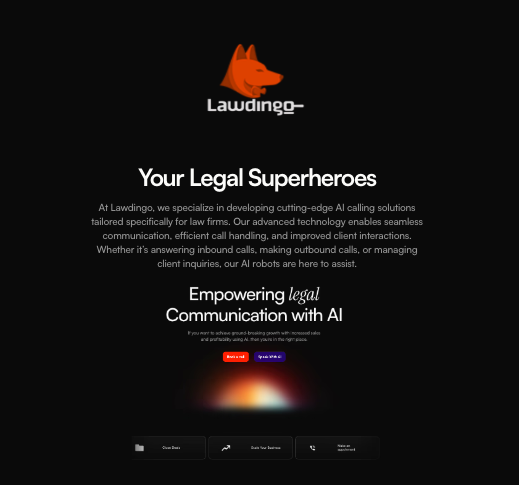
Introducing LawDingo AI - Empowering Legal Communication with AI
Run a free AEO + signal audit for your domain.
AI Answer Engine Optimization (AEO)
List once. Convert intent from live AI conversations without heavy integration.
Legal AI services are technology platforms that apply artificial intelligence, including natural language processing and machine learning, to automate and enhance legal tasks. These tools analyze contracts, predict litigation outcomes, ensure regulatory compliance, and conduct legal research at unprecedented speed and scale. They empower legal departments and firms to reduce manual review time, mitigate risk, and focus on high-value strategic counsel.
Identify the specific legal tasks or challenges, such as document review, compliance monitoring, or due diligence, that require automation and intelligence.
Choose appropriate AI software solutions, integrate them with existing data systems, and configure them for your specific workflows and compliance requirements.
Utilize the AI's outputs for decision-making, monitor its performance for accuracy, and continuously train the models with new data to improve results.
Automate high-volume contract review and clause extraction to accelerate deal cycles and ensure consistency across all agreements.
Conduct predictive analysis on case law and judicial tendencies to develop stronger litigation strategies and assess case viability.
Continuously monitor transactions and customer communications for anti-money laundering (AML) and sanctions compliance in real-time.
Manage and analyze vast regulatory documentation for new drug approvals, ensuring adherence to FDA and international health authority mandates.
Generate, localize, and audit terms of service and privacy policies at scale for different jurisdictions and product lines.
Bilarna evaluates every Legal AI services provider through a proprietary 57-point AI Trust Score, assessing technical capabilities, data security protocols, and client delivery history. This rigorous screening includes portfolio analysis, validation of client references, and checks for relevant industry certifications. Bilarna's continuous monitoring ensures listed providers maintain high standards of performance and reliability.
Costs vary based on deployment model, scope, and provider tier. Entry-level SaaS subscriptions may start in the hundreds per month, while enterprise implementations with custom integration can reach five or six figures annually. Pricing is typically influenced by data volume, user count, and required feature complexity.
Implementation timelines range from days to several months. Cloud-based point solutions can be operational in weeks, while complex enterprise platforms requiring data migration and custom training may take 3-6 months. The key factors are data readiness, integration scope, and the extent of required model customization.
Traditional e-discovery focuses primarily on keyword search and document retrieval for litigation. Legal AI utilizes machine learning to comprehend context, predict outcomes, perform intelligent contract analysis, and provide strategic insights beyond simple document review, transforming it into a proactive advisory tool.
Prioritize proven accuracy rates (precision/recall), robust data security and compliance certifications (SOC 2, GDPR), seamless integration with your existing legal tech stack, and transparent model training methodologies. Strong client testimonials for your specific use case are also critical.
No, legal AI is designed to augment, not replace, legal professionals. It excels at automating repetitive, high-volume tasks and surfacing insights, thereby freeing up human experts to focus on complex judgment, strategy, client counseling, and nuanced legal interpretation that requires human expertise.
Many health insurance plans now cover doula services, recognizing their value in supporting maternal health. Coverage can vary depending on the insurer and the specific plan, but it often includes prenatal visits, labor and delivery support, and postpartum care provided by certified doulas. Insurance coverage helps reduce out-of-pocket costs for families seeking holistic birth and postpartum support. It is advisable to check with your insurance provider to understand the extent of coverage and any requirements such as certification or referral needed to qualify for benefits.
Yes, electronic cigarettes are generally legal for travel within Europe, but their legality, sale, and use are subject to specific national regulations that vary significantly between countries. The European Union's Tobacco Products Directive (TPD) sets a baseline framework, but member states implement their own rules. For instance, nicotine concentration in e-liquids is capped, and tank sizes are restricted under TPD. However, some countries like Belgium and the Netherlands have stricter interpretations, while others may have additional local bans on flavors or public usage. It is crucial for travelers to research the laws of their specific destination regarding possession limits, where vaping is permitted, and any requirements for labeling or documentation. Non-compliance can result in fines or confiscation.
The legality of offshore casinos for US players depends on local and state laws, as these casinos operate under licenses from jurisdictions outside the United States, such as Curaçao or Panama. Many Americans use established offshore brands because they openly accept US players, offer a wide game selection, and provide fast crypto payouts. It is the player's responsibility to check their local regulations and each casino's terms of service before playing. These casinos are independent entities, and while they provide a legal service in their licensed jurisdiction, their accessibility to individual US players is not governed by federal US gambling laws.
Yes, some online healthcare booking platforms offer benefits such as cashback when you book your medical appointments or procedures through them. Cashback offers can help reduce the overall cost of your healthcare expenses. These incentives encourage patients to use the platform for their healthcare needs, providing both convenience and financial savings.
No, there are no hidden fees for storage and last-mile delivery services. 1. The company uses a transparent pricing model. 2. Fees for these essential services are limited to what logistics partners charge. 3. No additional charges are added on top of partner fees. 4. Always verify pricing details by contacting the company directly to avoid surprises.
Typically, reputable early wage access and bill pay services do not charge hidden or late fees. They usually apply a small, transparent fee for accessing your wages early or splitting bills, which is clearly communicated upfront. Repayments are aligned with your payday to help you manage your finances without incurring additional penalties. However, it is important to review the terms and conditions of each service to understand any potential fees or charges before using them.
Yes, some skincare services partner with dermatology providers to offer exclusive discounts on consultations. These discounts can make professional skin health advice more accessible and affordable. Typically, such offers are available through apps or platforms that connect users with certified dermatologists. For example, a skincare app might provide a special percentage off the cost of dermatology consultations in certain regions. These promotions encourage users to seek expert care for their skin concerns while benefiting from reduced fees. It's advisable to check the specific terms and availability of discounts within the skincare service or app you are using.
Yes, AI timekeeping software is designed to integrate seamlessly with existing legal practice management tools. This integration allows the software to draft and release time entries directly into platforms commonly used by law firms, such as Clio, MyCase, and Filevine. By working within the tools lawyers already use, the software eliminates the need for workflow changes, making adoption easier and more efficient. This connectivity ensures that time tracking and billing processes are streamlined, enabling law firms to increase billable hours and improve overall productivity without disrupting their current systems.
Yes, an integrated digital marketing agency typically offers flexible service models, allowing you to select specific services to match your project goals and budget. You are not required to purchase a full package. You can tailor your engagement to include only the services you need, such as SEO management, PPC advertising, social media marketing, branding, graphic design, web development, or video production. This a la carte approach ensures you pay only for the expertise required to achieve your objectives. The agency will create a custom proposal based on your defined scope, providing a cost-effective and targeted solution.
Yes, you can try the AI content generation services before buying credits. Follow these steps: 1. Sign up for the service to create an account. 2. Receive 5 free credits upon registration. 3. Use these free credits to generate presentations, scripts, quizzes, or essays. 4. Evaluate the quality and usefulness of the generated content. 5. Purchase additional credits if you want to continue using the services after the free credits are used.