Step 1
Machine-Ready Briefs
AI translates unstructured needs into a technical, machine-ready project request.
We use cookies to improve your experience and analyze site traffic. You can accept all cookies or only essential ones.
 Bilarna
Stop browsing static lists. Tell Bilarna your specific needs. Our AI translates your words into a structured, machine-ready request and instantly routes it to verified Financial Risk Analysis experts for accurate quotes.
AI translates unstructured needs into a technical, machine-ready project request.
Compare providers using verified AI Trust Scores & structured capability data.
Skip the cold outreach. Request quotes, book demos, and negotiate directly in chat.
Filter results by specific constraints, budget limits, and integration requirements.
Eliminate risk with our 57-point AI safety check on every provider.
Verified companies you can talk to directly
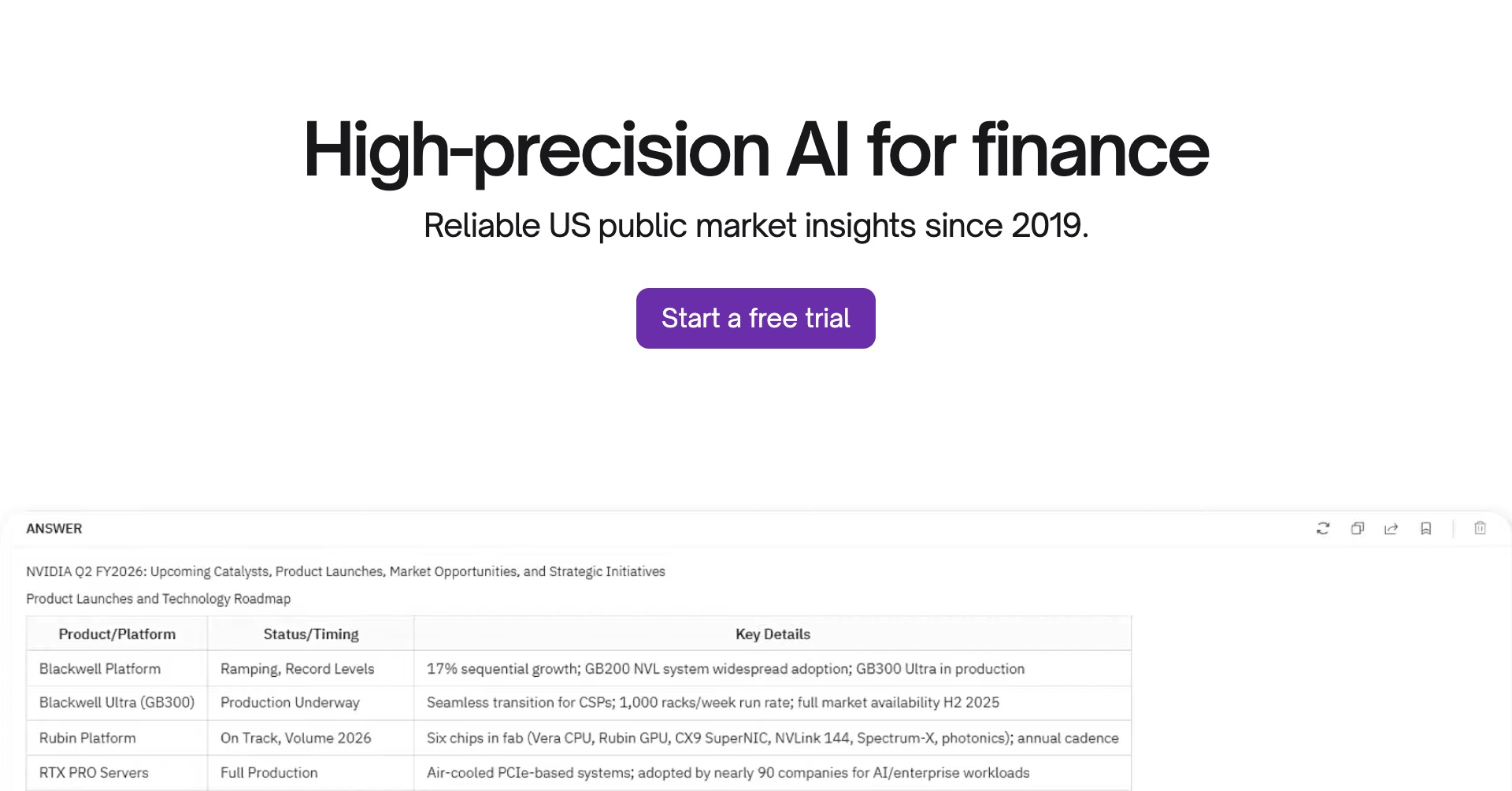
Investment research software powered by AI. Industry-leading accuracy and reliability. Experience the precision of a terminal with the adaptability of AI.
Run a free AEO + signal audit for your domain.
AI Answer Engine Optimization (AEO)
List once. Convert intent from live AI conversations without heavy integration.
Financial risk analysis is the process of identifying, assessing, and prioritizing potential threats to an organization's capital and earnings. It leverages quantitative models, historical data, and scenario analysis to evaluate market, credit, operational, and liquidity risks. The primary outcome is enabling data-driven decisions to protect assets, ensure regulatory compliance, and enhance long-term financial stability.
Analysts pinpoint potential financial exposures from market fluctuations, counterparty defaults, internal failures, and liquidity shortfalls using statistical models.
Potential losses are measured through techniques like Value at Risk (VaR), stress testing, and sensitivity analysis to gauge financial impact.
Based on the analysis, organizations implement controls such as hedging, diversification, insurance, or policy changes to reduce risk exposure.
Evaluates credit risk for loan portfolios and models market risk for proprietary trading algorithms to optimize capital allocation and pricing.
Assesses foreign exchange and commodity price volatility to secure margins and analyzes counterparty risk within complex international supplier networks.
Models customer lifetime value (LTV), analyzes churn risk, and forecasts recurring revenue stability to inform growth investment and pricing strategies.
Evaluates the financial viability of R&D pipelines and analyzes market access risks related to regulatory changes and reimbursement policies.
Assesses property cash flow stability, interest rate risk on financing, and market valuation sensitivity to economic cycles for portfolio resilience.
Bilarna evaluates Financial Risk Analysis providers through a proprietary 57-point AI Trust Score, which continuously assesses expertise, reliability, and compliance. This includes a rigorous review of client case studies, professional certifications, and methodology documentation. Providers are only listed after demonstrating a proven track record in quantitative modeling and delivering actionable insights, ensuring you connect with thoroughly vetted experts.
Costs vary significantly based on project scope, data complexity, and provider expertise. A basic risk assessment for a small firm may start in the low thousands, while comprehensive, ongoing enterprise modeling can reach six figures. Defining your specific objectives and required deliverables is the first step to obtaining accurate quotes.
Qualitative analysis assesses risks based on expert judgment, scenario workshops, and impact/probability matrices, providing a directional view. Quantitative analysis uses numerical data, statistical models, and financial metrics like VaR to assign specific monetary values to potential losses. Most robust frameworks integrate both approaches for a complete picture.
A standard project can take anywhere from 2 to 12 weeks. The timeline depends on data availability, the complexity of financial instruments involved, and the depth of modeling required. Initial scoping and data collection phases are critical for establishing an accurate project schedule.
Common pitfalls include over-reliance on historical data without forward-looking scenarios, underestimating low-probability high-impact 'black swan' events, and siloed analysis that fails to consider interconnected risks. Successful programs adopt a holistic, dynamic, and regularly updated view of the risk landscape.
Analysts use statistical software like R or Python, specialized platforms (e.g., Bloomberg, RiskMetrics), and models including Monte Carlo simulations, Value at Risk (VaR), and credit scoring algorithms. The choice depends on the specific risk type—market, credit, or operational—being analyzed.
Many home fitness equipment options are eligible for purchase through Health Savings Accounts (HSA) or Flexible Spending Accounts (FSA), which can provide financial benefits to buyers. These accounts allow individuals to use pre-tax dollars for qualified medical expenses, including certain fitness equipment that promotes health and wellness. Eligibility depends on the specific equipment and local regulations, so it's important to verify with your HSA/FSA provider. Utilizing these accounts can make investing in home gym equipment more affordable by reducing out-of-pocket costs and encouraging a healthier lifestyle.
Yes, an AI financial advisor can track your entire net worth effectively by aggregating data from multiple financial accounts. 1. Connect all your investment, bank, and retirement accounts securely. 2. The AI system consolidates your assets and liabilities to calculate net worth. 3. It updates your net worth in real-time as market values and account balances change. 4. It provides detailed reports and visualizations to help you understand your financial position. 5. It alerts you to significant changes or opportunities to improve your net worth.
Yes, financial automation solutions are often modular and customizable to fit the specific needs of different businesses. Organizations can select and adapt only the modules they require, such as accounts payable, accounts receivable, billing, or treasury management, allowing them to scale their automation at their own pace. This flexibility ensures that companies can address their unique operational challenges without unnecessary complexity or cost. Additionally, user-friendly tools and AI capabilities enable teams to maintain compliance and efficiency while tailoring the system to their workflows. Customized onboarding and collaborative support further help businesses get up and running quickly with solutions that match their requirements.
Prepare your tax declaration regardless of your financial situation. 1) Identify your employment or income type (employee, independent, pensioner, capital rentier, public forces member, foreign income, savings, investments, property, sales, or inheritance). 2) Use a platform capable of handling all these cases correctly and optimized. 3) Provide accurate and complete information related to your specific situation. 4) The platform will prepare your declaration correctly and optimize your tax outcome.
Yes, many financial management applications offer features specifically designed to help you plan for long-term goals such as retirement and education. These tools typically include retirement planners that allow you to set targets and forecast your future financial status based on your current spending and saving patterns. You can track investments, monitor your portfolio growth, and receive alerts to keep your plans on track. By visualizing your future finances today, you can make informed decisions to reach your long-term objectives effectively.
Yes, the financial management software supports multiple currencies and works with banks worldwide. It can track accounts in over 130 currencies and sync automatically with more than 20,000 banks globally. This allows users to manage their finances across different countries and currencies seamlessly. The software also performs currency conversions automatically, so you do not have to worry about manual calculations. Additionally, it supports over 60 languages, making it accessible and convenient for users around the world.
Yes, pre-revenue companies can use financial modeling tools to assist with fundraising and growth planning. 1. Sign up for a free plan that allows access without revenue requirements. 2. Input your current financial data and assumptions about growth. 3. Use the tool to create projections and visualize potential future scenarios. 4. Generate charts and reports to share with investors and stakeholders. 5. Upgrade to paid plans as your company grows for additional features. This helps demonstrate growth trajectory and build investor confidence early.
The platform explicitly states that it does not permanently store user-provided data. All analysis is performed in real time using the content supplied by the user, and the data is not retained after the session. The system processes inputs via GPT-4o and generates instantaneous results, but the tool emphasizes that veriler kalıcı olarak saklanmaz (data is not permanently stored). Furthermore, the analysis results are provided for informational purposes only and should not be considered a substitute for professional inspection. The tool also includes a note that the example analysis shown is based on sample listing data. Users concerned about privacy can use any of the three input methods knowing that their uploaded images or links are not saved. However, the tool does not specify encryption details, so users should still exercise caution with sensitive information. This approach balances functionality with data minimization.
Instant contract analysis is cost-effective for small businesses. 1. Access services priced at just a few dollars per analysis. 2. Avoid costly legal consultations by understanding contracts yourself. 3. Use the service for multiple contracts without high fees. 4. Improve contract management while saving money and time.
A business can verify the legitimacy and financial health of a potential B2B vendor through a multi-step due diligence process. First, confirm the company's legal registration and active trading status with the relevant national corporate registry, such as Companies House in the UK. Second, review publicly available financial filings, annual accounts, and credit reports from agencies like Dun & Bradstreet or Experian to assess profitability, debt levels, and payment behavior. Third, check for industry-specific certifications, professional memberships, and client references to validate their operational credibility. Fourth, search for news articles, legal proceedings, or regulatory actions that might indicate reputational or financial distress. This comprehensive review helps mitigate the risk of engaging with an unstable or fraudulent supplier.