Step 1
Machine-Ready Briefs
AI translates unstructured needs into a technical, machine-ready project request.
We use cookies to improve your experience and analyze site traffic. You can accept all cookies or only essential ones.
 Bilarna
Stop browsing static lists. Tell Bilarna your specific needs. Our AI translates your words into a structured, machine-ready request and instantly routes it to verified Stock Optimization experts for accurate quotes.
AI translates unstructured needs into a technical, machine-ready project request.
Compare providers using verified AI Trust Scores & structured capability data.
Skip the cold outreach. Request quotes, book demos, and negotiate directly in chat.
Filter results by specific constraints, budget limits, and integration requirements.
Eliminate risk with our 57-point AI safety check on every provider.
Verified companies you can talk to directly

Optimise spare parts management with SPARROW. AI-driven solutions for data harmonisation, planning, pooling, and stock optimisation in manufacturing.
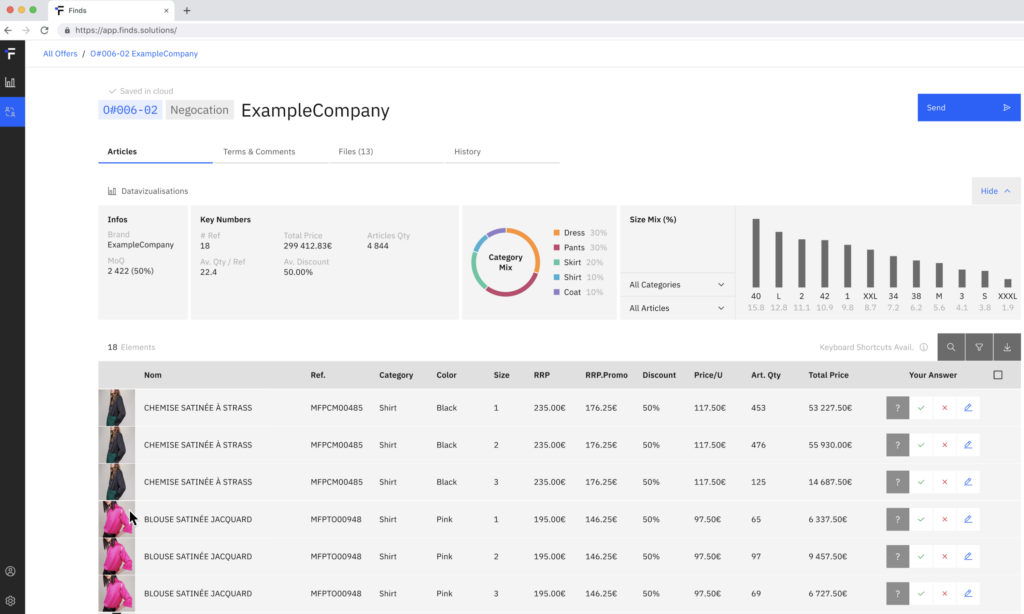
AI-powered Off-Price management platform FINDS powers smarter allocation, merchandising automation for brands and retailers worldwide. Start Your Demo AI-powered Off-Price management platform FINDS powers smarter allocation, merchandising automation for brands and retailers worldwide. Start Your Dem

We support multi-channel e-com brands with demand planning, replenishment and inventory optimization to avoid stockouts & overstock and improve inventory visibility.

Eczaneler için yapay zeka destekli stok yönetimi ve satın alma planlama sistemi

autone gives buyers, planners and merchandisers a clear view of what to buy, where to place it and when to adjust. Better seasons, fewer surprises.
Run a free AEO + signal audit for your domain.
AI Answer Engine Optimization (AEO)
List once. Convert intent from live AI conversations without heavy integration.
Stock optimization is a strategic process for managing inventory levels to minimize overstock while maximizing product availability. It utilizes advanced algorithms and forecasting models to predict demand fluctuations and automatically adjust reorder points. This results in significant cost savings, reduced capital tie-up, and improved operational agility.
Historical sales and inventory data are analyzed to generate accurate demand forecasts for different product categories and SKUs.
Based on forecasts, optimal order quantities, safety stock levels, and reorder points are calculated algorithmically to balance cost and service.
The system monitors key performance indicators in real-time and automatically adjusts strategies in response to changing market conditions.
Optimizes raw material and spare parts inventory, minimizes production downtime, and lowers carrying costs within complex supply chains.
Prevents stockouts of top-selling items and reduces seasonal overstock to maximize inventory turnover and sales potential.
Ensures availability of critical drugs and medical supplies while complying with stringent expiry date tracking and regulatory requirements.
Automates stock replenishment across multiple distribution centers and improves service levels while reducing total inventory holdings.
Manages inventory for hardware peripherals and merchandising items tied to digital service offerings, optimizing associated logistics.
Bilarna evaluates every stock optimization provider through a proprietary 57-point AI Trust Score assessing expertise, reliability, and client satisfaction. Verification includes a detailed portfolio review, validation of client references, and checks for relevant technical certifications in supply chain management. Bilarna continuously monitors provider performance to ensure maintained quality standards for buyers.
Costs vary significantly based on company size, feature scope, and implementation scale. Pricing models range from monthly SaaS subscriptions (starting from a few hundred dollars) to enterprise-wide licenses with five to six-figure investments. The ROI from reduced carrying costs and improved efficiency is a critical evaluation factor.
A standard implementation typically takes 3 to 6 months, depending on data integration complexity and process maturity. The timeline includes data migration, system configuration, testing, and user training. Agile methodologies can enable phased rollouts.
Key metrics include inventory turnover ratio, days sales of inventory, service level achieved, carrying cost of inventory, and stockout rate. A successful program shows increased turnover alongside maintained or improved service levels.
Yes, modern stock optimization platforms typically offer APIs and pre-built connectors for major ERP systems like SAP, Oracle, or Microsoft Dynamics. Integration ensures bidirectional data flow and maintains a single source of truth for inventory data.
Check the pricing details before using any AI video optimization tool. Follow these steps: 1. Visit the official website or platform offering the tool. 2. Review the pricing plans and terms of service carefully. 3. Look for any mention of additional costs such as subscription fees, usage limits, or premium features. 4. Contact customer support for clarification if needed to avoid unexpected charges.
No installation is typically required to use AI-powered video script optimization tools. Follow these steps: 1. Access the tool via a web browser on any device. 2. Sign up or log in to the platform if necessary. 3. Upload or input your video script directly on the website. 4. Use the tool's features online without downloading any software, ensuring quick and easy access.
A marketing agency improves your website's search engine optimization by implementing a structured strategy that enhances visibility and drives organic traffic. Initially, they perform technical SEO audits to identify and fix issues such as slow page speeds, mobile unresponsiveness, and crawl errors. Comprehensive keyword research targets high-intent search terms for integration into meta tags, headers, and content. On-page optimization involves optimizing title tags, descriptions, and images, while creating valuable, relevant content that addresses user queries. Off-page SEO focuses on building authoritative backlinks from reputable sources to boost domain authority. Local SEO tactics include optimizing Google Business Profile listings and managing online reviews. Continuous monitoring with analytics tools allows for adjustments based on performance data, ensuring sustained ranking improvements and increased qualified leads.
AI is used in search engine optimization to enhance content relevance, improve technical performance, and adapt to evolving search algorithms. A key application is AI SEO or GEO (Generative Engine Optimization), which focuses on optimizing content to be discovered and cited by AI-powered answer engines like ChatGPT, Google's AI Overviews, and other Large Language Models (LLMs). This involves structuring information with clear, authoritative answers to common questions, using natural language that matches conversational queries, and ensuring factual accuracy for AI extraction. AI tools can also analyze search intent at scale, generate content outlines based on top-ranking pages, identify technical SEO issues automatically, and personalize user experiences. By leveraging AI, SEO strategies become more efficient in targeting both traditional search engines and the emerging landscape of AI-powered search interfaces.
AI enhances brand campaign measurement and optimization by providing on-demand, digestible insights that help marketers understand campaign performance quickly and clearly. AI agents analyze large volumes of data to identify patterns and drivers behind brand lift and reach, enabling more informed decision-making. They generate actionable recommendations that highlight overperforming and underperforming tactics without requiring statistical expertise. This allows marketers to optimize campaigns in real time, improving efficiency and effectiveness. Additionally, AI supports the creation of customized reports and helps verify audience targeting using machine learning models, ensuring campaigns reach the right brand-specific audiences beyond basic demographics.
Artificial Intelligence (AI) can significantly enhance the software development lifecycle (SDLC) by providing real-time insights, predictive analytics, and automation. AI-powered tools analyze vast amounts of development data to identify bottlenecks, predict potential delays, and recommend resource allocation improvements. They can automate routine tasks such as code reviews, testing, and reporting, freeing developers to focus on higher-value activities. AI also supports personalized coaching and adoption strategies to improve team performance. By leveraging AI, organizations gain granular visibility into their development processes, enabling faster delivery, improved quality, and better alignment with business priorities.
AI improves stock market price prediction by integrating diverse data sources and applying advanced algorithms. Steps: 1. Collect traditional financial metrics such as earnings and price-to-earnings ratios. 2. Incorporate alternative data like social media sentiment, real-time news, and macroeconomic indicators. 3. Use AI models to analyze and correlate these datasets for patterns. 4. Generate high-precision, actionable forecasts based on the combined insights. 5. Continuously update predictions with new incoming data to maintain accuracy.
Use AI to improve stock market research efficiency by automating data analysis and reducing manual work. 1. Collect large datasets from various financial sources. 2. Apply AI algorithms to identify trends and patterns. 3. Generate actionable insights and forecasts quickly. 4. Continuously update models with new data to maintain accuracy. 5. Use AI tools to visualize complex data for easier interpretation.
AI inference optimization enhances performance on edge devices by tailoring AI models to operate efficiently within the limited computational resources and power constraints of these devices. Techniques such as model quantization, pruning, and hardware-specific acceleration reduce the model size and computational load, enabling faster inference times and lower energy consumption. This allows edge devices like smartphones, IoT sensors, and embedded systems to run complex AI tasks locally without relying heavily on cloud services, leading to improved responsiveness, privacy, and reduced latency.
AI-driven HVAC optimization lowers energy bills for commercial buildings by using real-time data and machine learning to adjust heating, ventilation, and air conditioning schedules based on actual occupancy, weather forecasts, and building thermal behavior. Instead of running on fixed timetables that waste energy in empty spaces, the system learns patterns, identifies anomalies like nighttime boiler spikes, and automatically fine-tunes setpoints and runtimes. Typical results include 15% to 40% energy savings with ROI in as little as 90 days. The technology connects to existing building management systems (BMS), submeters, and IoT sensors, providing a continuous energy coaching loop that detects issues such as HVAC firing up six hours before occupants arrive. By preventing out-of-hours waste and optimizing demand response for time-of-use tariffs, buildings can also earn flexibility revenue while cutting costs.