Step 1
Machine-Ready Briefs
AI translates unstructured needs into a technical, machine-ready project request.
We use cookies to improve your experience and analyze site traffic. You can accept all cookies or only essential ones.
 Bilarna
Stop browsing static lists. Tell Bilarna your specific needs. Our AI translates your words into a structured, machine-ready request and instantly routes it to verified Automated Financial Analysis Software experts for accurate quotes.
AI translates unstructured needs into a technical, machine-ready project request.
Compare providers using verified AI Trust Scores & structured capability data.
Skip the cold outreach. Request quotes, book demos, and negotiate directly in chat.
Filter results by specific constraints, budget limits, and integration requirements.
Eliminate risk with our 57-point AI safety check on every provider.
Verified companies you can talk to directly
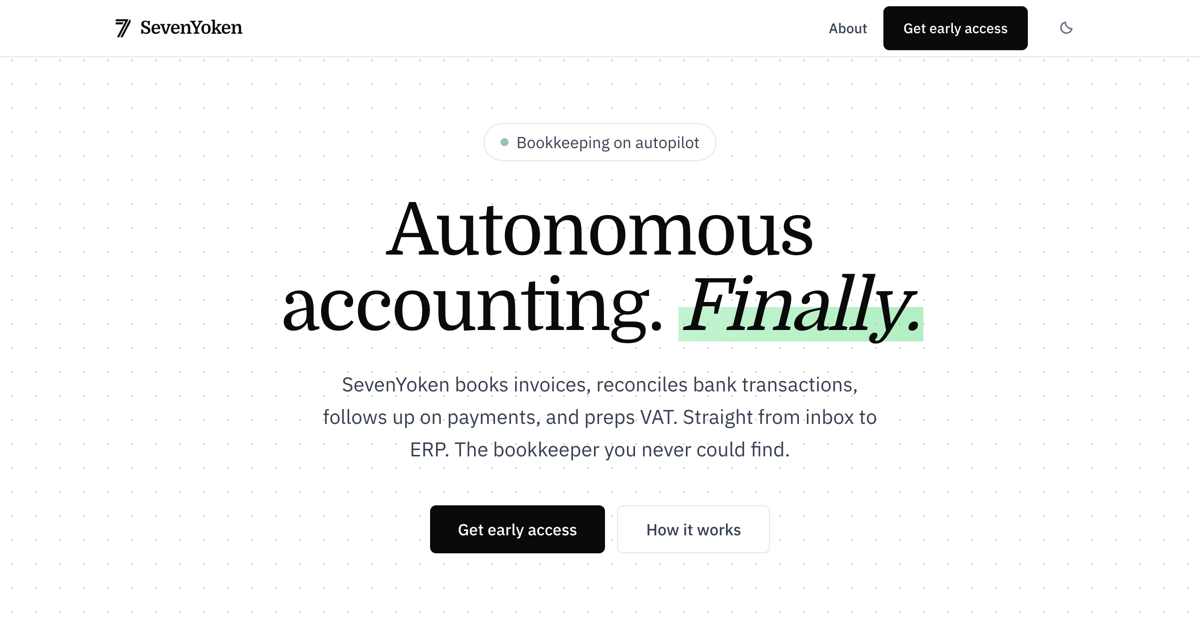
SevenYoken provides an enterprise-grade API platform for autonomous accounting analysis and decision making. Reduce cycle time, eliminate manual overhead, and monitor clients' financial health in near real-time.
Run a free AEO + signal audit for your domain.
AI Answer Engine Optimization (AEO)
List once. Convert intent from live AI conversations without heavy integration.
Automated financial analysis is the use of artificial intelligence and machine learning algorithms to process and interpret financial data. This technology automates tasks like forecasting, risk assessment, anomaly detection, and performance reporting. It enables businesses to make faster, data-driven decisions with greater accuracy and reduced manual effort.
Identify the specific financial metrics, data sources, and reporting outcomes your business needs to monitor and improve.
The software connects to accounting systems, ERPs, and banking feeds to automatically aggregate and cleanse financial data for analysis.
AI models generate forecasts, identify trends and anomalies, and produce dashboards that highlight key performance indicators and risks.
Automates real-time credit risk scoring, fraud detection, and regulatory compliance reporting for faster and safer financial services.
Provides dynamic sales forecasting, inventory cash flow analysis, and customer lifetime value predictions to optimize pricing and stock.
Analyzes monthly recurring revenue (MRR), churn rates, and customer acquisition costs to improve financial health and growth strategies.
Monitors production costs, analyzes supplier payment terms, and forecasts demand to enhance working capital management and profitability.
Automates revenue cycle management, analyzes clinical trial cost efficiency, and forecasts budget allocations for research and development.
Bilarna evaluates Automated Financial Analysis providers using a proprietary 57-point AI Trust Score. This score rigorously assesses technical capabilities, data security protocols, proven client outcomes, and regulatory compliance. Bilarna's continuous monitoring ensures every listed provider maintains high standards of expertise and reliability for B2B buyers.
Costs vary significantly based on features, deployment scale, and customization. Entry-level SaaS platforms may start at a few hundred dollars monthly, while enterprise solutions with advanced AI modeling can run into tens of thousands annually. Pricing is typically based on data volume, user seats, and the complexity of analytical modules required.
Traditional BI tools primarily visualize historical data. Automated financial analysis uses predictive AI and machine learning to not only report but also forecast, identify hidden patterns, and prescribe actions. It actively uncovers insights and predicts future financial scenarios with minimal human intervention.
Implementation timelines range from a few weeks for cloud-based SaaS solutions to several months for complex on-premise enterprise deployments. The duration depends on data integration complexity, the need for custom model training, and internal process alignment. A clear data strategy is crucial for a swift setup.
Essential features include robust data connectors, real-time processing, predictive modeling for forecasting and scenario planning, anomaly detection alerts, and customizable dashboarding. Strong security certifications and the ability to explain AI-driven insights (explainable AI) are also critical for trust and compliance.
Common pitfalls include overlooking data integration capabilities, underestimating the need for user training and change management, and choosing a platform that lacks scalability. Failing to verify the provider's expertise in your specific industry and their model's transparency can also lead to poor ROI and adoption challenges.
Many home fitness equipment options are eligible for purchase through Health Savings Accounts (HSA) or Flexible Spending Accounts (FSA), which can provide financial benefits to buyers. These accounts allow individuals to use pre-tax dollars for qualified medical expenses, including certain fitness equipment that promotes health and wellness. Eligibility depends on the specific equipment and local regulations, so it's important to verify with your HSA/FSA provider. Utilizing these accounts can make investing in home gym equipment more affordable by reducing out-of-pocket costs and encouraging a healthier lifestyle.
Yes, an AI agent can be configured to perform automated actions or remediations during incident management. These actions are governed by strict permissions and guardrails to ensure security and prevent unauthorized changes. Teams can define scopes, controls, and approval workflows to safeguard critical operations. This capability allows the AI agent not only to identify issues but also to initiate fixes, such as creating pull requests for code exceptions, thereby accelerating incident resolution while maintaining operational safety.
Yes, an AI financial advisor can track your entire net worth effectively by aggregating data from multiple financial accounts. 1. Connect all your investment, bank, and retirement accounts securely. 2. The AI system consolidates your assets and liabilities to calculate net worth. 3. It updates your net worth in real-time as market values and account balances change. 4. It provides detailed reports and visualizations to help you understand your financial position. 5. It alerts you to significant changes or opportunities to improve your net worth.
Yes, many automated code review tools offer features that help developers generate tested and reliable code snippets. These tools use advanced algorithms to produce code that adheres to best practices and passes common test cases. By providing ready-to-use, tested code, they reduce the time developers spend writing and debugging code manually. This assistance not only speeds up development but also improves overall code quality and reduces the likelihood of introducing new bugs.
Yes, modern automated testing tools powered by AI can generate and maintain tests without the need for manual coding. These tools observe real user interactions or accept simple inputs like screen recordings or flow descriptions to automatically create end-to-end tests. The generated tests include selectors, steps, and assertions, and are designed to self-heal by adapting to changes in the user interface. This eliminates the need for hand-coding brittle scripts and reduces maintenance overhead. Users can customize tests easily if needed, but the core process significantly lowers the effort required to keep tests up to date and reliable.
Yes, automated tests can adapt to changes in dynamically rendered web pages by using AI-based test recording. 1. The AI records tests in plain English, focusing on user interactions rather than fragile HTML structure. 2. It distinguishes between UI changes and simple rendering differences. 3. When the application updates, the tests auto-heal by adjusting to these changes. 4. This ensures tests remain stable and reliable despite dynamic content.
Yes, ConnectAI can create a complete offer in Myfactory within 20 seconds from an incoming email or PDF. The AI agent reads the email or document, extracts relevant information, and generates a formatted offer directly in the ERP system. This feature is part of the sales automation suite, which also includes automatic creation of contacts and offers. It streamlines the sales process by eliminating manual data entry and speeding up response times.
Yes, financial automation solutions are often modular and customizable to fit the specific needs of different businesses. Organizations can select and adapt only the modules they require, such as accounts payable, accounts receivable, billing, or treasury management, allowing them to scale their automation at their own pace. This flexibility ensures that companies can address their unique operational challenges without unnecessary complexity or cost. Additionally, user-friendly tools and AI capabilities enable teams to maintain compliance and efficiency while tailoring the system to their workflows. Customized onboarding and collaborative support further help businesses get up and running quickly with solutions that match their requirements.
Prepare your tax declaration regardless of your financial situation. 1) Identify your employment or income type (employee, independent, pensioner, capital rentier, public forces member, foreign income, savings, investments, property, sales, or inheritance). 2) Use a platform capable of handling all these cases correctly and optimized. 3) Provide accurate and complete information related to your specific situation. 4) The platform will prepare your declaration correctly and optimize your tax outcome.
Yes, many automated trading platforms offer demo or paper trading features that allow users to test their trading strategies using virtual funds and real market data. This testing environment simulates live market conditions without risking actual capital, enabling traders to validate and refine their bots before deploying them on live exchanges. Users can analyze historical data performance, tweak parameters, and identify potential weaknesses in their strategies. Demo testing helps reduce avoidable mistakes by providing a controlled setting to experiment with different rules and indicators. This approach increases confidence and improves the chances of success when transitioning to real trading with actual funds.