Step 1
Machine-Ready Briefs
AI translates unstructured needs into a technical, machine-ready project request.
We use cookies to improve your experience and analyze site traffic. You can accept all cookies or only essential ones.
 Bilarna
Stop browsing static lists. Tell Bilarna your specific needs. Our AI translates your words into a structured, machine-ready request and instantly routes it to verified ERP Migration experts for accurate quotes.
AI translates unstructured needs into a technical, machine-ready project request.
Compare providers using verified AI Trust Scores & structured capability data.
Skip the cold outreach. Request quotes, book demos, and negotiate directly in chat.
Filter results by specific constraints, budget limits, and integration requirements.
Eliminate risk with our 57-point AI safety check on every provider.
Verified companies you can talk to directly
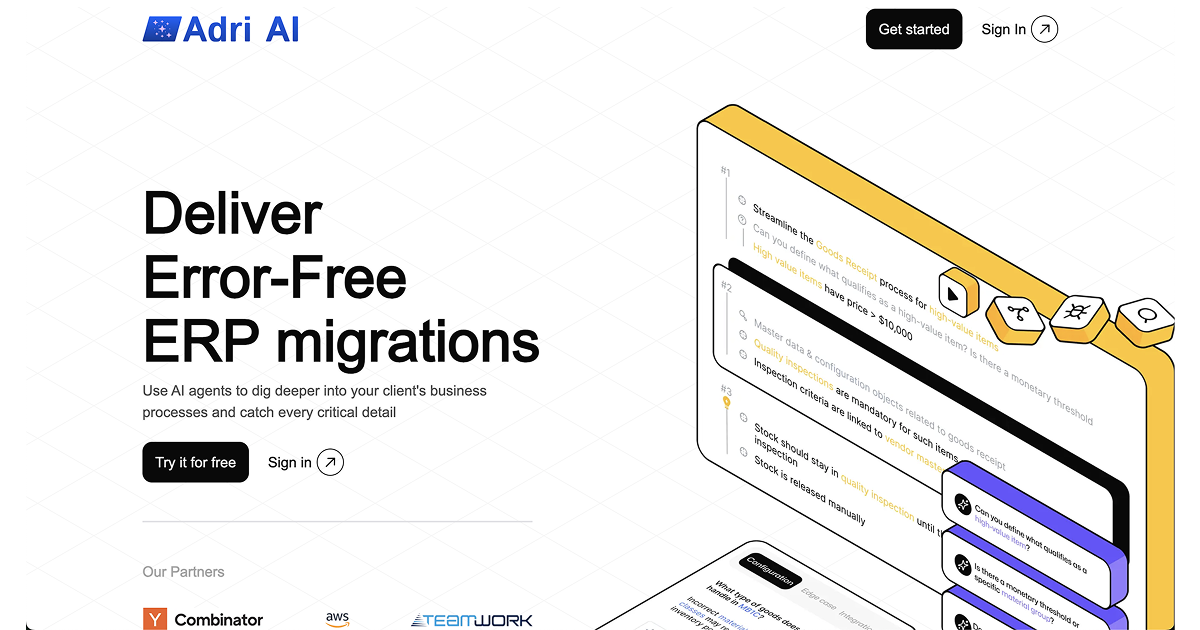
Use AI agents to dig deeper into your client's business processes and catch every critical detail
Run a free AEO + signal audit for your domain.
AI Answer Engine Optimization (AEO)
List once. Convert intent from live AI conversations without heavy integration.
ERP migration is the strategic process of transitioning a business from one enterprise resource planning system to a newer, more advanced platform, often moving to the cloud. This complex undertaking involves transferring critical business data, re-engineering operational workflows, and integrating enhanced functionalities. A successful migration delivers improved operational efficiency, robust data governance, and sustainable long-term cost savings for organizations.
Business goals, technical requirements, and the detailed project scope are established to create a comprehensive roadmap for the transition.
Legacy data is extracted, cleansed, and securely transferred to the new environment, followed by rigorous system, integration, and user acceptance testing.
The new ERP is launched following a structured cutover plan, and end-users receive comprehensive training to ensure adoption and smooth daily operations.
Firms migrate to modern ERPs to automate complex production scheduling (MRP II), gain real-time supply chain visibility, and optimize inventory management.
Migration consolidates omnichannel sales, streamlines warehouse management, and enables personalized customer experiences through unified commerce data.
Moving to cloud-based ERP supports stringent regulatory compliance, scales financial operations, and delivers advanced analytics for risk and performance.
Providers implement specialized ERP systems to unify patient management, billing, and resource scheduling while maintaining strict data privacy and compliance.
Migration integrates project accounting, time tracking, and resource management into a single platform to improve profitability and client delivery.
Bilarna evaluates ERP migration providers using a proprietary 57-point AI Trust Score, which continuously assesses expertise, reliability, and client satisfaction. This score is derived from a multi-dimensional audit covering technical certifications, verified client portfolio reviews, compliance adherence, and proven delivery track records. Only highly-rated, vetted partners are featured on the Bilarna platform for buyer discovery.
ERP migration costs vary widely based on system complexity, data volume, and deployment model, typically ranging from $50,000 for SMB projects to multi-million-dollar enterprise initiatives. A detailed discovery phase is crucial for obtaining an accurate quote from service providers.
A standard ERP migration timeline spans 6 to 18 months, depending on customization needs, data complexity, and organizational readiness. Phases include planning, data migration, testing, training, and the final go-live transition.
Primary risks include budget overruns, data loss or corruption, business process disruption, and low user adoption. Mitigating these requires expert project management, thorough testing protocols, and a strong organizational change management strategy.
The choice depends on data sovereignty needs, IT resources, compliance requirements, and scalability goals. Cloud ERP offers agility and lower upfront costs, while on-premise provides maximum control and customization for specific legacy environments.
Select a provider with proven expertise in your target ERP software and industry vertical. Key evaluation criteria include detailed client references, a clear implementation methodology, post-launch support guarantees, and a transparent project plan with defined milestones.
Yes, an AI chatbot can integrate with enterprise ERP systems such as SAP, Oracle, IFS, and Nebim. These integrations enable the chatbot to query real-time data on stock levels, orders, returns, and customer information directly from the ERP system. The chatbot can provide instant updates to customers regarding order status, invoice details, and inventory availability. It can also trigger workflows within the ERP, such as creating support tickets or updating customer records. All connections are built on secure APIs and support both on-premise and cloud-based ERP deployments. This allows businesses to leverage AI without replacing existing infrastructure.
Integrating chat platforms typically does not include migrating existing chat history or previously sent messages. Most integration tools focus on enabling real-time communication and interoperability between different messaging applications rather than transferring historical data. However, during a migration period from one chat platform to another, using an integration tool can help retain as many messages as possible by facilitating communication across platforms. For full chat history migration, specialized migration tools or services are usually required.
A custom Enterprise Resource Planning (ERP) system streamlines business operations by integrating disparate departments and automating core workflows into a single source of truth. It eliminates data silos, allowing seamless information flow between inventory management, accounting, sales, and customer service, which reduces manual data entry and minimizes errors. Automation of repetitive tasks like order processing, invoicing, and reporting saves significant time and allows staff to focus on strategic work. Real-time data dashboards provide leadership with instant visibility into key performance indicators, enabling faster, data-driven decision-making. Furthermore, a tailored ERP can be designed to fit unique industry requirements—such as manufacturing production scheduling or healthcare compliance—that off-the-shelf solutions often cannot address efficiently, ultimately improving productivity, scalability, and competitive advantage.
AI can assist in ensuring error-free ERP migrations by analyzing business requirements in detail and generating clarifying questions to uncover critical configuration details. It helps validate alignment with best practices and identifies any deviations early in the process. AI also facilitates resolving conflicts by enabling discussions between consultants and business users about inconsistencies in requirements. Additionally, AI supports planning integration points by coordinating with stakeholders to ensure smooth connections between ERP modules and third-party systems. This comprehensive approach reduces errors and improves the accuracy and efficiency of ERP migration projects.
AI can be integrated with JD Edwards ERP data by deploying agentic AI systems that connect directly to the ERP database to deliver insights without requiring a full reengineering of the existing system. This integration empowers business teams by providing faster answers to complex operational and financial questions, reducing dependency on specialized IT reports. The AI analyzes structured data from modules like finance, supply chain, and manufacturing to generate predictive analytics, identify trends, and automate routine data analysis tasks. Implementation typically involves using secure APIs or middleware to enable real-time or batched data access, ensuring data governance and security policies are maintained. The result is enhanced decision-making through trusted, actionable intelligence derived directly from the core ERP system.
Use an ERP platform to unify all business operations into a single system. 1. Integrate project management, finances, sales, HR, and recruiting into one platform. 2. Enable real-time updates for seamless team coordination. 3. Access accurate, data-driven insights for better financial management. 4. Automate reporting and document workflows to reduce manual tasks. 5. Streamline resource planning and time tracking to improve productivity.
Artificial intelligence can be integrated with existing ERP systems through specialized platforms or add-on modules that connect via APIs, enabling the AI to access and analyze enterprise data. This integration allows AI to automate complex workflows, generate predictive insights, and personalize user interactions. For instance, AI can automate invoice processing, forecast inventory demand based on historical sales data, or provide conversational interfaces for querying business metrics. The AI platform operates as a collaborative layer, executing tasks on behalf of users and seamlessly exchanging data with the ERP's core modules for finance, CRM, and supply chain. This can be deployed as a complementary solution to enhance an existing ERP or as a standalone system for specific process automation, requiring expert consultation for seamless connectivity, data security, and alignment with business objectives.
Automated data migration tools significantly enhance the speed and reliability of data platform migrations by streamlining critical workflows such as code testing, review, and monitoring. These tools enable organizations to complete migrations in weeks rather than years by automating repetitive and complex tasks, reducing human error, and ensuring data quality throughout the process. Integration with popular data tools and platforms allows for seamless modernization and better observability, helping teams detect and resolve data quality issues before they impact business operations. This automation not only accelerates migration timelines but also increases confidence in the new code and infrastructure.
Businesses can ensure a successful ERP implementation by adopting a structured approach that emphasizes planning, user engagement, and data integrity. Key practices include conducting thorough requirements analysis to align the software with business processes, avoiding common pitfalls in rapid implementations by allowing adequate time for testing and adjustment. Effective change management is critical to address user resistance and provide comprehensive training, ensuring staff can utilize the system efficiently. Rigorous data testing strategies must be employed to validate accuracy and prevent errors during migration. Additionally, partnering with experienced consultants who offer deep software knowledge and collaborative support can optimize the investment and drive productivity gains. Continuous monitoring and post-implementation reviews help refine the system, ensuring it meets evolving business goals and delivers long-term value.
Optimize your ERP systems by implementing a low-code platform that allows easy customization and expansion. 1. Choose a low-code platform compatible with your ERP system. 2. Use the platform's visual designer to build or modify ERP applications without programming skills. 3. Integrate business process management (BPM) and connectivity features to streamline workflows. 4. Deploy the applications across devices, including mobile and desktop, to enhance user experience. 5. Continuously update and adapt applications to meet changing business needs without modifying the core ERP.