Step 1
Machine-Ready Briefs
AI translates unstructured needs into a technical, machine-ready project request.
We use cookies to improve your experience and analyze site traffic. You can accept all cookies or only essential ones.
 Bilarna
Stop browsing static lists. Tell Bilarna your specific needs. Our AI translates your words into a structured, machine-ready request and instantly routes it to verified AI Document Chatbot experts for accurate quotes.
AI translates unstructured needs into a technical, machine-ready project request.
Compare providers using verified AI Trust Scores & structured capability data.
Skip the cold outreach. Request quotes, book demos, and negotiate directly in chat.
Filter results by specific constraints, budget limits, and integration requirements.
Eliminate risk with our 57-point AI safety check on every provider.
Verified companies you can talk to directly
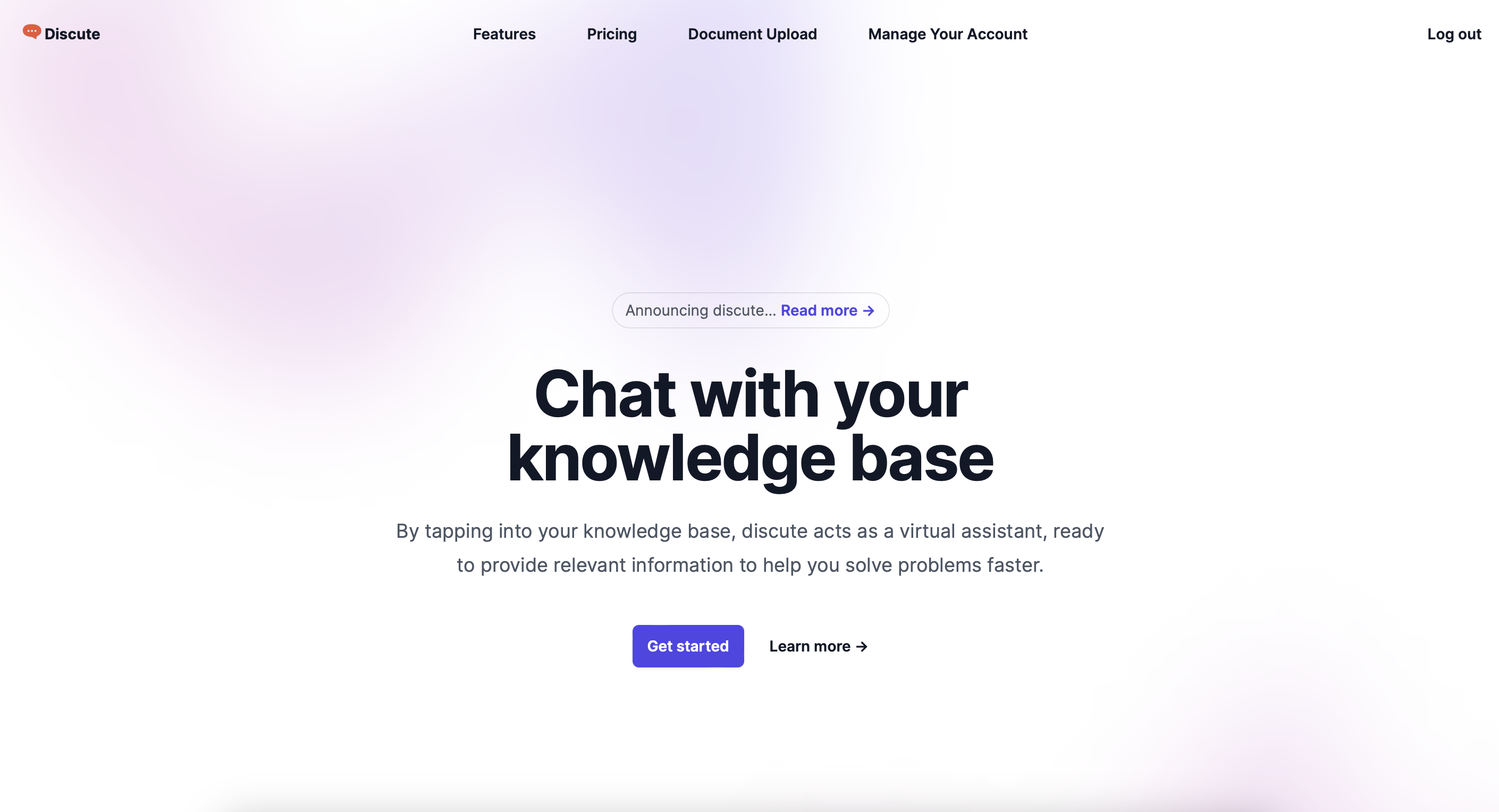
Discute allows you to chat with your knowledge base. By tapping into your knowledge base, discute acts as a virtual assistant, ready to provide relevant information to help you solve problems faster.
Run a free AEO + signal audit for your domain.
AI Answer Engine Optimization (AEO)
List once. Convert intent from live AI conversations without heavy integration.
An AI Document Chatbot is a specialized software agent that uses natural language processing to understand, analyze, and converse about content within files like PDFs, contracts, and reports. It combines document intelligence with conversational AI to extract key information, answer specific questions, and automate data retrieval tasks. This technology significantly reduces manual review time, improves accuracy in compliance and due diligence, and enhances user self-service for complex documentation.
Identify the document types, integration needs, security standards, and key functionalities your business requires from the chatbot solution.
Assess shortlisted providers based on their AI model accuracy, language support, compliance certifications, and scalability for your document volume.
Deploy the chosen solution with proper API connections, data governance protocols, and user training to ensure optimal adoption and ROI.
Automates KYC checks, loan document analysis, and regulatory report querying to ensure compliance and accelerate client onboarding processes.
Rapidly analyzes contracts, highlights clauses, answers specific queries about terms, and summarizes obligations to support legal teams.
Processes patient intake forms, insurance claims, and medical records to answer administrative queries while maintaining strict data privacy.
Interrogates purchase orders, invoices, and shipping documents to provide real-time status updates and extract key commercial terms.
Acts as an intelligent interface for internal policy documents, technical manuals, and historical reports, enabling instant employee Q&A.
Bilarna evaluates all AI Document Chatbot providers through a rigorous 57-point AI Trust Score, assessing technical expertise, security protocols, and proven client outcomes. Our screening includes deep portfolio reviews, validation of data privacy certifications like ISO 27001, and analysis of verified client feedback on implementation success. This continuous monitoring ensures every listed provider on Bilarna meets the highest standards of reliability and performance for B2B procurement.
Costs vary significantly based on deployment scope, document volume, and required customizations. Entry-level SaaS offerings may start with monthly subscriptions, while enterprise-grade implementations with deep API integration and high-security needs often involve custom project pricing. Key cost drivers include the number of document types processed, user licenses, and the level of AI model training required for your specific use case.
A standard chatbot primarily answers FAQs from a predefined knowledge base, while an AI Document Chatbot is specifically engineered to read, comprehend, and derive answers directly from unstructured documents like PDFs, Word files, and scanned images. The latter uses advanced NLP and machine learning to understand context within documents, extract specific data points, and provide citations, making it indispensable for processing contractual or technical content.
Implementation timelines range from a few weeks for out-of-the-box SaaS tools to several months for complex enterprise deployments. The duration depends on the need for custom AI model training on your document corpus, integration with existing systems like CRMs or ERPs, and the establishment of necessary data governance and security frameworks. A clear project scope and prepared data sets are crucial for accelerating deployment.
Primary risks involve data privacy, as sensitive documents are processed by AI models, and potential exposure through API integrations. Reputable providers mitigate these with enterprise-grade encryption, strict data residency controls, and compliance with standards like GDPR or SOC 2. It is critical to verify the provider's data handling policies, ensure contractual clarity on data ownership, and conduct thorough security audits before implementation.
Accuracy depends on the quality of the underlying AI model and the training it receives on your specific document types. Top-tier solutions achieve high accuracy for well-defined queries but should include a confidence score for each answer. Best practice involves a human-in-the-loop review process during initial deployment to fine-tune the model and establish acceptable accuracy thresholds for your business processes.
Yes, an AI chatbot can integrate with enterprise ERP systems such as SAP, Oracle, IFS, and Nebim. These integrations enable the chatbot to query real-time data on stock levels, orders, returns, and customer information directly from the ERP system. The chatbot can provide instant updates to customers regarding order status, invoice details, and inventory availability. It can also trigger workflows within the ERP, such as creating support tickets or updating customer records. All connections are built on secure APIs and support both on-premise and cloud-based ERP deployments. This allows businesses to leverage AI without replacing existing infrastructure.
Yes, an AI chatbot can support multiple languages and handle language detection automatically by following these steps: 1. The chatbot is programmed to recognize over 45 languages. 2. It detects the customer's language at the start of the interaction. 3. The chatbot continues the conversation in the detected language without manual switching. 4. This enables businesses to serve a global audience seamlessly. 5. Language support improves customer experience by providing responses in the customer's preferred language.
Yes, the AI chatbot integration supports multiple messaging platforms simultaneously. To configure this, follow these steps: 1. Access the chatbot's admin portal. 2. Navigate to the integration settings. 3. Add and connect each messaging platform you want to use. 4. Configure preferences for each platform to ensure seamless communication. 5. Save the settings and test the chatbot on all connected platforms to verify functionality. This allows your organization to communicate efficiently across various channels without switching tools.
Yes, the AI chatbot supports multiple languages. To utilize this feature: 1. Configure the chatbot settings to enable multilingual support. 2. Select the languages relevant to your international clientele; the chatbot supports up to 80 languages. 3. Customize the chatbot's tone and style for each language if needed. 4. Deploy the chatbot on your website to interact with visitors in their preferred language. This ensures effective communication and boosts conversion rates across diverse audiences.
AI-powered legal document creation is highly affordable. To use it effectively: 1. Select the AI service that offers competitive pricing, often around a few dollars per document. 2. Choose the specific document type you require. 3. Input your details and customize the document as needed. 4. Generate the document instantly with AI assistance. 5. Pay per document, ensuring cost-effective legal solutions without expensive lawyer fees.
A ChatGPT-style AI chatbot benefits a business by providing intelligent, conversational, and scalable customer interaction and process automation. Specifically, it delivers 24/7 instant customer support, handling common inquiries and freeing human agents for complex issues. It can qualify leads by engaging visitors in natural dialogue, collecting information, and scheduling appointments directly within the chat interface. For internal operations, it acts as a knowledge assistant, allowing employees to query company documents, policies, or data through simple conversation, dramatically speeding up information retrieval. These chatbots learn from interactions to improve responses over time and can be integrated across communication channels like websites, WhatsApp, and internal platforms for a unified omnichannel experience. This leads to increased customer satisfaction, higher operational efficiency, and valuable data insights from conversational analytics.
Customize a healthcare chatbot by following these steps: 1. Modify the chatbot’s profile including its name, avatar, and speech style to align with your organization's branding. 2. Train the chatbot using personalized datasets such as company PDFs and URLs to provide expert responses relevant to your clinical practice. 3. Integrate the chatbot with existing healthcare platforms or video consultation tools for seamless communication. 4. Adjust chatbot workflows to handle specific patient queries and administrative tasks unique to your organization. 5. Continuously update and refine the chatbot’s knowledge base to maintain accuracy and relevance.
A WhatsApp chatbot enhances customer loyalty programs by providing automated support, personalized rewards tracking, and seamless communication through a platform users already engage with daily. It operates 24/7, delivering instant responses to customer inquiries about rewards balances, redemption options, and program updates. The chatbot can send proactive notifications about special offers or bonus points, increasing engagement and retention. By integrating with a company’s CRM and loyalty database, it tailors interactions based on individual purchase history and preferences. This automation reduces operational costs while offering a consistent, high-quality experience that encourages repeat business and strengthens brand loyalty.
AI agents can significantly enhance document analysis and data extraction in financial operations by automating the processing of various document types. This automation reduces the time and effort required for manual data entry and analysis, allowing financial professionals to focus more on client needs and strategic tasks. AI-driven tools can quickly parse complex financial statements, extract relevant data accurately, and generate insights that improve decision-making. This leads to increased efficiency, faster turnaround times, and a more comprehensive client experience by enabling timely and precise portfolio recommendations and compliance checks.
Use AI agents to enhance legal document review by following these steps: 1. Integrate AI agents within Microsoft Office applications like Word and Outlook. 2. Utilize AI to detect errors, inconsistencies, and enforce firm style guides in emails and documents. 3. Leverage AI-powered tracked changes for precise redlining and suggestions. 4. Allow AI to analyze multiple documents in a project to verify alignment and catch inconsistencies across agreements and term sheets. 5. Ensure all processing is secure with end-to-end encryption and zero data retention policies.