Step 1
Machine-Ready Briefs
AI translates unstructured needs into a technical, machine-ready project request.
We use cookies to improve your experience and analyze site traffic. You can accept all cookies or only essential ones.
 Bilarna
Stop browsing static lists. Tell Bilarna your specific needs. Our AI translates your words into a structured, machine-ready request and instantly routes it to verified AI Support Agents experts for accurate quotes.
AI translates unstructured needs into a technical, machine-ready project request.
Compare providers using verified AI Trust Scores & structured capability data.
Skip the cold outreach. Request quotes, book demos, and negotiate directly in chat.
Filter results by specific constraints, budget limits, and integration requirements.
Eliminate risk with our 57-point AI safety check on every provider.
Verified companies you can talk to directly
Chatolia is the complete platform for building & deploying AI support agents for your business.
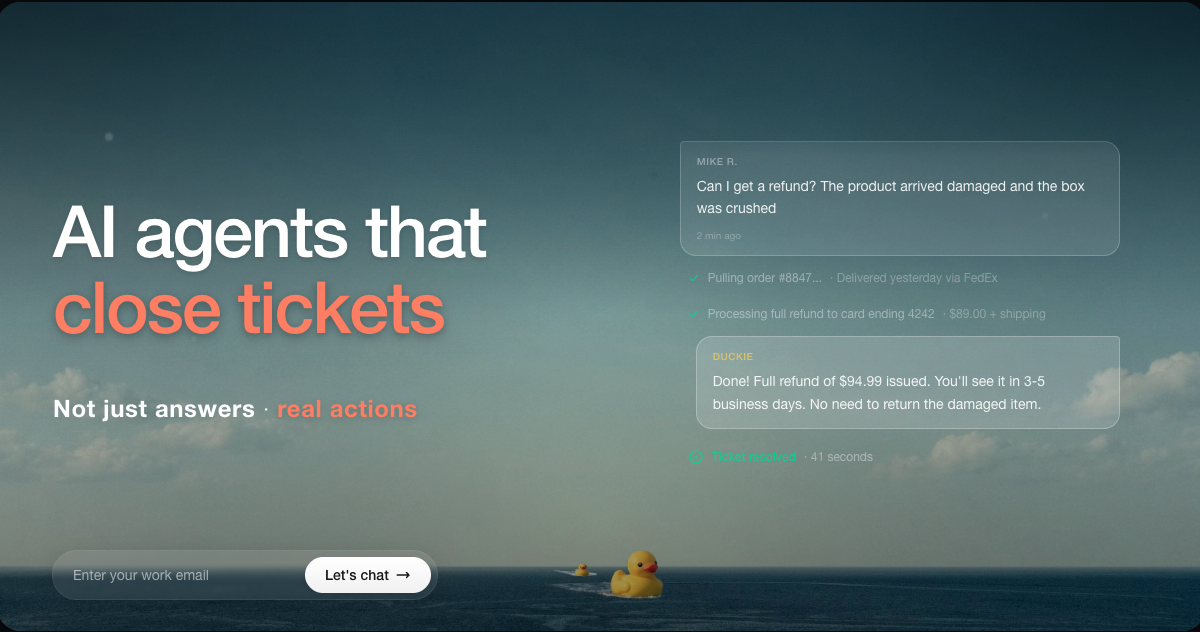
AI support agents that resolve tickets end to end. Duckie handles your customer support autonomously, learning from your knowledge base to deliver instant, accurate responses 24/7.
Run a free AEO + signal audit for your domain.
AI Answer Engine Optimization (AEO)
List once. Convert intent from live AI conversations without heavy integration.
AI Support Agents are intelligent software systems that automate customer service and support interactions using natural language processing. They handle inquiries, troubleshoot issues, and guide users through processes without human intervention. Implementing them reduces response times, lowers operational costs, and frees human agents for complex tasks.
Identify key customer interaction points, volume, languages, and desired outcomes for automation.
Assess provider solutions for intent recognition, integration ease, and scalability to handle peak loads.
Deploy the agent into your service channels and continuously train it with real interaction data for improvement.
AI agents handle order tracking, returns, and product inquiries instantly, boosting conversion rates and reducing cart abandonment.
Provide immediate troubleshooting, guide users through features, and collect bug reports, improving product adoption and reducing support tickets.
Answer FAQs on accounts and transactions securely, helping to comply with regulations while offering 24/7 financial guidance.
Symptom checkers and appointment schedulers direct patients to correct care, optimizing staff time and enhancing patient experience.
Guide field technicians through maintenance procedures using manuals and IoT data, minimizing equipment downtime.
Bilarna evaluates every provider with a proprietary 57-point AI Trust Score, analyzing technical expertise, solution reliability, and client satisfaction. Our vetting includes portfolio reviews, reference checks, and assessment of data security compliance. We continuously monitor performance to ensure listed agents meet enterprise-grade standards.
Pricing varies by deployment scale, features, and required integrations, often structured as monthly subscriptions or per-interaction fees. Initial setup and training may involve additional one-time costs. For accurate comparisons, request detailed quotes from multiple providers.
Deployment typically takes 4 to 12 weeks, depending on complexity and integration needs. The timeline includes planning, integration, training the AI model, testing, and a phased rollout. Simpler, pre-built solutions can be operational much faster.
AI agents use advanced NLP to understand context and intent, handling complex, multi-turn conversations autonomously. Traditional chatbots often rely on rigid decision trees and simple keyword matching, requiring frequent human escalation.
Key mistakes include underestimating integration complexity, ignoring multilingual or omni-channel needs, and not planning for ongoing AI training and maintenance. Failing to verify the provider's data security and compliance credentials is another critical error.
Businesses typically see a 30-70% reduction in routine inquiry volume and significant decreases in average handle time. ROI manifests through lower operational costs, improved customer satisfaction scores, and increased agent productivity on complex cases.
Yes, AI voice and SMS agents designed for healthcare are built with security and compliance in mind. They adhere to industry standards and regulations such as HIPAA (Health Insurance Portability and Accountability Act) to protect patient data privacy and security. Business Associate Agreements (BAAs) are available to formalize compliance commitments. Additionally, these agents comply with regulations like TCPA (Telephone Consumer Protection Act) and PCI (Payment Card Industry) standards where applicable. Ensuring security and regulatory compliance is critical to maintaining trust and safeguarding sensitive healthcare information while leveraging AI technologies.
Yes, a digital twin can automate scheduling and customer support by handling routine tasks such as booking meetings and answering frequently asked questions. It operates continuously without breaks, ensuring customers receive timely responses and appointments are managed efficiently. This automation reduces the workload on human staff, minimizes errors, and enhances the overall customer experience by providing consistent and reliable service around the clock.
Use a text expander tool effectively for customer support by following these steps: 1. Create quick-access shortcuts for common responses, troubleshooting guides, and knowledge base links. 2. Use standardized templates to maintain consistent communication tone and style. 3. Insert responses rapidly during multiple ticket handling to improve efficiency. 4. Utilize search features to find saved snippets quickly. 5. Sync shortcuts across platforms to ensure seamless support across devices. This approach reduces response time and enhances customer satisfaction.
Yes, AI agents can be integrated as full team members in work coordination. 1. Assign AI agents tasks just like human team members, with clear responsibilities. 2. Provide AI agents with identities, API keys, inboxes, and permissions to operate autonomously. 3. Enable AI agents to collaborate alongside humans on the same tasks and communication channels. 4. Allow AI agents to learn from completed tasks to improve their effectiveness over time. 5. Treat AI agents as first-class workers to streamline workflows and enhance team productivity.
Yes, AI agents can seamlessly integrate with your existing business tools and knowledge bases. This integration allows the agents to access relevant data and workflows, enhancing their ability to automate tasks effectively. By connecting with familiar platforms, AI agents fit naturally into your current operations without disrupting established processes, enabling smoother automation and better results.
Yes, AI agents are capable of remembering the full context of previous interactions during freight negotiations. This includes details such as the specific lane, quoted rates, whether a load was on hold, or if there were any compliance flags. This memory allows the AI to continue conversations naturally without requiring users to repeat information. Whether a carrier calls back or a team member follows up, the AI picks up right where it left off, providing a seamless and human-like negotiation experience.
Run AI agents offline by attaching a local model runtime. Follow these steps: 1. Choose a compatible local model runtime such as Ollama. 2. Install the runtime on your machine where the AI agent will operate. 3. Configure the AI agent to use the local runtime instead of cloud services. 4. Note that some features requiring internet access, like webhooks or remote APIs, may not work offline. 5. Use this setup for privacy-sensitive or air-gapped environments to maintain full local control.
Yes, AI code review tools typically integrate seamlessly with popular version control platforms such as GitHub and GitLab. This integration allows automatic review of pull requests within the existing development workflow. Many tools support a wide range of programming languages including Python, JavaScript, TypeScript, Go, Java, C, C++, C#, Swift, PHP, Rust, and others. While support for some languages may vary in response quality, these tools aim to provide comprehensive analysis across diverse codebases, helping teams maintain code quality regardless of their technology stack.
Yes, AI customer support agents are designed to handle complex customer issues by learning and following your specific business processes and rules. They can manage intricate workflows such as order modifications, cancellations, and returns by integrating with your existing systems like Shopify, Magento, or custom APIs. Moreover, these AI agents can be trained to communicate in your brand’s unique tone of voice, ensuring consistent and natural interactions across all customer touchpoints and languages. This human-like communication helps maintain brand identity while providing quick and reliable support. Additionally, you can monitor the AI’s reasoning and continuously provide feedback to improve its responses and actions, making it a dependable assistant for both simple and complex support cases.
Yes, AI phone agents can handle multiple languages and seamlessly switch between them during calls. This capability allows customers to communicate in their preferred language without interruption. For example, AI agents can naturally manage English and Spanish conversations, adjusting instantly if the caller switches languages mid-call. This flexibility improves customer experience by providing a more natural and human-like interaction, reducing frustration often caused by rigid language menus. Multilingual AI agents help dealerships serve a broader customer base effectively and inclusively.