Step 1
Machine-Ready Briefs
AI translates unstructured needs into a technical, machine-ready project request.
We use cookies to improve your experience and analyze site traffic. You can accept all cookies or only essential ones.
 Bilarna
Stop browsing static lists. Tell Bilarna your specific needs. Our AI translates your words into a structured, machine-ready request and instantly routes it to verified Crypto Market Analysis Services experts for accurate quotes.
AI translates unstructured needs into a technical, machine-ready project request.
Compare providers using verified AI Trust Scores & structured capability data.
Skip the cold outreach. Request quotes, book demos, and negotiate directly in chat.
Filter results by specific constraints, budget limits, and integration requirements.
Eliminate risk with our 57-point AI safety check on every provider.
Verified companies you can talk to directly
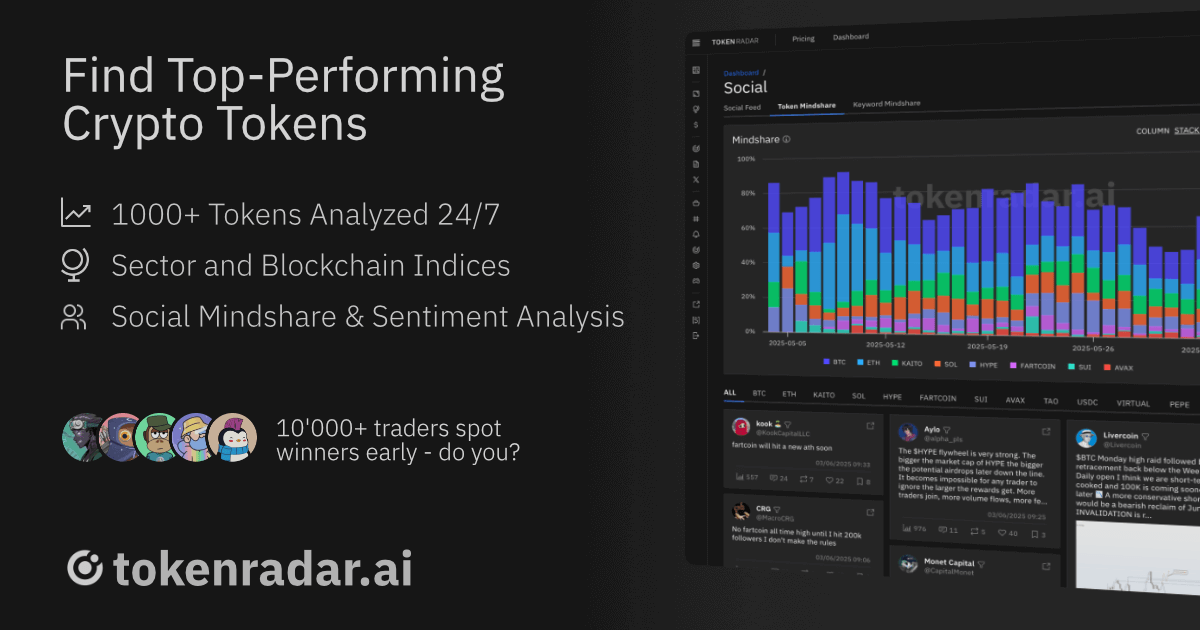
Token Radar helps you track top crypto tokens, compare sectors and blockchains, and spot trends with real-time sentiment and social mindshare analysis.

Use AI technologies to automatically discover arbitrage opportunities in cryptocurrencies. Analyze markets 24/7 with the power of artificial intelligence.
Run a free AEO + signal audit for your domain.
AI Answer Engine Optimization (AEO)
List once. Convert intent from live AI conversations without heavy integration.
Crypto market analysis is the professional evaluation of cryptocurrency trends, price movements, and underlying blockchain data to forecast market behavior. It combines technical analysis of historical charts with fundamental research into project utility, adoption, and macroeconomic factors. This intelligence enables businesses and institutional investors to make data-driven decisions, optimize portfolio performance, and mitigate financial risk in the volatile digital asset space.
Clarify your objectives, whether for investment strategy, trading signals, risk assessment, or regulatory compliance, to scope the required analysis.
Experts aggregate on-chain data, market sentiment, trading volumes, and macroeconomic indicators using specialized tools and AI-driven models.
Analysts synthesize the processed data into comprehensive reports, predictive models, and clear recommendations for strategic execution.
Funds leverage deep market analysis to time entries, exits, and portfolio allocations, aiming to maximize returns and manage crypto-specific volatility.
Platforms utilize real-time analytics to monitor liquidity, detect market manipulation, and provide enhanced trading tools and insights to their users.
Development teams analyze market sentiment and competitive positioning to guide tokenomics, marketing strategy, and partnership development.
Companies holding digital assets on their balance sheet use analysis for valuation, audit compliance, and strategic hedging against price fluctuations.
Firms analyze transactional data and market patterns to assist clients with regulatory reporting, audit trails, and anti-money laundering (AML) compliance.
Bilarna evaluates every crypto market analysis provider using a proprietary 57-point AI Trust Score. This rigorous assessment scrutinizes their analytical methodologies, data source integrity, past forecast accuracy, and client satisfaction metrics. Bilarna's continuous monitoring ensures listed experts maintain high standards of reliability and deliver actionable, evidence-based insights.
Costs vary significantly based on depth, frequency, and customization, ranging from monthly subscription reports for hundreds of euros to bespoke institutional research projects costing thousands. Pricing is influenced by the required data sets, the complexity of predictive modeling, and the seniority of the analyst team.
Technical analysis focuses on historical price charts and trading volumes to predict future movements, while fundamental analysis evaluates a cryptocurrency's intrinsic value based on its technology, team, adoption rate, and real-world utility. A comprehensive crypto market analysis service typically integrates both approaches for a holistic view.
Standard market overview reports can be delivered within a few days, while in-depth, customized research involving complex data modeling and predictive analytics may require several weeks. The timeline depends entirely on the agreed scope, data availability, and the depth of insight required.
Prioritize providers with a transparent track record of forecast accuracy, depth of on-chain data access, clarity of methodology, and expertise in your specific sector, such as DeFi or NFTs. Proven experience with institutional clients and strong client testimonials are also critical trust signals.
Common pitfalls include over-relying on short-term price predictions, choosing providers without verifiable long-term accuracy, neglecting the importance of fundamental project research, and failing to align the analysis scope with specific strategic business objectives rather than general market news.
Many prediction market APIs offer free access to their data, making them accessible for developers and traders who want to experiment or build applications without upfront costs. Reliability is a key factor, as these APIs provide real-time data crucial for timely decision-making. Providers often ensure stable uptime and accurate data delivery, but users should review specific API documentation and terms to understand any usage limits or premium features that may apply.
Instant contract analysis is cost-effective for small businesses. 1. Access services priced at just a few dollars per analysis. 2. Avoid costly legal consultations by understanding contracts yourself. 3. Use the service for multiple contracts without high fees. 4. Improve contract management while saving money and time.
In a prediction market, contracts are priced based on the collective belief of participants about the likelihood of an event occurring. The price typically ranges between zero and one dollar, representing the probability of the event. For example, a contract priced at $0.30 implies a 30% chance of the event happening. Traders can buy or sell contracts at any time, allowing prices to fluctuate with new information and market sentiment. Once the event outcome is known, contracts are settled by paying out the agreed amount to holders of correct predictions, usually on a predetermined settlement date or earlier if the result is confirmed.
A brand creates authentic content by rejecting shallow trends and investing in deep, original storytelling rooted in unique research and insights. Authenticity is achieved by breaking molds instead of fitting into them, which means developing content that reflects the brand's genuine perspective and complex nature. Key steps include prioritizing thoughtful narrative over quick-click formulas, embracing risks with unique ideas, and focusing on provoking meaningful thought and conversation rather than just chasing algorithmic approval. This approach moves beyond the paradox of volume versus value, cultivating a distinct voice that resonates on a deeper level and builds lasting brand equity, even if it sacrifices short-term virality.
A brand design agency assists with global market entry by providing specialized expertise in cultural adaptation and integrated branding solutions. First, they conduct in-depth market research to analyze the new market's dynamics, consumer preferences, and cultural nuances, which forms the foundation for a customized brand strategy. The agency then develops or adapts the brand's visual and verbal identity, including logos, design systems, and messaging, through localization and transcreation to ensure appeal and appropriateness for the local audience. Additionally, they manage the implementation across various touchpoints, from digital platforms to physical events and productions, ensuring a cohesive brand presence. This comprehensive approach helps businesses reduce risks, enhance engagement with local customers, and establish a strong, culturally-sensitive foothold in new international markets.
A branding and design service helps position a company as a market leader by developing a comprehensive brand strategy that differentiates the business from competitors. This process begins with in-depth market research and audience analysis to identify unique value propositions and opportunities. The service then translates these insights into a cohesive visual identity—including logo, color palette, typography, and imagery—along with a consistent brand voice and messaging framework. By creating a distinctive brand experience across all touchpoints, from packaging and website to advertising and customer interactions, the service builds recognition, credibility, and trust. This unified presence elevates the company's perceived authority in its industry, making it the go-to choice for customers seeking quality and reliability. Ultimately, professional branding and design work directly supports market leadership by ensuring the brand is memorable, respected, and preferred over competitors.
A business can differentiate itself in a competitive market by developing a unique and compelling brand identity and value proposition that resonates deeply with its target audience. This process involves conducting a thorough market analysis to identify gaps and opportunities that competitors are not addressing. Differentiation is achieved through a combination of strategic branding, which shapes how the brand is perceived, and tailored marketing actions that communicate its unique benefits. Key strategies include creating innovative or custom product offerings, deploying targeted digital marketing campaigns to build authority and engagement, and designing exceptional customer experiences at every touchpoint. The goal is to move beyond competing on price alone and instead become more memorable and preferred by solving specific customer problems in a distinctive way.
To improve a website's SEO in a highly competitive market, businesses should implement a multi-faceted approach that includes technical optimization, targeted content creation, and strategic link building. First, conduct thorough keyword research to identify terms with commercial intent yet manageable competition. Second, ensure technical SEO aspects like site speed, mobile responsiveness, HTTPS security, and crawlability are flawless. Third, create high-quality, relevant content that addresses user intent and incorporates keywords naturally. Fourth, build authoritative backlinks from reputable industry sites to boost domain authority. Additionally, leverage local SEO tactics if applicable, such as optimizing for local search queries and managing online reviews. Continuous monitoring via analytics tools allows for data-driven adjustments to stay ahead of algorithm changes and competitor moves.
A business can succeed with digital marketing in the Japanese market by combining deep local expertise, cultural adaptation, and a strategic, multi-channel approach. Success requires thorough market and competitor research to understand local consumer behavior and identify strategic opportunities. Culturally sensitive localization of all content—from website copy and SEO keywords to social media posts and ad creatives—is non-negotiable to build trust and resonate with Japanese audiences. A successful strategy typically integrates several key services: localized SEO to rank on Yahoo! Japan and Google, targeted PPC/SEM campaigns using locally researched keywords, engagement on appropriate Japanese social media platforms (SNS), and professional website design that meets native standards. Furthermore, maintaining transparent communication and being prepared for long-term partnership building, rather than seeking quick wins, aligns with Japanese business culture and is essential for sustainable success.
A collaborative SQL editor enhances team productivity by providing a centralized workspace where team members can write, share, and review SQL queries together in real time. It reduces the need for back-and-forth communication through other channels like chat apps, enabling inline comments and peer reviews directly on queries. This approach fosters a collaborative data culture, streamlines workflows, and helps teams deliver accurate insights faster. Additionally, features like autocomplete, version control, and shared repositories help maintain organization and reduce errors, making the data analysis process more efficient and transparent.