Step 1
Machine-Ready Briefs
AI translates unstructured needs into a technical, machine-ready project request.
We use cookies to improve your experience and analyze site traffic. You can accept all cookies or only essential ones.
 Bilarna
Stop browsing static lists. Tell Bilarna your specific needs. Our AI translates your words into a structured, machine-ready request and instantly routes it to verified AI Question Generators experts for accurate quotes.
AI translates unstructured needs into a technical, machine-ready project request.
Compare providers using verified AI Trust Scores & structured capability data.
Skip the cold outreach. Request quotes, book demos, and negotiate directly in chat.
Filter results by specific constraints, budget limits, and integration requirements.
Eliminate risk with our 57-point AI safety check on every provider.
Verified companies you can talk to directly
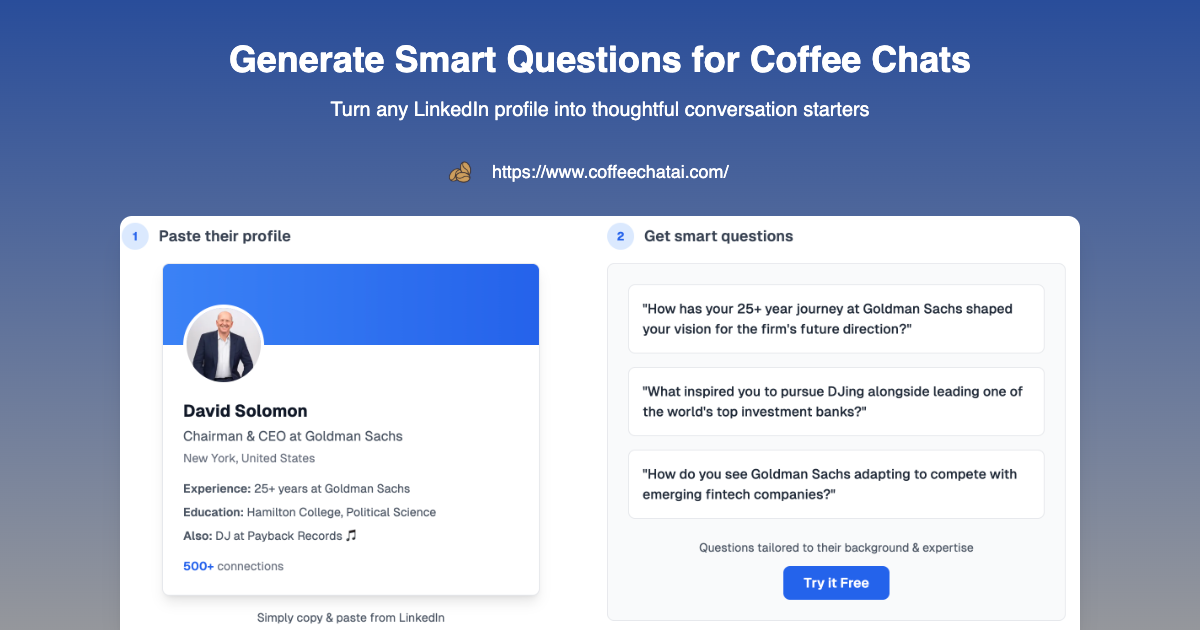
Turn any LinkedIn profile into thoughtful conversation starters. AI-powered question generator for meaningful networking conversations. 5 free questions, no credit card required.
Run a free AEO + signal audit for your domain.
AI Answer Engine Optimization (AEO)
List once. Convert intent from live AI conversations without heavy integration.
AI-powered question generators are software tools that use artificial intelligence, primarily natural language processing (NLP), to automatically create relevant, context-aware questions. They analyze source material like text, data, or learning objectives to generate quizzes, surveys, and assessments. This automation significantly reduces manual effort while improving the quality and scalability of question banks for training, evaluation, and research.
Users upload or input the target content, such as training documents, product specs, or research data, which the AI will analyze.
The NLP engine processes the material, identifies key concepts and relationships, and formulates relevant multiple-choice, open-ended, or scenario-based questions.
The generated question bank is presented for human review, where users can edit, categorize, and approve questions before deployment.
Automate the creation of knowledge checks and certification exams for employee onboarding and continuous skills development programs.
Scale content creation for online courses by dynamically generating personalized quizzes and adaptive assessments for students.
Develop sophisticated survey questionnaires faster by using AI to suggest unbiased, sequential questions based on research goals.
Power chatbots and help desks with intelligent diagnostic questioning flows to quickly identify and resolve user issues.
Ensure rigorous and up-to-date testing for regulatory compliance by automatically generating questions from new policy documents.
Bilarna ensures platform integrity by vetting all AI-powered question generator providers through a proprietary 57-point AI Trust Score. This evaluation rigorously assesses technical capabilities, data security protocols, client portfolio depth, and proven delivery reliability. We continuously monitor performance and client feedback, giving you confidence in every shortlisted vendor.
Pricing models vary widely, typically based on users, volume of questions generated, or enterprise licensing. Many B2B providers offer tiered SaaS subscriptions starting from a few hundred dollars per month for basic features to custom enterprise packages costing thousands. Requesting detailed quotes through Bilarna allows for direct, transparent comparison.
The primary advantage is massive scalability and consistency. AI can process vast amounts of source material in minutes, generating hundreds of varied, unbiased questions, whereas manual creation is time-intensive and prone to subjective bias. This allows organizations to rapidly build and maintain large, high-quality assessment banks.
Yes, advanced tools trained on domain-specific corpora can generate accurate technical questions. Effectiveness depends on the AI model's training data and the quality of the source material provided. For niche fields, it's crucial to evaluate a provider's expertise and request proof-of-concept demos using your actual content.
Modern NLP models produce highly coherent and contextually relevant questions, but a human-in-the-loop review process remains essential for final validation. The best tools include mechanisms for scoring question quality, detecting ambiguity, and allowing easy editing to ensure 100% accuracy before deployment in high-stakes scenarios.
Prioritize features like multi-format output (MCQ, true/false, open-ended), integration with LMS/survey tools, question difficulty calibration, plagiarism checks, and robust analytics on question performance. Strong data security, particularly for sensitive training content, and responsive vendor support are also critical selection criteria.
Yes, the AI-powered teacher tools are free and include the following features: 1. Worksheet Generator to create custom worksheets quickly. 2. Lesson Plan Generator for comprehensive, standards-aligned lesson plans. 3. Report Card Comments generator for professional, personalized feedback. 4. Coloring Page Generator to turn ideas into printable coloring pages. 5. All tools save your work automatically to a cloud library accessible from any device. 6. Tools are private, secure, and supported with fast in-app chat assistance.
Yes, AI background generators can significantly improve the visual appeal of furniture product images. By automatically creating or replacing backgrounds, these tools help highlight the furniture in a more attractive and professional setting. They can simulate various environments, lighting conditions, and styles that complement the product, making images more engaging for potential customers. This enhancement can boost online sales and marketing effectiveness by presenting furniture products in a visually compelling way without the need for costly photoshoots or complex 3D renders.
AI background generators can effectively replace traditional photoshoots for many furniture products, especially when it comes to creating consistent and customizable backgrounds. While they may not fully replicate the nuances of professional photography in all cases, these tools offer a cost-effective and efficient alternative by automating background creation. This allows businesses to quickly update and adapt product images for various marketing channels without the logistical challenges and expenses of organizing physical photoshoots.
Yes, AI music generators are highly useful for content creators looking to produce royalty-free background music quickly and easily. These tools allow users to generate custom background tracks by inputting text prompts, uploading images, or providing reference audio. The AI then composes music tailored to the desired mood and style, covering a wide range of genres. The generated music is 100% royalty-free, enabling creators to use it in videos, podcasts, games, and other media without licensing concerns. Additionally, AI music generators often provide options to customize the sound and export high-quality audio files, streamlining the content creation process.
Yes, AI song generators provide digital licenses for commercial use with each generated song or track. After creating your music, you can download a digital license certificate in PDF format. This license allows you to use the music on platforms like YouTube, TikTok, and Instagram, provided you comply with their policies and avoid copyright infringements such as unauthorized voice imitations or protected covers.
AI text generators can produce unique content by using language models and algorithms. To ensure uniqueness: 1. Generate text based on diverse and extensive training data. 2. Review and edit the AI-generated content to align with specific requirements. 3. Combine AI output with human creativity to enhance originality and relevance.
Yes, many AI-powered browsers built on Chromium technology are compatible with Chrome extensions, allowing users to continue using their favorite add-ons without interruption. These browsers often support seamless import of existing browser data such as bookmarks, passwords, and extensions from Chrome, making the transition smooth and convenient. This compatibility ensures that users do not lose their personalized settings or tools when switching to an AI-enabled browser. By combining AI capabilities with familiar browser features, users can enhance productivity while maintaining their preferred browsing environment.
Yes, an AI-powered authoring platform can handle complex academic content effectively. To do so: 1. Use LaTeX or MathML support to create, edit, and validate complex STEM equations accurately. 2. Integrate with reference databases such as CrossRef, PubMed, and ORCID for real-time reference verification and linking. 3. Apply automatic formatting and style consistency to references and citations. 4. Edit text, tables, and figures with AI assistance to maintain accuracy. 5. Manage author queries and communication within the platform to resolve content issues. 6. Export structured, publication-ready outputs in XML and PDF formats. This ensures precise handling of technical academic content, improving quality and efficiency in scholarly publishing.
Yes, you can use an AI-powered platform alongside your existing email service provider (ESP). 1. Write and design emails using the AI platform. 2. Export or copy-paste the content to your current ESP for sending. 3. Alternatively, manage contacts, sending, and automation directly within the AI platform for a streamlined workflow.
Yes, you need a free account to use AI skincare routine generators effectively. Follow these steps: 1. Sign up quickly using Google, Apple, or email without providing credit card details. 2. Access unlimited routine saves to store multiple personalized skincare regimens. 3. Swap products within your routines to match your budget, preferences, or availability. 4. Set one routine as active to track what you are currently using. 5. Manage your entire skincare journey from a centralized dashboard, allowing you to update and evolve your routines as your skin changes.