Step 1
Machine-Ready Briefs
AI translates unstructured needs into a technical, machine-ready project request.
We use cookies to improve your experience and analyze site traffic. You can accept all cookies or only essential ones.
 Bilarna
Stop browsing static lists. Tell Bilarna your specific needs. Our AI translates your words into a structured, machine-ready request and instantly routes it to verified AI Content Detection experts for accurate quotes.
AI translates unstructured needs into a technical, machine-ready project request.
Compare providers using verified AI Trust Scores & structured capability data.
Skip the cold outreach. Request quotes, book demos, and negotiate directly in chat.
Filter results by specific constraints, budget limits, and integration requirements.
Eliminate risk with our 57-point AI safety check on every provider.
Verified companies you can talk to directly

Use our free tool to check if your cover letter looks AI-written. Automatically write cover letters that pass AI-checks and sound authentically human.
Free AI content detector provides a simple and accurate way to detect AI-generated content from ChatGPT, GPT-4, GPT-3, GPT-2, LLaMA, and other AI services.

Detect AI-generated text, images, videos, and audio instantly with isFake.ai — the fast and fun way to check if content is real or AI-made
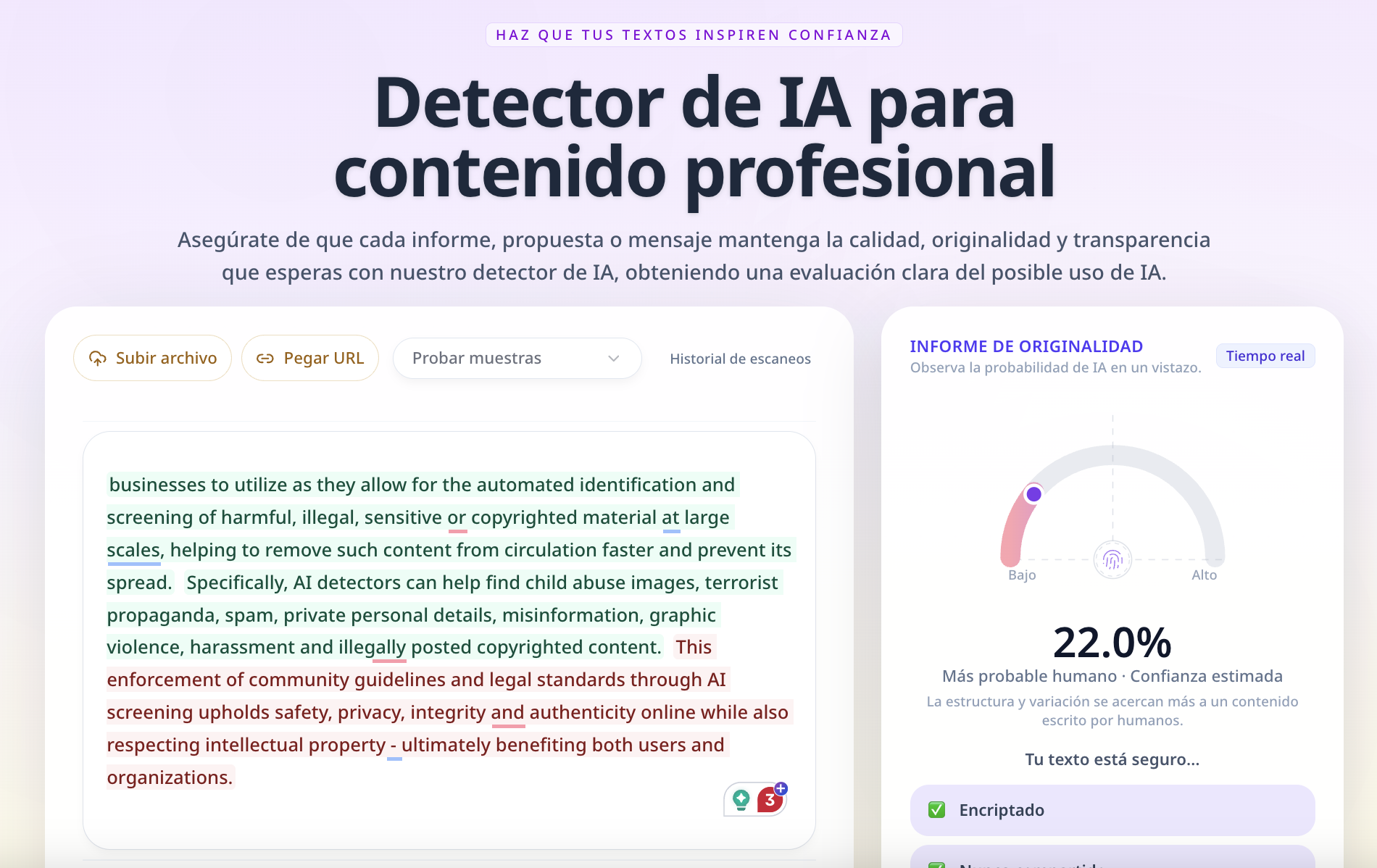
Use VeriIA to see if a text was written with AI. Clear results in seconds, no registration required.
Use our free AI content detector to analyze your content without any limitations, helping you refine and perfect it before sharing with your audience.
Run a free AEO + signal audit for your domain.
AI Answer Engine Optimization (AEO)
List once. Convert intent from live AI conversations without heavy integration.
AI content detection is the automated process where machine learning algorithms analyze text to determine its origin, style, and authenticity. The technology uses linguistic pattern recognition and statistical probabilities to distinguish AI-generated from human-authored content. For businesses, this creates transparency, aids compliance, and guards against unwanted automation in critical communications.
The system processes the provided text, breaking it into tokens and extracting linguistic features such as perplexity and burstiness.
Advanced models compare the features against training data to calculate the probability of AI generation.
A detailed report with a confidence score and explanation of the decisive features is provided for decision-making.
Universities and exam boards use AI detection to ensure the authenticity of theses and assignments, upholding academic integrity standards.
Newsrooms employ the technology to verify the provenance of submitted articles, ensuring editorial standards and transparency.
Banks analyze compliance documentation and customer communications to ensure critical content is human-accountable and reviewed.
Marketing and PR departments use detection tools to monitor brand voice consistency and the authenticity of public statements.
Platforms filter automatically generated product reviews to maintain the credibility of feedback systems and buyer trust.
Bilarna evaluates every AI content detection provider using a proprietary 57-point AI Trust Score measuring expertise, reliability, and client satisfaction. Our vetting process includes rigorous checks on technical methodology, model transparency, and adherence to data privacy regulations like GDPR. Bilarna continuously monitors performance metrics to ensure listed partners meet the highest accuracy and service delivery standards.
Modern AI detection tools typically achieve accuracy between 95% and 99%, depending on text length and complexity. Accuracy improves through continuous model training with new datasets. False positives are possible with highly formal or repetitive human writing.
Pricing varies significantly by volume, accuracy requirements, and integration depth, ranging from usage-based API models at a few cents per query to five-figure enterprise licenses. Total cost depends on monthly analysis volume and support level.
Plagiarism checking looks for verbatim copies of existing sources, while AI content detection analyzes a text's stylistic and statistical features to determine the likelihood of its generation by an AI model. It concerns origin, not duplication.
Leading services support all major languages, with accuracy highest for English. Performance for other languages depends on the quality and quantity of the provider's training data in that language. Multilingual support is a key selection criterion.
Analysis is near real-time, typically within 1-5 seconds for documents up to 10,000 characters. Processing time scales linearly with text length and may take several minutes for batch processing thousands of documents.
Yes, AI masks are legally safe and users retain ownership by following these steps: 1. Verify your real identity as required by the platform to comply with legal regulations. 2. Use AI masks ethically and avoid violating terms of service. 3. Understand that AI masks are generated and do not steal anyone's identity. 4. Create and publish content with AI masks knowing you have full commercial license and ownership over your masked videos and photos. 5. Avoid using AI masks for unethical purposes to maintain compliance and safety.
Yes, AI email tools can be trained with your own documents or website content. 1. Access the AI tool's dashboard or training section. 2. Upload your documents, FAQs, or provide your website URL. 3. The AI will analyze the content to learn your specific information. 4. Use the trained AI to generate personalized and contextually relevant email replies. 5. Monitor character counts to stay within your plan's limits.
Yes, AI music generators are highly useful for content creators looking to produce royalty-free background music quickly and easily. These tools allow users to generate custom background tracks by inputting text prompts, uploading images, or providing reference audio. The AI then composes music tailored to the desired mood and style, covering a wide range of genres. The generated music is 100% royalty-free, enabling creators to use it in videos, podcasts, games, and other media without licensing concerns. Additionally, AI music generators often provide options to customize the sound and export high-quality audio files, streamlining the content creation process.
AI text generators can produce unique content by using language models and algorithms. To ensure uniqueness: 1. Generate text based on diverse and extensive training data. 2. Review and edit the AI-generated content to align with specific requirements. 3. Combine AI output with human creativity to enhance originality and relevance.
Yes, an AI chatbot can support multiple languages and handle language detection automatically by following these steps: 1. The chatbot is programmed to recognize over 45 languages. 2. It detects the customer's language at the start of the interaction. 3. The chatbot continues the conversation in the detected language without manual switching. 4. This enables businesses to serve a global audience seamlessly. 5. Language support improves customer experience by providing responses in the customer's preferred language.
Yes, an AI-powered authoring platform can handle complex academic content effectively. To do so: 1. Use LaTeX or MathML support to create, edit, and validate complex STEM equations accurately. 2. Integrate with reference databases such as CrossRef, PubMed, and ORCID for real-time reference verification and linking. 3. Apply automatic formatting and style consistency to references and citations. 4. Edit text, tables, and figures with AI assistance to maintain accuracy. 5. Manage author queries and communication within the platform to resolve content issues. 6. Export structured, publication-ready outputs in XML and PDF formats. This ensures precise handling of technical academic content, improving quality and efficiency in scholarly publishing.
Yes, most AI content generation tools allow you to customize the output before downloading. You can usually adjust various settings such as style, color schemes, resolution, length (for videos), and other creative parameters. This customization helps tailor the generated content to better fit your specific needs or branding requirements. By modifying these options, you can influence the final look and feel of the video or image, ensuring it aligns with your vision. After making your adjustments, the AI reprocesses the input and updates the content accordingly, which you can then download.
Customize the tone of AI-generated content in WordPress easily. 1. Specify your preferred tone before generating content, such as formal or conversational. 2. The AI assistant adjusts the text style accordingly. 3. Use tone adjustment features integrated into the editor toolbar for fine-tuning. 4. Review and edit the content to ensure it matches your brand voice. This flexibility helps create content that resonates with your audience.
Yes, you can export the generated content in different formats by following these steps: 1. After generating your content, choose the export option. 2. Select the desired format such as web pages or markdown files. 3. For videos, you can also download SRT files for subtitles. 4. Download or share the exported files as needed for your project or platform.
Refunds are not available for AI-generated content due to the computational costs involved. 1. Understand that each AI content generation request consumes credits from your plan or purchased package immediately. 2. The platform incurs costs for processing these requests, making refunds unfeasible. 3. Review your credit usage carefully before generating content. 4. Contact support for any issues but note that refunds will not be issued. 5. Plan your projects accordingly to avoid unexpected credit consumption.