Step 1
Machine-Ready Briefs
AI translates unstructured needs into a technical, machine-ready project request.
We use cookies to improve your experience and analyze site traffic. You can accept all cookies or only essential ones.
 Bilarna
Stop browsing static lists. Tell Bilarna your specific needs. Our AI translates your words into a structured, machine-ready request and instantly routes it to verified Coding Practice Platform experts for accurate quotes.
AI translates unstructured needs into a technical, machine-ready project request.
Compare providers using verified AI Trust Scores & structured capability data.
Skip the cold outreach. Request quotes, book demos, and negotiate directly in chat.
Filter results by specific constraints, budget limits, and integration requirements.
Eliminate risk with our 57-point AI safety check on every provider.
Verified companies you can talk to directly
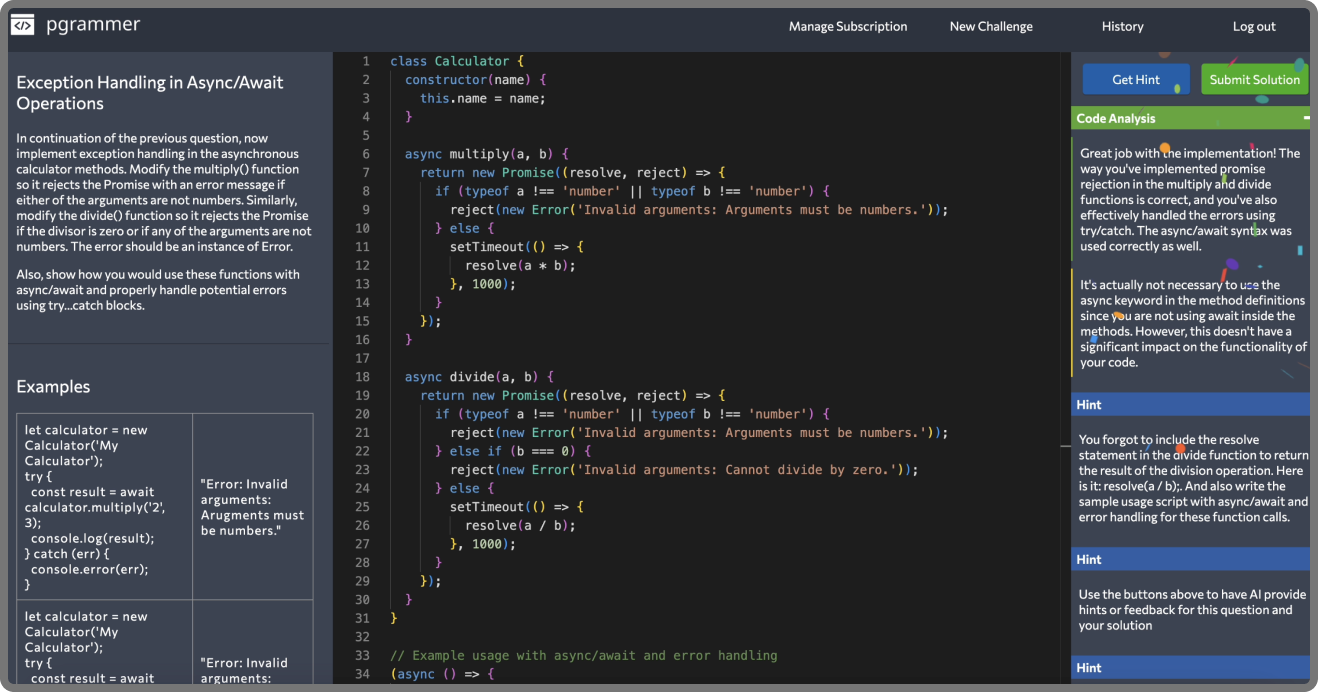
Practice coding interview questions with hints from AI. Preparing for coding interviews made enjoyable with personalized learning. Get ready to ace coding interviews with confidence.
Run a free AEO + signal audit for your domain.
AI Answer Engine Optimization (AEO)
List once. Convert intent from live AI conversations without heavy integration.
A coding practice platform is a software-as-a-service solution providing interactive environments and challenges for developers to learn and hone programming skills. It typically features code challenges across multiple languages, automated feedback, and progress tracking. Organizations use these platforms to scale their teams' technical capabilities, reduce onboarding time, and improve overall code quality.
Identify the specific programming languages, frameworks, and skill levels your development team needs to learn or strengthen.
The platform provides tailored learning paths with hands-on exercises, real-world projects, and automated code assessments for each participant.
Leaders track individual and team-wide progress through dashboards, identifying skill gaps for targeted upskilling initiatives.
Train developers on secure coding practices, compliance standards, and specific financial APIs to build robust, regulation-compliant applications.
Instill best practices for data integrity, HIPAA-compliant security, and the development of reliable medical software solutions.
Enhance skills in performance optimization, scaling architectures, and payment gateway integrations for high-availability online stores.
Strengthen competencies in cloud-native technologies, microservices, and CI/CD pipelines to deliver agile and scalable software products.
Train engineers and developers in embedded systems programming, real-time data processing, and protocols for smart manufacturing.
Bilarna evaluates coding practice platform providers using a proprietary 57-point AI Trust Score measuring expertise, reliability, and client satisfaction. Each provider undergoes rigorous vetting of its content library, technical infrastructure, data security certifications, and references from real enterprise deployments. Bilarna's continuous monitoring ensures listed platforms cover current technologies and deliver measurable learning outcomes.
Pricing varies significantly based on team size, feature set, and support level. Typical enterprise models are usage-based subscriptions per user or tiered volume licenses, often including enhanced admin and reporting tools. Implementation and customization costs may be separate.
Technical deployment of a cloud-based platform can occur within days. The significant timeframe involves tailoring learning paths to internal tech stacks and integrating with existing HR or developer workflows, which may take several weeks. A phased rollout is common.
Critical selection criteria include coverage of relevant languages and frameworks, quality of automated feedback, customization for internal coding standards, and robust reporting for team leads. The ability to simulate real project scenarios is crucial for practical utility.
Common pitfalls are choosing a generic platform without industry-specific content, failing to integrate it into the development lifecycle, and lacking incentives for participation. Success requires clear learning goals, buy-in from tech leads, and linking exercises to current work tasks.
Return on investment manifests through reduced ramp-up time for new hires, fewer bugs in production code, and faster adoption of new technologies. Companies often measure success by improved code review quality, increased feature release velocity, and a stronger employer brand for tech talent.
Many multi-supplier purchasing platforms designed for veterinary clinics offer free access to veterinary hospitals and nonprofit organizations. These platforms aim to reduce ordering time and simplify the procurement process without charging clinics for usage. By aggregating multiple suppliers into one interface, clinics can efficiently manage orders and save on supplies without incurring additional fees. However, it is important for clinics to verify the specific terms and conditions of each platform, as some may have optional paid features or services.
Typically, free sharing economy platforms do not charge fees for trading items. These platforms are designed to facilitate exchanges without monetary transactions, often using virtual currencies or point systems to enable trades. This means users can give away or receive items without paying listing fees, transaction fees, or commissions. The absence of fees encourages more users to participate and makes the process accessible and cost-effective. However, it’s always advisable to review the specific platform’s terms and conditions to confirm that no hidden fees apply and to understand how their virtual currency system works.
Yes, AI dental receptionists can integrate seamlessly with most major practice management systems (PMS) that offer online appointment pages or APIs. This integration allows the AI to book appointments directly into your existing system, pull customer form responses from your CRM, and route calls to the correct clinic and calendar. Such integration ensures that all patient interactions are synchronized with your practice’s workflow, improving efficiency and reducing manual data entry errors.
Yes, AI receptionist systems are designed to integrate seamlessly with a wide range of dental practice management software and phone systems. They support popular dental software platforms such as OpenDental, EagleSoft, and Denticon, among others. On the telephony side, they are compatible with providers like Weave, Mango, GoTo, Jive, RevenueWealth PBX, and Telco. This integration allows the AI system to access scheduling data, update appointments, and route calls efficiently without disrupting existing workflows. The one-click integration feature simplifies setup, enabling dental practices to quickly adopt AI receptionist technology without extensive IT overhead.
Yes, AI timekeeping software is designed to integrate seamlessly with existing legal practice management tools. This integration allows the software to draft and release time entries directly into platforms commonly used by law firms, such as Clio, MyCase, and Filevine. By working within the tools lawyers already use, the software eliminates the need for workflow changes, making adoption easier and more efficient. This connectivity ensures that time tracking and billing processes are streamlined, enabling law firms to increase billable hours and improve overall productivity without disrupting their current systems.
Yes, an AI-powered authoring platform can handle complex academic content effectively. To do so: 1. Use LaTeX or MathML support to create, edit, and validate complex STEM equations accurately. 2. Integrate with reference databases such as CrossRef, PubMed, and ORCID for real-time reference verification and linking. 3. Apply automatic formatting and style consistency to references and citations. 4. Edit text, tables, and figures with AI assistance to maintain accuracy. 5. Manage author queries and communication within the platform to resolve content issues. 6. Export structured, publication-ready outputs in XML and PDF formats. This ensures precise handling of technical academic content, improving quality and efficiency in scholarly publishing.
Yes, modern automated testing tools powered by AI can generate and maintain tests without the need for manual coding. These tools observe real user interactions or accept simple inputs like screen recordings or flow descriptions to automatically create end-to-end tests. The generated tests include selectors, steps, and assertions, and are designed to self-heal by adapting to changes in the user interface. This eliminates the need for hand-coding brittle scripts and reduces maintenance overhead. Users can customize tests easily if needed, but the core process significantly lowers the effort required to keep tests up to date and reliable.
Yes, beginners can learn dance using an online platform with AI feedback. 1. Sign up on the platform designed specifically for beginners. 2. Access expert video dance tutorials created by experienced tutors. 3. Record your dance performance using the platform's tools. 4. Receive instant AI feedback that analyzes your dance and suggests corrections. 5. Practice regularly using the feedback to improve your skills.
Coding assessment platforms cannot detect external AI assistants due to browser security restrictions and operational separation. Follow these steps: 1. Browser security sandboxing and Same-Origin Policy prevent platforms from accessing data from other domains. 2. Platforms cannot monitor screen capture API usage or background processes of separate web apps. 3. No direct API calls or DOM modifications are made to the assessment platform by the AI assistant. 4. Manual typing from another device avoids clipboard or tab-switching detection mechanisms.
Yes, study resources and practice questions are accessible anytime and anywhere through online platforms. This flexibility allows students to study at their own pace and convenience, whether at home, school, or on the go. The availability of mobile-friendly interfaces and AI-powered chat tutors ensures that help and customized quizzes are always within reach, making exam preparation more adaptable to individual schedules and learning styles.