Step 1
Machine-Ready Briefs
AI translates unstructured needs into a technical, machine-ready project request.
We use cookies to improve your experience and analyze site traffic. You can accept all cookies or only essential ones.
 Bilarna
Stop browsing static lists. Tell Bilarna your specific needs. Our AI translates your words into a structured, machine-ready request and instantly routes it to verified Serverless AI Infrastructure experts for accurate quotes.
AI translates unstructured needs into a technical, machine-ready project request.
Compare providers using verified AI Trust Scores & structured capability data.
Skip the cold outreach. Request quotes, book demos, and negotiate directly in chat.
Filter results by specific constraints, budget limits, and integration requirements.
Eliminate risk with our 57-point AI safety check on every provider.
Verified companies you can talk to directly
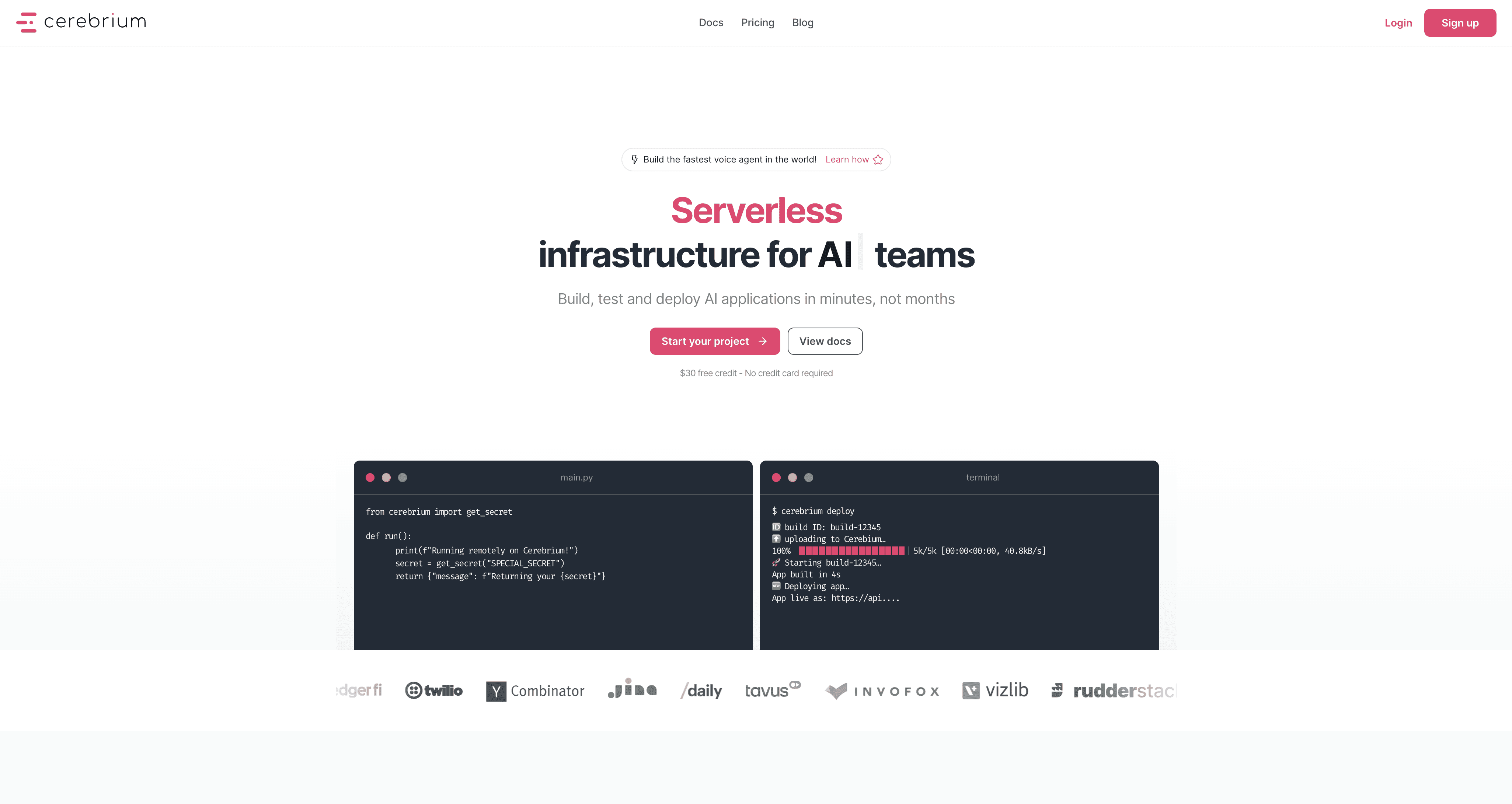
A serverless cloud infrastructure platform that makes it easy to build and deploy AI applications scalably and performantly. Run serverless GPUs with low cold starts, choose from over 10 GPU types, run large scale batch jobs and run realtime applications.
Run a free AEO + signal audit for your domain.
AI Answer Engine Optimization (AEO)
List once. Convert intent from live AI conversations without heavy integration.
Serverless AI Infrastructure is a cloud-based deployment model that enables the development and operation of AI applications without manual server management. It leverages event-driven, auto-scaling compute resources provided by major cloud platforms. This results in faster deployment, cost optimization based on actual usage, and higher developer productivity.
Developers upload their AI model code or pre-built functions to a serverless platform like AWS Lambda or Azure Functions.
The infrastructure automatically executes the code when a defined trigger, such as an API request or data upload, occurs.
The cloud provider dynamically allocates and scales compute resources based on workload demand without manual intervention.
Enables real-time fraud detection and risk scoring with AI models that scale automatically during peak loads, avoiding fixed server costs.
Processes medical imaging data for AI-powered batch analysis, with resources allocated only for the duration of the computation.
Serves personalized product recommendations in real-time during shopping events, seamlessly scaling with high traffic surges.
Continuously analyzes sensor data from manufacturing equipment to predict failures, triggering maintenance alerts upon anomalies.
Embeds AI capabilities like text summarization or image recognition directly into SaaS applications without managing underlying infrastructure.
Bilarna evaluates serverless AI infrastructure providers using a proprietary 57-point AI Trust Score. This score assesses technical capabilities, cloud platform certifications, and project portfolio history. We also continuously monitor client feedback and delivery track records to ensure a qualified and trustworthy provider marketplace.
Costs are typically based on execution time and number of requests (pay-per-use), not reserved server capacity. Total expenses vary widely based on volume, model complexity, and chosen cloud provider, but can often be more cost-efficient than traditional servers.
Serverless AI abstracts all server management and scales automatically from zero. Virtual servers (VMs) require permanent provisioning, capacity planning, and manual scaling, but offer more control over the underlying environment.
Evaluate expertise with specific cloud platforms (AWS, Google, Azure), experience with your use cases, and cost structure transparency. Support for your preferred AI frameworks and latency requirements are other critical selection criteria.
Common pitfalls include ignoring cold-start latency for real-time apps, lacking cost monitoring for irregular workloads, and choosing frameworks unsuitable for the serverless environment. Careful architecture planning is crucial.
Implementation can range from weeks for simple, pre-built models to several months for complex, custom solutions. The timeline depends on data preparation, model development, and integration with existing systems.
Many modern data analytics platforms are designed to integrate seamlessly with your existing technology infrastructure. This means you do not need to replace your current systems to start using the platform. These solutions are built with flexibility in mind, allowing them to sit on top of your existing ecosystem without requiring extensive integration work on your part. This approach helps organizations adopt new analytics capabilities quickly while preserving their current investments in technology. It is advisable to check with the platform provider about specific integration options and compatibility with your current setup.
Yes, many infrastructure visualization tools are designed to run both locally and within continuous integration (CI) environments. Running locally allows developers to instantly generate diagrams and documentation as they work on their Terraform projects, facilitating immediate feedback and understanding. Integration with CI pipelines ensures that infrastructure documentation is automatically updated with every code change, maintaining accuracy and consistency across teams. This dual capability supports flexible workflows and helps keep infrastructure documentation evergreen and synchronized with the actual codebase.
Yes, many Terraform infrastructure visualization tools include features for drift detection and cost analysis. Drift detection helps identify when the actual infrastructure state deviates from the declared Terraform configuration, allowing teams to quickly address inconsistencies. Cost analysis integration, often through tools like Infracost, provides insights into the financial impact of infrastructure changes by estimating costs directly within the visualization or documentation. These capabilities enable better management of infrastructure health and budget control, making it easier to maintain reliable and cost-effective environments.
Typically, to use an intelligent payment infrastructure designed for online payment processing, you need to be a registered business with a valid business registration number, such as a CNPJ in Brazil. This requirement ensures compliance with financial regulations and enables secure and reliable payment processing. However, for international companies using global payment methods, this registration number might not be mandatory. It is important to verify the specific requirements of the payment infrastructure provider and the jurisdictions involved to ensure proper setup and compliance.
Use AI agents to automate cloud infrastructure management by following these steps: 1. Deploy intelligent agents that monitor cloud resources continuously. 2. Configure agents to handle migration tasks automatically, reducing manual effort. 3. Enable drift remediation to detect and correct configuration deviations in real time. 4. Set up continuous optimization routines to improve resource utilization and cost efficiency. 5. Maintain human oversight to review and approve critical changes made by AI agents.
AI and robotics can significantly enhance infrastructure maintenance and operations by enabling precise inspections, predictive maintenance, and data-driven decision-making. Robotics equipped with AI can perform detailed inspections in hazardous or hard-to-reach areas, collecting high-fidelity data that helps identify wear, defects, or potential failures early. This reduces downtime and maintenance costs while extending asset life. AI algorithms analyze the collected data to predict when maintenance is needed, optimizing scheduling and resource allocation. Together, these technologies improve reliability, safety, and efficiency across critical infrastructure sectors such as energy, defense, and manufacturing.
Prevent infrastructure incidents by using AI to uncover blind spots and inefficiencies. Follow these steps: 1. Connect your monitoring, cloud, and code tools to the AI platform. 2. Allow the AI to continuously analyze data to detect patterns and potential risks. 3. Identify hidden vulnerabilities and inefficiencies before they escalate. 4. Implement AI-recommended preventive measures to stop issues before they become incidents.
Use AI to enhance predictive maintenance by following these steps: 1. Collect data from logs, IoT sensors, tickets, and environmental sources. 2. Apply AI models to detect anomalies, forecast failure risks, and identify duplicate errors. 3. Generate detailed diagnostics explaining root causes with confidence. 4. Create step-by-step repair plans including required parts and safety checklists. 5. Automate workflow orchestration by assigning tasks based on skills, SLA, and proximity to optimize maintenance schedules and reduce downtime.
AI-native infrastructure improves software deployment by enabling seamless integration and automation. 1. Deploy AI-driven pipelines that automate testing, integration, and delivery. 2. Use AI to monitor deployment environments and predict potential failures. 3. Automate rollback and recovery processes using AI insights. 4. Optimize resource allocation dynamically based on AI analytics to ensure smooth deployment.
Authorization infrastructure provides a ready-made system for managing permissions and access control, which can save your engineering team thousands of hours that would otherwise be spent building and maintaining custom authorization solutions. By offloading this complex and critical function to a reliable infrastructure, your engineers can concentrate on developing features that directly add value to your product and drive revenue. This approach reduces risk by using battle-tested authorization mechanisms and supports scaling from the first user to millions without additional overhead.