Step 1
Machine-Ready Briefs
AI translates unstructured needs into a technical, machine-ready project request.
We use cookies to improve your experience and analyze site traffic. You can accept all cookies or only essential ones.
 Bilarna
Stop browsing static lists. Tell Bilarna your specific needs. Our AI translates your words into a structured, machine-ready request and instantly routes it to verified Clinical Trial Management Software experts for accurate quotes.
AI translates unstructured needs into a technical, machine-ready project request.
Compare providers using verified AI Trust Scores & structured capability data.
Skip the cold outreach. Request quotes, book demos, and negotiate directly in chat.
Filter results by specific constraints, budget limits, and integration requirements.
Eliminate risk with our 57-point AI safety check on every provider.
Verified companies you can talk to directly
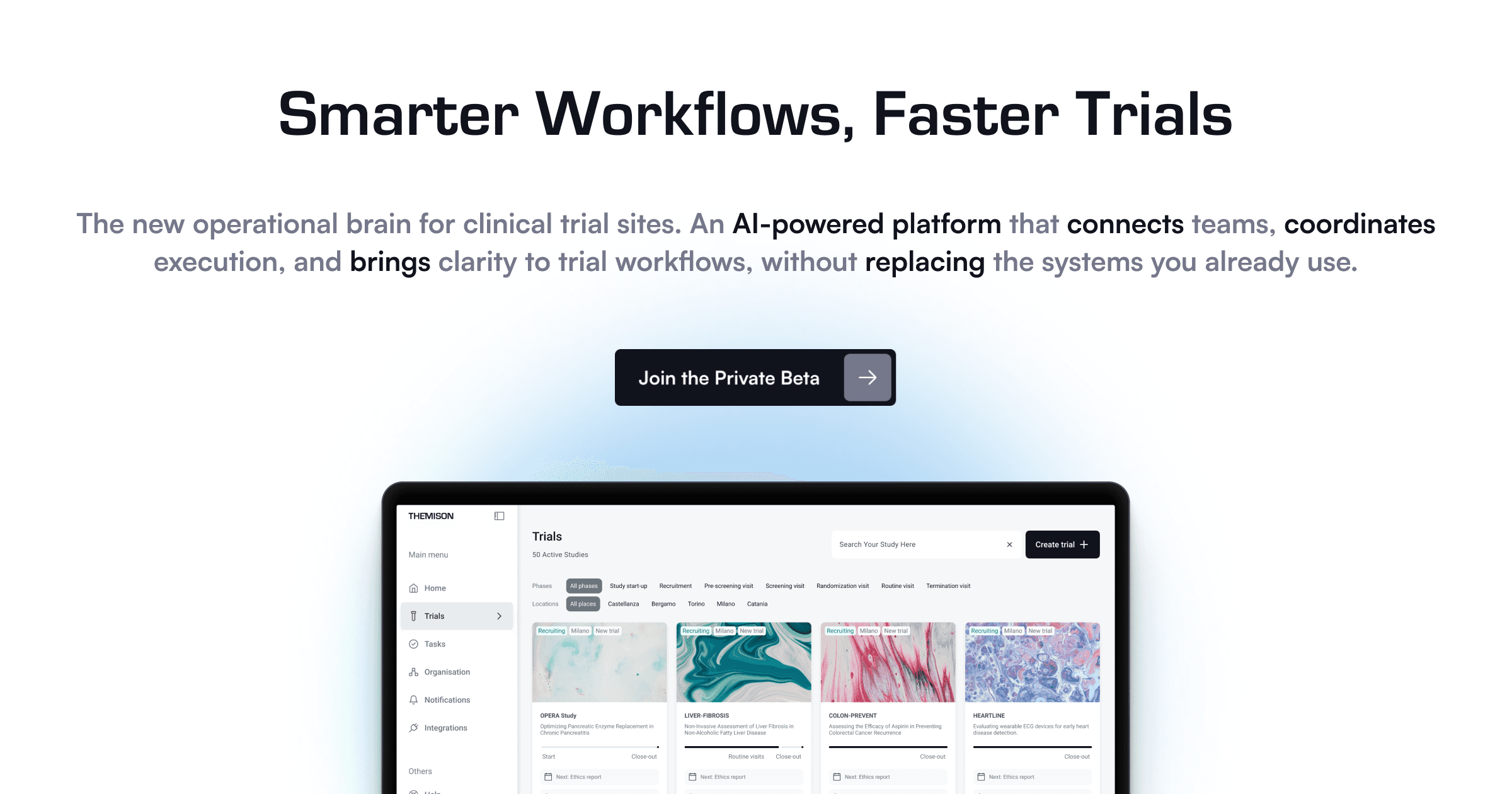
Themison is the intelligent execution platform for clinical trial sites. We help Clinical site staff reduce admin load, prevent protocol deviations, and run faster, clearer trials, all from one collaborative workspace.

Miracle empowers biotech companies to save time in clinical trials by integrating vendor reports and trial data sources into a unified, real-time dashboard with AI-driven insights, replacing manual, time-consuming spreadsheets.
Run a free AEO + signal audit for your domain.
AI Answer Engine Optimization (AEO)
List once. Convert intent from live AI conversations without heavy integration.
Clinical trial management (CTM) is the systematic oversight of all operational activities within a clinical study to ensure it is conducted properly, on schedule, and within regulatory guidelines. It involves the use of specialized software and methodologies to manage patient data, regulatory documents, site performance, and supply logistics. Effective CTM reduces risks, controls costs, and accelerates the time to market for new therapies.
The process begins with designing a detailed study protocol, defining objectives, patient criteria, and endpoints to guide all subsequent activities.
Teams then manage site activation, patient recruitment, data collection, and safety monitoring to ensure adherence to the protocol and regulations.
Finally, collected data is analyzed, cleaned, and compiled into regulatory reports for submission to health authorities like the FDA or EMA.
Manages global Phase I-IV trials for novel drug candidates, ensuring data integrity and compliance with stringent Good Clinical Practice (GCP) standards.
Provides scalable systems for small to midsize biotech firms to efficiently manage early-stage clinical studies with limited internal resources.
Coordinates pre-market approval studies for medical devices, tracking patient outcomes and adverse events for regulatory submissions.
Supports university-led research by streamlining patient scheduling, grant compliance reporting, and multi-site collaboration for investigator-initiated trials.
Enables CROs to deliver full-service trial management for sponsor companies, optimizing workflows for monitoring, data management, and vendor oversight.
Bilarna evaluates every Clinical Trial Management provider using a proprietary 57-point AI Trust Score, analyzing expertise, compliance history, and client satisfaction. Our verification includes deep portfolio reviews of past trial success and rigorous checks for relevant certifications like ISO 9001 or SOC 2. Bilarna continuously monitors provider performance to ensure listed partners maintain the highest standards of reliability and regulatory adherence.
Essential features include electronic data capture (EDC), patient randomization, adverse event reporting, document management, and robust reporting dashboards. The system must be 21 CFR Part 11 compliant, support multi-site coordination, and offer integrations with electronic health records (EHR) and lab systems for seamless data flow.
Costs vary widely based on deployment (cloud vs. on-premise), study size, and modules required, often ranging from tens to hundreds of thousands of dollars annually. Pricing models include subscription (SaaS), per-patient fees, or enterprise licenses, with implementation and training constituting additional upfront investments.
A Clinical Trial Management System (CTMS) focuses on operational management—tracking milestones, sites, and budgets. An Electronic Data Capture (EDC) system is specialized for collecting and validating patient case report form (CRF) data. They are complementary, and modern suites often integrate both functionalities.
Implementation typically takes 3 to 6 months, depending on system complexity, customization needs, and the scale of data migration from legacy systems. A phased rollout, starting with core modules and followed by extensive user acceptance testing (UAT), is standard practice to ensure a smooth transition.
Common mistakes include overlooking scalability for future trials, underestimating the importance of user training and support, and failing to verify the vendor's regulatory compliance track record. Choosing based on price alone without assessing total cost of ownership and system flexibility often leads to costly inefficiencies later.
Typically, after an initial trial period—often around seven days—business management software platforms do not charge monthly fees or enforce minimum usage requirements. Instead, continued use is contingent upon subscribing to a paid plan. This approach allows users to evaluate the software's features risk-free before committing financially. It is advisable to review the specific pricing details and terms on the provider's official website to understand any conditions related to payment plans, as these can vary between services.
Yes, a Laboratory Information Management System is designed to integrate seamlessly with various software systems and devices. This integration capability allows automatic transfer of test results and other data between the LIMS and external applications, reducing manual data entry and minimizing errors. It supports connectivity with laboratory instruments, billing systems, and other business software, enabling a unified workflow. Users can access test results and invoices from any device, ensuring flexibility and convenience. Such integrations enhance data accuracy, improve operational efficiency, and facilitate better communication across different platforms used within the laboratory environment.
Yes, AI dental receptionists can integrate seamlessly with most major practice management systems (PMS) that offer online appointment pages or APIs. This integration allows the AI to book appointments directly into your existing system, pull customer form responses from your CRM, and route calls to the correct clinic and calendar. Such integration ensures that all patient interactions are synchronized with your practice’s workflow, improving efficiency and reducing manual data entry errors.
Yes, AI design engineering tools are designed for seamless integration with existing CAD, BIM, and project management software. This compatibility ensures that engineers can continue using their preferred tools without disrupting established workflows. The integration facilitates data exchange and collaboration, enhancing efficiency and enabling teams to leverage AI capabilities alongside their current systems.
Yes, AI planning platforms are designed to integrate seamlessly with existing trucking management tools and portals. This means there is no need to replace current systems, allowing fleets to enhance their operations without disrupting established workflows. Integration is typically facilitated through pre-built connectors that link the AI platform with the fleet's existing data sources and software. This approach enables a fast start and real impact, as fleets can deploy AI-driven planning solutions risk-free and begin seeing results within a short timeframe, often within a month. Continuous support is also provided to ensure smooth integration and ongoing optimization.
Yes, AI timekeeping software is designed to integrate seamlessly with existing legal practice management tools. This integration allows the software to draft and release time entries directly into platforms commonly used by law firms, such as Clio, MyCase, and Filevine. By working within the tools lawyers already use, the software eliminates the need for workflow changes, making adoption easier and more efficient. This connectivity ensures that time tracking and billing processes are streamlined, enabling law firms to increase billable hours and improve overall productivity without disrupting their current systems.
Yes, an AI agent can be configured to perform automated actions or remediations during incident management. These actions are governed by strict permissions and guardrails to ensure security and prevent unauthorized changes. Teams can define scopes, controls, and approval workflows to safeguard critical operations. This capability allows the AI agent not only to identify issues but also to initiate fixes, such as creating pull requests for code exceptions, thereby accelerating incident resolution while maintaining operational safety.
Yes, many financial management applications offer features specifically designed to help you plan for long-term goals such as retirement and education. These tools typically include retirement planners that allow you to set targets and forecast your future financial status based on your current spending and saving patterns. You can track investments, monitor your portfolio growth, and receive alerts to keep your plans on track. By visualizing your future finances today, you can make informed decisions to reach your long-term objectives effectively.
Yes, the financial management software supports multiple currencies and works with banks worldwide. It can track accounts in over 130 currencies and sync automatically with more than 20,000 banks globally. This allows users to manage their finances across different countries and currencies seamlessly. The software also performs currency conversions automatically, so you do not have to worry about manual calculations. Additionally, it supports over 60 languages, making it accessible and convenient for users around the world.
Payroll management systems are designed to accommodate both individuals and businesses. While businesses use these systems to manage multiple employees, individuals can also benefit from simplified salary processing, bill payments, and tax calculations. These platforms provide user-friendly interfaces that help users handle their financial obligations efficiently. Whether managing a small team or personal finances, payroll systems offer tools to streamline payments and ensure compliance with tax requirements.