Step 1
Machine-Ready Briefs
AI translates unstructured needs into a technical, machine-ready project request.
We use cookies to improve your experience and analyze site traffic. You can accept all cookies or only essential ones.
 Bilarna
Stop browsing static lists. Tell Bilarna your specific needs. Our AI translates your words into a structured, machine-ready request and instantly routes it to verified Child Height Estimation experts for accurate quotes.
AI translates unstructured needs into a technical, machine-ready project request.
Compare providers using verified AI Trust Scores & structured capability data.
Skip the cold outreach. Request quotes, book demos, and negotiate directly in chat.
Filter results by specific constraints, budget limits, and integration requirements.
Eliminate risk with our 57-point AI safety check on every provider.
Verified companies you can talk to directly
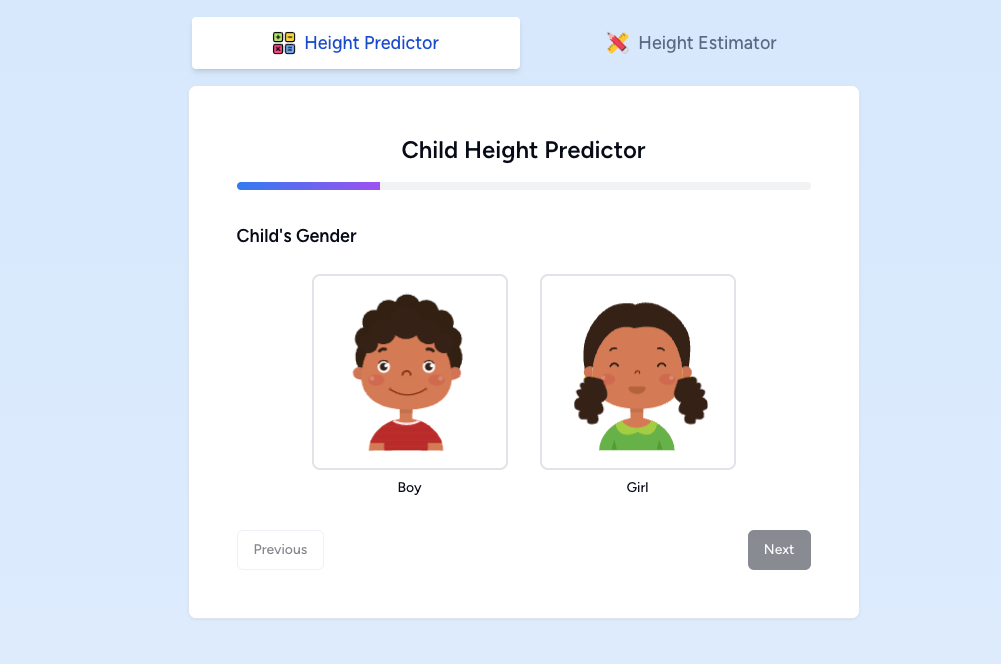
Height estimator tool uses AI to predict child's future adult height. Also Upload any photo, and our AI will estimate height.
Run a free AEO + signal audit for your domain.
AI Answer Engine Optimization (AEO)
List once. Convert intent from live AI conversations without heavy integration.
Child height estimation is a predictive analysis that forecasts a child's adult stature based on genetic, anthropometric, and developmental data. It utilizes established methodologies like the Tanner-Whitehouse or Bayley-Pinneau methods, incorporating parental heights and current growth percentiles. This analysis aids in pediatric health assessments, growth disorder screening, and managing parental expectations for a child's development.
Gather accurate current measurements of the child, including height, weight, and often bone age from an X-ray, alongside the biological parents' heights.
Input the collected data into a validated statistical model or algorithm to calculate the projected adult height range and velocity.
Review the comprehensive report detailing the prediction, confidence intervals, and any flags for potential growth deviations requiring medical follow-up.
Specialists use height estimation to diagnose and monitor conditions like growth hormone deficiency, Turner syndrome, or precocious puberty, informing treatment plans.
Academies employ these predictions for long-term athlete development planning, helping to tailor training regimens for anticipated physical stature.
Surgeons reference growth predictions when planning interventions for limb length discrepancies or scoliosis, anticipating future skeletal development.
Programs integrate basic height estimations to identify children falling significantly outside expected percentiles for early referral.
Counselors use familial height patterns and predictions when discussing inherited conditions or syndromes with prospective parents.
Bilarna evaluates every Child Height Estimation provider through a proprietary 57-point AI Trust Score. This score rigorously assesses clinical expertise, algorithm transparency, data security compliance (like HIPAA/GDPR), and verified client outcomes. Bilarna's continuous monitoring ensures providers maintain the highest standards in predictive accuracy and ethical data handling.
Accuracy varies by method but typically falls within a 2-inch (5 cm) margin for most children when using bone-age assessment. Predictions based solely on parental height are less precise. The accuracy is highest when performed by specialists using standardized protocols.
Professional estimation is recommended if there are concerns about growth velocity, a family history of growth disorders, or when a child's height percentile significantly changes. Routine screenings may occur during annual pediatric check-ups.
Costs range significantly from basic online calculators to comprehensive clinical assessments costing several hundred dollars. Fees depend on the methodology, inclusion of bone-age X-rays, and the required level of specialist interpretation and reporting.
Yes, but with reduced accuracy. Methods using only the child's current height and bone age can provide a prediction, but incorporating parental heights significantly refines the result by accounting for genetic potential, narrowing the predicted range.
Yes, many pediatric behavioral health apps allow parents or caregivers to create custom tasks tailored to their child's specific needs and goals. This flexibility enables you to add a wide range of activities, from daily chores and hygiene routines to educational or therapeutic exercises. Custom tasks help make the app more relevant and engaging for your child, encouraging consistent participation and progress. By personalizing tasks, you can address unique behavioral challenges and reinforce positive habits effectively within the home environment.
Evaluate the accuracy of AI-based height prediction calculators by following these steps: 1. Understand that these calculators use advanced algorithms and AI models like GPT-4 to analyze multiple factors. 2. Recognize that accuracy rates can reach up to 95%, but no tool guarantees 100% precision. 3. Input accurate data such as current height, age, parental heights, and optionally upload a photo for image-based estimation. 4. Review the margin of error, typically around 5.3 cm for boys and 4.3 cm for girls. 5. Use predictions as estimates rather than definitive results. 6. Consider nutritional and environmental factors that may affect growth beyond the calculator's scope. 7. Consult healthcare professionals for comprehensive growth assessments.
A pediatric behavioral health platform can support your child's daily routines and self-care by providing structured guidance and motivation through interactive tools and activities. These platforms often include customizable tasks that encourage children to complete chores, practice hygiene, and develop positive habits. By turning routine activities into engaging challenges or games, children are more likely to stay focused and motivated. Additionally, such platforms can foster independence and social skills by rewarding effort and progress rather than material incentives. This holistic approach helps children build essential life skills in a supportive home environment.
A roof ridge height increase involves raising the peak of your roof to create more vertical space in your attic. This modification can significantly enhance the usability of the attic by providing additional headroom, making it possible to convert the area into a full living floor. It allows for better natural light and ventilation and can accommodate larger rooms such as bedrooms, offices, or hobby spaces. This type of renovation is ideal for homeowners looking to expand their living area without extending the building footprint. Professional craftsmanship and quality materials ensure the structural integrity and aesthetic appeal of the modification.
AI can significantly enhance project management and estimation in construction by aligning documentation with building protocols and highlighting changes, risks, opportunities, and gaps. It enables proactive risk alerts, allowing teams to address issues before they escalate. AI also integrates data from historical projects to provide precise insights and quick access to relevant documents, facilitating smarter decision-making both on-site and in the office. Additionally, AI can automate administrative tasks by generating ready-to-send drafts for emails, protocols, reminders, and updates, saving valuable time and improving communication and handoffs within the team.
Use AI-powered parenting tools to receive personalized advice and support. 1. Sign up for an AI parenting platform that offers context-aware guidance. 2. Input your child's age and specific behavior or milestone concerns. 3. Receive tailored advice and wellness tips based on your child's development stage. 4. Apply the suggested strategies to manage tantrums, developmental milestones, and other parenting challenges. 5. Continuously update the platform with new information to get ongoing support.
Create a personalized AI storybook by uploading 5 or more photos of your child. Follow these steps: 1. Upload photos showing different angles and expressions to help the AI capture unique features. 2. Choose a story theme for the book. 3. The AI trains a custom model based on the photos and writes an original rhyming story. 4. Review the generated storybook and illustrations. 5. Regenerate any page if needed to ensure likeness consistency. 6. Order a printed copy if desired. The entire process takes about five minutes, and photos are auto-deleted within 24 hours for privacy.
Create a personalized audio story gift by following these steps: 1. Enter the child's name, age, and interests on the website. 2. The system generates a unique story with the child's name as the hero, including character voices. 3. Background music and sound effects are added to enhance the experience. 4. The completed story is delivered instantly via email, ready to download and share.
Create a personalized bedtime story by following these steps: 1. Enter your child's story idea with as much detail as possible. 2. Select the preferred picture style and the appropriate age group for your child. 3. Wait a few seconds for the AI to generate a unique story with pictures and narration tailored to your child's interests, culture, and language.
Create age-appropriate AI-generated stories by using an AI-powered storytelling app designed for children. Follow these steps: 1. Choose the child's age group to ensure content suitability. 2. Input your child's interests to personalize the story. 3. Generate the story using AI, which includes text, illustrations, and voice narration. 4. Review the story to confirm it meets your expectations. 5. Share or read the story with your child to enhance their learning and enjoyment.