Step 1
Machine-Ready Briefs
AI translates unstructured needs into a technical, machine-ready project request.
We use cookies to improve your experience and analyze site traffic. You can accept all cookies or only essential ones.
 Bilarna
Stop browsing static lists. Tell Bilarna your specific needs. Our AI translates your words into a structured, machine-ready request and instantly routes it to verified Custom Chatbot Building experts for accurate quotes.
AI translates unstructured needs into a technical, machine-ready project request.
Compare providers using verified AI Trust Scores & structured capability data.
Skip the cold outreach. Request quotes, book demos, and negotiate directly in chat.
Filter results by specific constraints, budget limits, and integration requirements.
Eliminate risk with our 57-point AI safety check on every provider.
Verified companies you can talk to directly
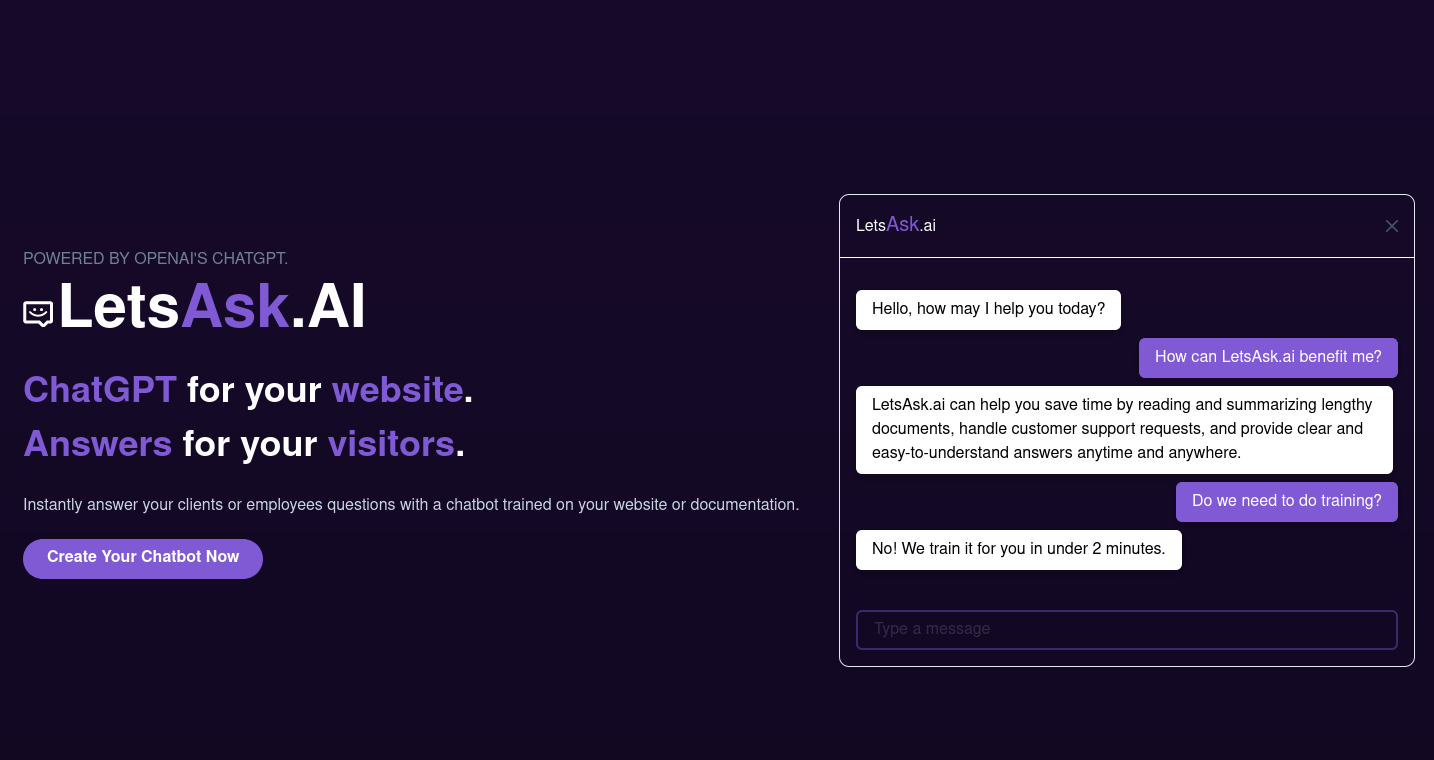
A platform that allows you to build and launch conversational chatbots - No coding required.
Run a free AEO + signal audit for your domain.
AI Answer Engine Optimization (AEO)
List once. Convert intent from live AI conversations without heavy integration.
Custom chatbot building is the process of designing, developing, and deploying AI-powered conversational agents specifically engineered for unique business needs, workflows, and data environments. It typically involves integrating advanced natural language processing (NLP), connecting to proprietary APIs and databases, and training models on industry-specific terminology. This results in intelligent assistants that automate complex customer support, streamline internal operations, and deliver highly personalized user interactions.
Project stakeholders collaborate to outline specific use cases, target audience, desired conversational flows, and key performance indicators for the chatbot.
Engineers build the chatbot architecture, integrate necessary data sources, and train the AI model using relevant datasets to understand context and intent.
The finalized chatbot is deployed across chosen platforms, followed by ongoing monitoring, analysis of conversation logs, and iterative improvements to enhance performance.
Banks deploy custom chatbots for secure account inquiries, fraud alert handling, and personalized financial advice, improving customer service while ensuring compliance.
Healthcare providers use tailored chatbots for initial symptom assessment, appointment scheduling, and medication reminders, reducing administrative burden on staff.
Online retailers implement chatbots for 24/7 order tracking, personalized product recommendations, and instant handling of returns and exchanges.
Internal chatbots automate employee ticket resolution for common IT issues, password resets, and software guidance, boosting operational efficiency.
Chatbots on factory floors provide technicians with instant access to equipment manuals, maintenance procedures, and real-time troubleshooting steps.
Bilarna evaluates all custom chatbot building vendors through a rigorous 57-point AI Trust Score, analyzing their technical expertise, project delivery history, and client satisfaction metrics. This proprietary system continuously audits providers for security practices, data handling compliance, and the proven reliability of their AI solutions. By vetting portfolios and validating client references, Bilarna ensures you connect only with thoroughly screened and high-performing specialists.
Costs vary significantly based on complexity, integrations, and AI capabilities, typically ranging from mid-four figures for simple bots to six figures for enterprise-grade solutions. Key cost drivers include the need for custom natural language processing, connections to existing business systems, and the scope of ongoing training and maintenance. A detailed project scoping with providers is essential for an accurate quote.
Custom chatbots are built from the ground up to address unique business logic, integrate with proprietary software, and use company-specific data, offering superior flexibility and alignment. Off-the-shelf bots offer generic templates with limited customization, often struggling with niche use cases or complex workflows. The custom approach delivers a competitive advantage through tailored user experiences and deeper process automation.
A standard project timeline ranges from 8 to 16 weeks, depending on the chatbot's complexity and the number of required integrations. This timeline encompasses phases for requirement analysis, design, development, rigorous testing, and final deployment. More advanced projects involving complex AI training or multiple data sources can extend this timeframe accordingly.
Common pitfalls include insufficiently defined conversational scope, neglecting ongoing training and maintenance plans, and failing to properly integrate with backend business systems. Another frequent error is overlooking the importance of a clear handoff protocol to human agents for unresolved queries, which can frustrate users. Success hinges on meticulous initial planning and a commitment to iterative improvement post-launch.
Primary success metrics include deflection rate (queries resolved without human agent), user satisfaction score (CSAT), conversation completion rate, and average resolution time. Secondary metrics often track business outcomes like cost savings, increased lead generation, or improved employee productivity. Continuous monitoring of these KPIs is crucial for optimizing the chatbot's performance and return on investment.
Physical orders for custom clothing printing are currently not accepted. You can still use the design app to create and save your clothing designs. The service will notify you when it is ready to accept physical orders. Meanwhile, continue designing and preparing your items digitally until the ordering option becomes available.
Many made-to-order clothing providers include a variety of adjustments at no additional cost when ordering custom-fit men's shirts. These adjustments can involve changes to sleeve length, collar size, torso width, and other fit-related details to ensure the garment fits perfectly. Offering these modifications without extra charges allows customers to achieve a personalized fit without worrying about added expenses. However, it is always advisable to check the specific provider's policy, as some may charge for certain customizations or premium fabric choices.
Yes, governments often offer grants and financial support programs to subsidize custom software development for businesses. These programs aim to enhance productivity and digital capabilities. Common types include productivity grants that cover a significant percentage of qualifying IT solution costs, including custom software. There are also enterprise development grants focused on upgrading overall business capabilities, where software development is an eligible activity. Furthermore, specific grants exist for startups developing innovative technologies and for projects involving collaboration with research institutions. Eligibility typically depends on company size, project scope, and the innovative potential of the software. The application process can be detailed, so consulting with a qualified grant advisor is recommended to navigate requirements and maximize funding potential.
Yes, AI-driven CRM updates can handle custom fields and automate follow-up tasks. The AI agents are designed to understand all custom objects and fields within your CRM, allowing you to specify exactly how data should be synced. Moreover, professional and enterprise plans often include automation features that enable tasks such as email follow-ups and spreadsheet updates to be performed automatically with high accuracy. This capability helps streamline workflows and reduces manual operational work.
Yes, an AI chatbot can support multiple languages and handle language detection automatically by following these steps: 1. The chatbot is programmed to recognize over 45 languages. 2. It detects the customer's language at the start of the interaction. 3. The chatbot continues the conversation in the detected language without manual switching. 4. This enables businesses to serve a global audience seamlessly. 5. Language support improves customer experience by providing responses in the customer's preferred language.
Collaborate with your team on AI agents by using multi-seat paid plans. 1. Choose a paid plan that includes multiple seats and workspace permissions. 2. Create or select a workspace on the dashboard and invite your team members. 3. Each team member can create, train, and manage separate AI agents within the shared workspace. 4. Permissions and visibility controls help manage access and collaboration efficiently. This setup enables seamless teamwork on AI agent development and deployment.
Enable real-time collaboration using a cloud-based game engine. 1. Sign up and open your game project in the browser. 2. Invite team members to join the project. 3. Work simultaneously with multiple developers editing the same game. 4. View live cursors, edits, and changes from collaborators. 5. Save and deploy your game with all team contributions integrated.
Yes, many pediatric behavioral health apps allow parents or caregivers to create custom tasks tailored to their child's specific needs and goals. This flexibility enables you to add a wide range of activities, from daily chores and hygiene routines to educational or therapeutic exercises. Custom tasks help make the app more relevant and engaging for your child, encouraging consistent participation and progress. By personalizing tasks, you can address unique behavioral challenges and reinforce positive habits effectively within the home environment.
Yes, you can generate unlimited custom emojis using an AI emoji generator. To try different designs, follow these steps: 1. Enter a detailed description of your emoji idea in the prompt input field. 2. If you want a surprise design, use the 'Random Emoji' button to generate a random style and variation. 3. Review the generated emoji concepts and select your favorite or input a new prompt to create more options. Repeat as many times as you like to explore various designs.
Yes, importing existing backlinks is supported to streamline management. To import backlinks: 1. Prepare your backlink data in a compatible format such as CSV or Excel. 2. Access the import feature within the CRM dashboard. 3. Upload your backlink file and map the data fields as required. 4. Confirm the import and verify that all backlinks are correctly added to your account.