Step 1
Machine-Ready Briefs
AI translates unstructured needs into a technical, machine-ready project request.
We use cookies to improve your experience and analyze site traffic. You can accept all cookies or only essential ones.
 Bilarna
Stop browsing static lists. Tell Bilarna your specific needs. Our AI translates your words into a structured, machine-ready request and instantly routes it to verified AI Voice Automation experts for accurate quotes.
AI translates unstructured needs into a technical, machine-ready project request.
Compare providers using verified AI Trust Scores & structured capability data.
Skip the cold outreach. Request quotes, book demos, and negotiate directly in chat.
Filter results by specific constraints, budget limits, and integration requirements.
Eliminate risk with our 57-point AI safety check on every provider.
Verified companies you can talk to directly
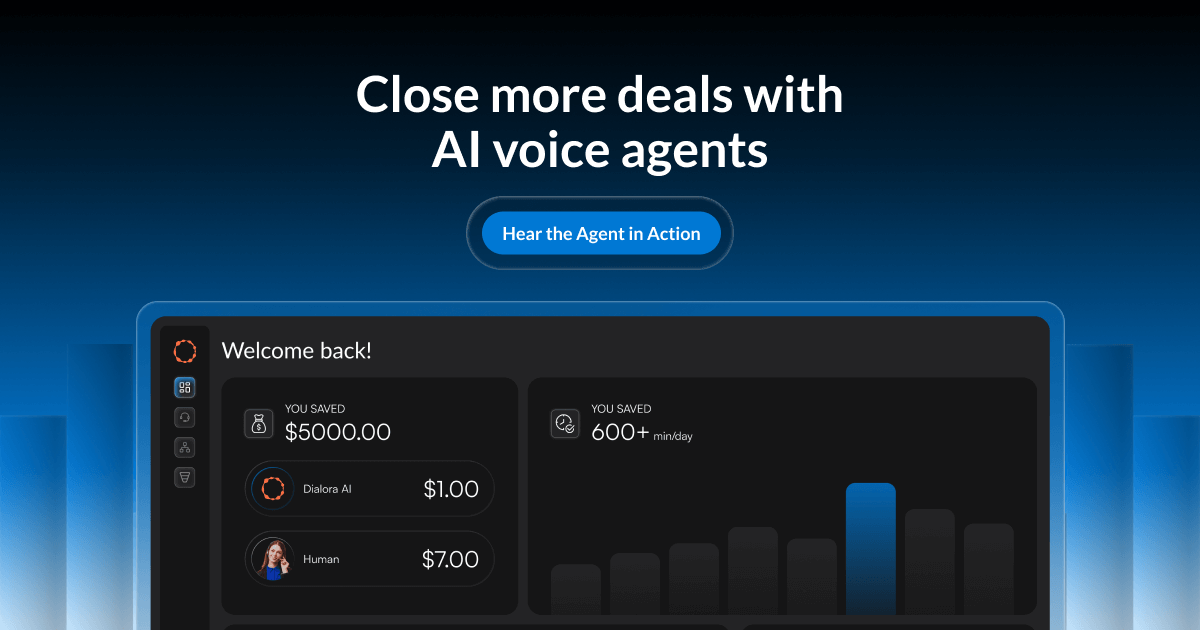
Dialora AI provides advance AI Voice Agents for businesses in the USA. Automate customer service, boost sales, and improve efficiency with our AI solutions.
Run a free AEO + signal audit for your domain.
AI Answer Engine Optimization (AEO)
List once. Convert intent from live AI conversations without heavy integration.
AI voice automation for business efficiency is the application of artificial intelligence to manage and execute voice-based tasks without human intervention. It leverages speech recognition, natural language processing (NLP), and conversational AI to handle customer service calls, internal queries, and process workflows. This technology reduces operational costs, improves response times, and provides scalable, 24/7 support capabilities.
Businesses identify repetitive voice-based tasks, such as call routing or information queries, that are suitable for automation to improve efficiency.
A tailored system integrating speech-to-text, NLP engines, and business logic is deployed and connected to existing telephony or communication platforms.
The AI autonomously handles defined interactions, escalating complex cases to human agents while analytics provide insights for continuous refinement.
Banks use AI voice systems for secure balance inquiries, fraud alert calls, and transaction confirmations, reducing call center volume and wait times.
Providers deploy voice AI for appointment scheduling, medication reminders, and answering common patient questions, freeing up clinical staff for critical tasks.
Retailers automate order status updates, return initiation, and product inquiries via voice, enhancing the post-purchase experience and customer loyalty.
Warehouses implement hands-free, voice-directed picking and inventory management, increasing accuracy and operational speed for workers.
Software companies offer tier-1 support through intelligent voice assistants that guide users through troubleshooting steps based on error descriptions.
Bilarna evaluates AI voice automation providers through a rigorous 57-point AI Trust Score. This proprietary framework assesses technical capabilities in NLP and speech synthesis, verifies project delivery history and client satisfaction, and checks compliance with relevant data security standards. Continuous monitoring ensures all listed partners maintain Bilarna's high benchmarks for reliability and performance.
Costs vary significantly based on scope, from simple interactive voice response (IVR) systems costing a few thousand dollars to enterprise-grade, custom conversational AI platforms reaching six figures. Key cost drivers include integration complexity, required languages, and the level of AI customization.
Prioritize providers with proven accuracy in your target languages and accents, robust API for seamless integration with your CRM/ERP, strong data privacy and security protocols, and demonstrable ROI from past deployments in your industry.
Deployment can take from 4-6 weeks for out-of-the-box solutions to 6 months or more for fully customized implementations. Timeline depends on the number of use cases, complexity of integrations, and the volume of training data required for the AI model.
Traditional IVRs use rigid touch-tone menus, while AI voice automation understands natural language, handles complex multi-turn conversations, learns from interactions, and can perform actions within connected systems, offering a far more intuitive user experience.
ROI is realized through reduced call handling costs, increased agent productivity, higher call resolution rates, and improved customer satisfaction scores. Most enterprises achieve a full return on investment within 12 to 24 months post-implementation.
Yes, AI voice and SMS agents designed for healthcare are built with security and compliance in mind. They adhere to industry standards and regulations such as HIPAA (Health Insurance Portability and Accountability Act) to protect patient data privacy and security. Business Associate Agreements (BAAs) are available to formalize compliance commitments. Additionally, these agents comply with regulations like TCPA (Telephone Consumer Protection Act) and PCI (Payment Card Industry) standards where applicable. Ensuring security and regulatory compliance is critical to maintaining trust and safeguarding sensitive healthcare information while leveraging AI technologies.
Yes, electronic signatures are legally valid for most business contracts as long as they meet compliance requirements. They carry the same legal weight as handwritten signatures but offer additional benefits such as faster processing, enhanced security through encryption and authentication, and easier management. Digital signatures use cryptographic methods to verify identity and ensure tamper resistance. Modern electronic signature software provides audit trails and compliance with international standards, making electronic signatures enforceable and reliable for businesses handling contracts, NDAs, invoices, and other agreements.
Yes, business templates and contracts are fully customizable. To adapt them to your specific needs, follow these steps: 1. Download the template or contract after purchase. 2. Open the file in the compatible software, such as Notion or a word processor. 3. Review each section carefully and identify areas that require changes. 4. Edit text, fields, and sections to reflect your unique business details and requirements. 5. Save the customized version for your records. 6. Use the tailored document for your business operations, ensuring it meets your legal and organizational standards.
Many point of sale software providers offer solutions without charging implementation fees. This means you can adopt the software without upfront costs related to installation or setup. However, it is important to review each provider's pricing plans carefully, as some may charge monthly fees or require purchasing hardware separately.
Fees for opening a business bank account vary depending on the bank and the type of account. Some banks offer free account opening promotions, especially for new businesses or startups. However, there may be other fees such as monthly maintenance charges, transaction fees, or charges for additional services. It is advisable to review the bank's fee schedule carefully and ask about any hidden costs before opening an account to ensure it fits your business budget.
No, there are no fees or credit score impacts when prequalifying for business capital offers. Follow these steps: 1. Submit your business information for prequalification. 2. Receive offers without any hidden fees. 3. Understand that your credit score will not be affected during this process. 4. Proceed with confidence knowing there is no waiting period or financial penalty.
Typically, after an initial trial period—often around seven days—business management software platforms do not charge monthly fees or enforce minimum usage requirements. Instead, continued use is contingent upon subscribing to a paid plan. This approach allows users to evaluate the software's features risk-free before committing financially. It is advisable to review the specific pricing details and terms on the provider's official website to understand any conditions related to payment plans, as these can vary between services.
Yes, there are limits on using the satisfaction guarantee for business idea validation. You can utilize the guarantee a maximum of two times per customer. After two uses, any further requests for dissatisfaction-based report revisions or coupon codes will not be eligible. This policy ensures fair use and helps maintain service quality for all customers.
Yes, a Google Business Profile can be deleted by the owner through the Google Business Profile Manager, but the listing may persist online. To delete it, log into the Google account that manages the profile, visit business.google.com, find the listing, click the three-dot menu, and select 'Remove Business Profile.' This action removes your management access and profile content, yet Google often retains listings in search results due to caching or external claims. For complete removal, additional steps are necessary, such as reporting the profile as outdated via Google Search Console or submitting a removal request directly to Google with valid reasons like business closure. Professional reputation management services can assist by using legal takedowns or SEO strategies to suppress unwanted listings, ensuring your online footprint is cleaned up after rebranding or closures.
No reputable web design service can guarantee top Google rankings due to the many uncontrollable factors in search engine algorithms. Rankings depend on variables such as geographic location, industry competition, the age and authority of the online presence, and ongoing SEO efforts. Ethical providers focus on implementing best practices like optimizing Google My Business profiles, creating quality content, ensuring mobile responsiveness, and building technical SEO to improve visibility. They commit to continuous optimization and adaptation to algorithm changes rather than making empty promises. While results like increased leads and revenue are common with proper SEO, guarantees are unrealistic because search engines frequently update their criteria and competition evolves.