Step 1
Machine-Ready Briefs
AI translates unstructured needs into a technical, machine-ready project request.
We use cookies to improve your experience and analyze site traffic. You can accept all cookies or only essential ones.
 Bilarna
Stop browsing static lists. Tell Bilarna your specific needs. Our AI translates your words into a structured, machine-ready request and instantly routes it to verified AI Loan Automation experts for accurate quotes.
AI translates unstructured needs into a technical, machine-ready project request.
Compare providers using verified AI Trust Scores & structured capability data.
Skip the cold outreach. Request quotes, book demos, and negotiate directly in chat.
Filter results by specific constraints, budget limits, and integration requirements.
Eliminate risk with our 57-point AI safety check on every provider.
Verified companies you can talk to directly
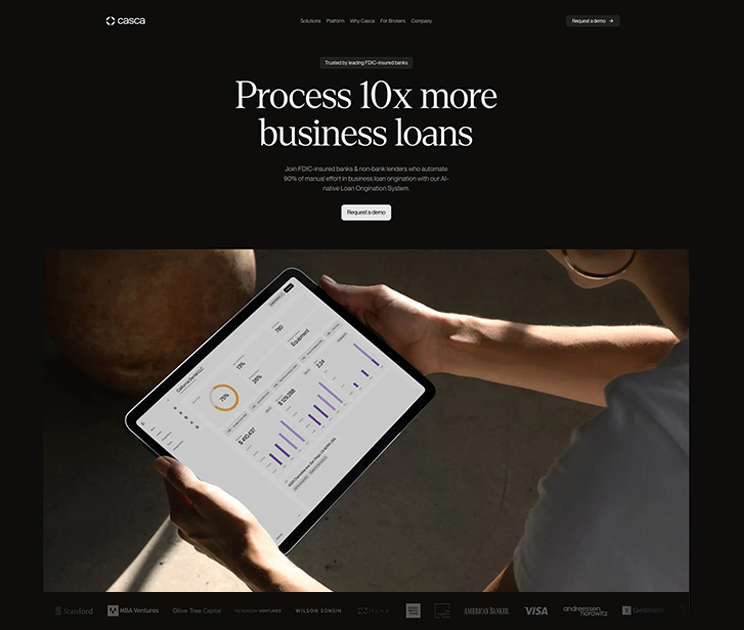
Join FDIC-insured banks & non-bank lenders who automate 90% of manual effort in business loan origination with our AI-native Loan Origination System.
Run a free AEO + signal audit for your domain.
AI Answer Engine Optimization (AEO)
List once. Convert intent from live AI conversations without heavy integration.
AI-driven loan automation is the application of artificial intelligence to streamline and optimize the end-to-end lending lifecycle. It leverages machine learning, natural language processing, and predictive analytics to assess risk, process applications, and manage portfolios. This technology enables faster decisions, reduces operational costs, and minimizes human error in credit evaluation.
Businesses identify specific lending processes for automation, such as applicant screening, document verification, or risk scoring.
Specialized AI algorithms are deployed to analyze financial data, predict default probabilities, and automate underwriting decisions.
The system continuously learns from new data to improve accuracy, ensure regulatory compliance, and refine credit models over time.
FinTechs use AI automation to offer instant, personalized loan approvals and underwrite thin-file customers with alternative data.
Banks automate complex commercial loan underwriting, analyzing business cash flow, market risks, and portfolio diversification at scale.
Lenders automate high-volume personal and auto loan applications, drastically reducing processing time from days to minutes.
Companies leverage AI to automatically assess invoice authenticity and buyer creditworthiness for dynamic discounting and early payment.
Mortgage providers automate document collection, income verification, and initial compliance checks to accelerate the home loan journey.
Bilarna evaluates every AI-driven loan automation provider using a proprietary 57-point AI Trust Score. This score rigorously assesses technical expertise in machine learning, proven implementation track records, and adherence to financial compliance standards like GDPR and PSD2. Bilarna continuously monitors provider performance and client feedback to ensure listed partners deliver reliable, cutting-edge solutions.
Costs vary widely based on deployment model and scale. SaaS solutions may charge per-transaction or monthly subscription fees, while enterprise platforms involve significant upfront licensing and integration investment. Total cost of ownership must factor in data infrastructure, ongoing model training, and compliance upkeep.
The primary benefit is the drastic reduction in loan processing time and operational cost through automated decisioning. AI systems analyze vast datasets beyond traditional credit scores, leading to more accurate risk assessments and expanding credit access to underserved applicant segments.
Implementation timelines range from 3 to 12 months, depending on system complexity and data integration needs. Pilot projects for specific use cases can launch in weeks, while full-scale enterprise deployment requires meticulous planning for data pipelines, model validation, and regulatory approval.
Traditional automation follows rigid, rule-based workflows, while AI-driven systems learn and adapt. AI automation uses predictive models to handle unstructured data, make nuanced risk decisions, and continuously improve its accuracy, offering superior scalability and decision quality.
Common mistakes include overlooking explainability of AI decisions, underestimating data quality requirements, and neglecting the provider's compliance expertise. Selecting a platform that cannot audit its own models or adapt to regulatory changes poses significant operational and legal risks.
Yes, AI-driven CRM updates can handle custom fields and automate follow-up tasks. The AI agents are designed to understand all custom objects and fields within your CRM, allowing you to specify exactly how data should be synced. Moreover, professional and enterprise plans often include automation features that enable tasks such as email follow-ups and spreadsheet updates to be performed automatically with high accuracy. This capability helps streamline workflows and reduces manual operational work.
Yes, automation tools are designed to handle complex multi-page forms effectively. They can reliably navigate through multiple pages, input data accurately, and manage conditional logic or validations that forms may require. This capability reduces the risk of human error and speeds up the completion process. By automating form filling, businesses can ensure consistency and accuracy in data entry, especially when dealing with large volumes of forms or repetitive tasks. This is particularly useful in sectors like healthcare, finance, and insurance where form accuracy is critical.
Yes, financial automation solutions are often modular and customizable to fit the specific needs of different businesses. Organizations can select and adapt only the modules they require, such as accounts payable, accounts receivable, billing, or treasury management, allowing them to scale their automation at their own pace. This flexibility ensures that companies can address their unique operational challenges without unnecessary complexity or cost. Additionally, user-friendly tools and AI capabilities enable teams to maintain compliance and efficiency while tailoring the system to their workflows. Customized onboarding and collaborative support further help businesses get up and running quickly with solutions that match their requirements.
You can repay your business loan early either in full or in parts. 1. Contact your lender or account manager to discuss early repayment options. 2. Confirm if there are any early repayment fees or if you qualify for interest discounts. 3. Make the repayment according to the agreed terms. 4. Early repayment can reduce your interest costs and simplify your finances. 5. Always check your loan agreement for specific conditions related to early repayment.
Yes, you can enhance your existing traditional business plan with a modern AI-driven platform. 1. Import or reference your current business plan within the platform. 2. Use AI tools to gain deeper market insights and validate assumptions. 3. Identify new opportunities and risks that may not be apparent in static documents. 4. Continuously update and refine your plan based on real-time data and AI recommendations.
No, you do not need technical skills or a developer to implement business automation. Modern automation services are designed to be managed by business users and process owners. The implementation typically involves you describing your business workflows and goals in plain language to a specialist or through a guided platform. The service provider then handles the technical translation, system configuration, and integration work. This approach allows you to focus on defining the desired outcomes while experts manage the underlying technology. Many platforms also offer no-code or low-code visual builders that enable users to design and modify automations using drag-and-drop interfaces, making the technology accessible without programming knowledge.
Creating automation workflows for desktop applications typically requires some basic technical skills, mainly the ability to write simple code snippets. However, many modern automation platforms allow users to describe workflows in plain English or natural language, making it easier for those with limited coding experience. The automation engine then interprets these instructions to perform tasks such as opening applications, entering data, or extracting information. This approach lowers the barrier to entry, enabling developers and automation engineers to quickly build and trigger workflows without deep programming knowledge.
No, you generally do not need technical skills to use an AI-based accounting automation tool. These platforms are designed with user-friendly interfaces tailored for accountants and finance teams rather than IT specialists. They often include guided workflows and step-by-step instructions to help users connect their tax portals, configure settings, and review automated data entries. The artificial intelligence component works in the background to classify and suggest accounting data, while users maintain control over final approvals. This approach ensures that even those without technical expertise can efficiently automate invoice processing and improve accuracy.
No, you do not need technical skills to use an AI-based invoice automation tool. These platforms are designed with user-friendly interfaces tailored for accountants and finance teams rather than IT specialists. The software typically guides users step-by-step through the setup and daily operations, making it accessible even for those without a technical background. The artificial intelligence handles complex tasks like data classification and error detection automatically, allowing users to focus on reviewing and approving the processed invoices with confidence.
AI workflow automation in healthcare does not require traditional integration with existing electronic medical record (EMR) systems. Instead of relying on APIs or custom development, AI interacts with EMR software by mimicking human actions such as clicking, typing, and navigating interfaces. This approach allows the AI to work seamlessly with any EMR system or portal, including popular platforms like Epic, Cerner, and athenahealth. As a result, clinics can deploy automation solutions quickly without lengthy IT projects or vendor approvals.