Step 1
Machine-Ready Briefs
AI translates unstructured needs into a technical, machine-ready project request.
We use cookies to improve your experience and analyze site traffic. You can accept all cookies or only essential ones.
 Bilarna
Stop browsing static lists. Tell Bilarna your specific needs. Our AI translates your words into a structured, machine-ready request and instantly routes it to verified Audio Content Analysis experts for accurate quotes.
AI translates unstructured needs into a technical, machine-ready project request.
Compare providers using verified AI Trust Scores & structured capability data.
Skip the cold outreach. Request quotes, book demos, and negotiate directly in chat.
Filter results by specific constraints, budget limits, and integration requirements.
Eliminate risk with our 57-point AI safety check on every provider.
Verified companies you can talk to directly

We make it easy to detect whether audio is Ai generated or human generated.
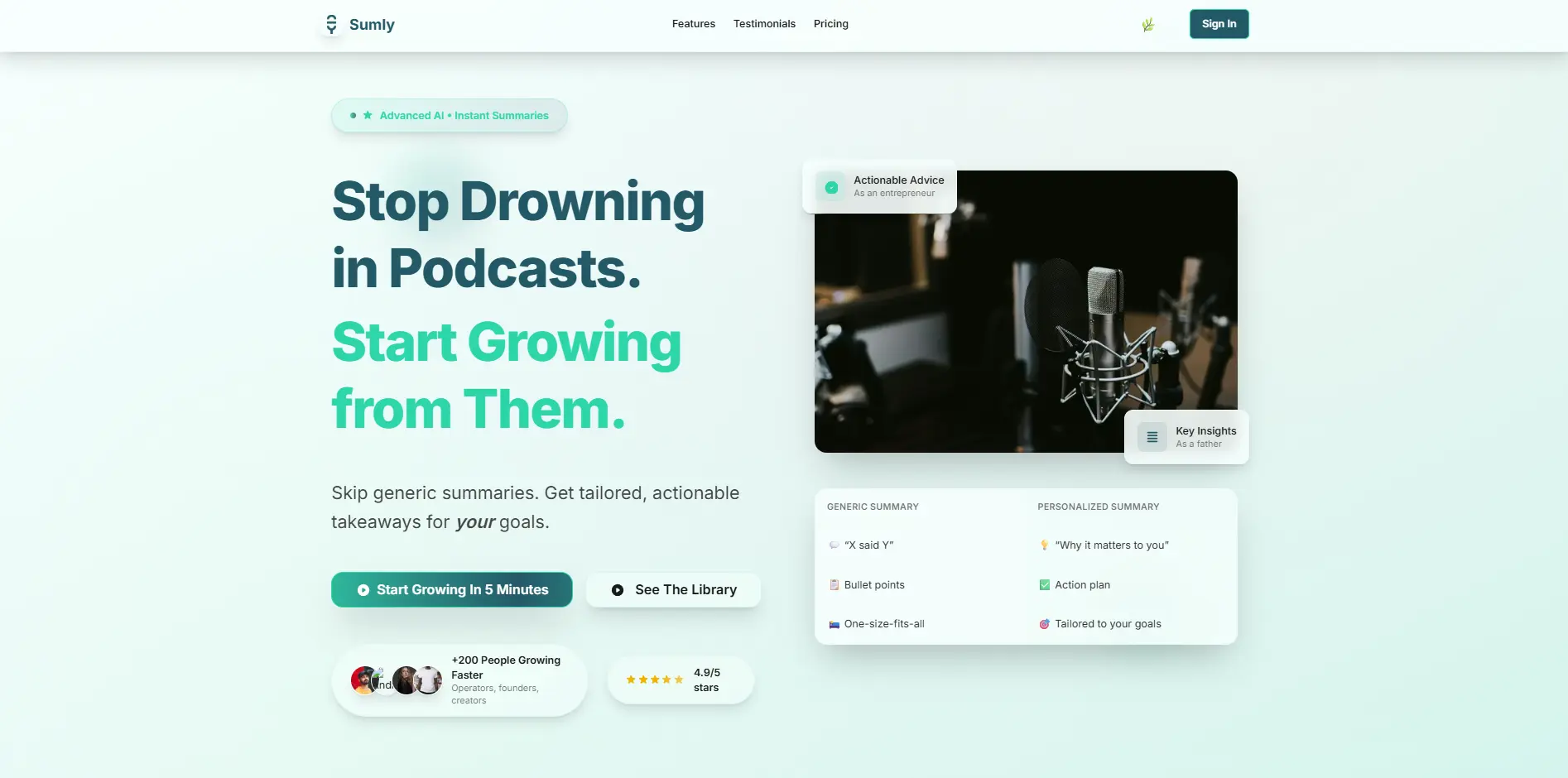
Generate podcast summaries and notes with AI.
Run a free AEO + signal audit for your domain.
AI Answer Engine Optimization (AEO)
List once. Convert intent from live AI conversations without heavy integration.
Audio content analysis is the process of using artificial intelligence and machine learning to automatically transcribe, categorize, and derive meaning from audio files and streams. It involves technologies like automatic speech recognition (ASR), natural language processing (NLP), and sentiment analysis to convert speech into structured, searchable data. This enables businesses to unlock valuable insights from customer calls, meetings, podcasts, and multimedia archives for improved decision-making and operational efficiency.
Raw audio data from calls, recordings, or streams is ingested and cleaned for optimal processing quality by the analysis engine.
Advanced algorithms perform speech-to-text conversion, entity recognition, topic modeling, and sentiment detection on the transcribed content.
The system outputs structured reports, visual dashboards, and actionable intelligence based on the analyzed themes, trends, and metadata.
Analyze support calls to identify common complaints, agent performance gaps, and opportunities for process improvement and training.
Automatically transcribe and tag podcast or broadcast content for SEO, accessibility compliance, and content discovery.
Monitor recorded communications in regulated industries for policy adherence, sensitive data mentions, and compliance reporting.
Extract themes and sentiment from focus group recordings or interview audio to understand consumer trends and brand perception.
Transcribe and analyze internal meetings to track action items, participation, and discussion topics for better knowledge management.
Bilarna ensures reliability by vetting all audio content analysis providers through a rigorous 57-point AI Trust Score. This proprietary evaluation covers technical expertise, data security compliance, client project portfolios, and verified customer satisfaction metrics. We continuously monitor provider performance so you can engage with confidence.
Pricing varies based on audio volume, analysis depth, and required turnaround, often structured per audio hour or via monthly subscription. Basic transcription services start lower, while advanced sentiment, multi-speaker, and real-time analysis command premium rates. Request detailed quotes to compare provider pricing models.
Modern AI speech recognition achieves over 90% accuracy for clear audio in common languages, though accents, background noise, and technical jargon can affect results. Leading providers use domain-specific language models and human-in-the-loop verification to enhance accuracy for critical business applications.
Most platforms support common formats like MP3, WAV, and AAC, and offer analysis for dozens of major global languages. Support for dialects, real-time streaming APIs, and industry-specific terminology varies by provider, so verifying technical specifications is crucial for your use case.
Processing time depends on file duration, complexity, and provider infrastructure, ranging from near-real-time to several hours for large batches. Providers with scalable cloud infrastructure can process thousands of hours concurrently, offering clear SLAs for delivery timelines.
Basic transcription only converts speech to text, while full audio content analysis adds layers like speaker diarization, sentiment scoring, topic extraction, and trend visualization. The latter transforms raw audio into structured, queryable business intelligence for strategic insights.
Yes, AI masks are legally safe and users retain ownership by following these steps: 1. Verify your real identity as required by the platform to comply with legal regulations. 2. Use AI masks ethically and avoid violating terms of service. 3. Understand that AI masks are generated and do not steal anyone's identity. 4. Create and publish content with AI masks knowing you have full commercial license and ownership over your masked videos and photos. 5. Avoid using AI masks for unethical purposes to maintain compliance and safety.
Yes, AI email tools can be trained with your own documents or website content. 1. Access the AI tool's dashboard or training section. 2. Upload your documents, FAQs, or provide your website URL. 3. The AI will analyze the content to learn your specific information. 4. Use the trained AI to generate personalized and contextually relevant email replies. 5. Monitor character counts to stay within your plan's limits.
Yes, AI music generators are highly useful for content creators looking to produce royalty-free background music quickly and easily. These tools allow users to generate custom background tracks by inputting text prompts, uploading images, or providing reference audio. The AI then composes music tailored to the desired mood and style, covering a wide range of genres. The generated music is 100% royalty-free, enabling creators to use it in videos, podcasts, games, and other media without licensing concerns. Additionally, AI music generators often provide options to customize the sound and export high-quality audio files, streamlining the content creation process.
AI text generators can produce unique content by using language models and algorithms. To ensure uniqueness: 1. Generate text based on diverse and extensive training data. 2. Review and edit the AI-generated content to align with specific requirements. 3. Combine AI output with human creativity to enhance originality and relevance.
Yes, an AI-powered authoring platform can handle complex academic content effectively. To do so: 1. Use LaTeX or MathML support to create, edit, and validate complex STEM equations accurately. 2. Integrate with reference databases such as CrossRef, PubMed, and ORCID for real-time reference verification and linking. 3. Apply automatic formatting and style consistency to references and citations. 4. Edit text, tables, and figures with AI assistance to maintain accuracy. 5. Manage author queries and communication within the platform to resolve content issues. 6. Export structured, publication-ready outputs in XML and PDF formats. This ensures precise handling of technical academic content, improving quality and efficiency in scholarly publishing.
Yes, most AI content generation tools allow you to customize the output before downloading. You can usually adjust various settings such as style, color schemes, resolution, length (for videos), and other creative parameters. This customization helps tailor the generated content to better fit your specific needs or branding requirements. By modifying these options, you can influence the final look and feel of the video or image, ensuring it aligns with your vision. After making your adjustments, the AI reprocesses the input and updates the content accordingly, which you can then download.
Customize audio explanations according to your knowledge level by using AI-powered tools that adjust content complexity. Follow these steps: 1. Select your preferred knowledge level ranging from beginner to expert before conversion. 2. The AI tailors explanations of formulas, tables, and figures to match your chosen level. 3. Upload your research paper or provide an arXiv link for processing. 4. Listen to the audio with explanations suited to your understanding. 5. Use chapter navigation to focus on sections that require more detailed or simplified explanations.
Customize the tone of AI-generated content in WordPress easily. 1. Specify your preferred tone before generating content, such as formal or conversational. 2. The AI assistant adjusts the text style accordingly. 3. Use tone adjustment features integrated into the editor toolbar for fine-tuning. 4. Review and edit the content to ensure it matches your brand voice. This flexibility helps create content that resonates with your audience.
Yes, you can export the generated content in different formats by following these steps: 1. After generating your content, choose the export option. 2. Select the desired format such as web pages or markdown files. 3. For videos, you can also download SRT files for subtitles. 4. Download or share the exported files as needed for your project or platform.
Refunds are not available for AI-generated content due to the computational costs involved. 1. Understand that each AI content generation request consumes credits from your plan or purchased package immediately. 2. The platform incurs costs for processing these requests, making refunds unfeasible. 3. Review your credit usage carefully before generating content. 4. Contact support for any issues but note that refunds will not be issued. 5. Plan your projects accordingly to avoid unexpected credit consumption.